
JWST Stuns Scientists: Ice Clouds Found on Distant Giant Exoplanet
The James Webb Space Telescope has made a groundbreaking discovery, detecting clear evidence of ice clouds high in the atmosphere of a massive exoplanet. This finding provides unprecedented insights into alien weather systems and planetary formation.
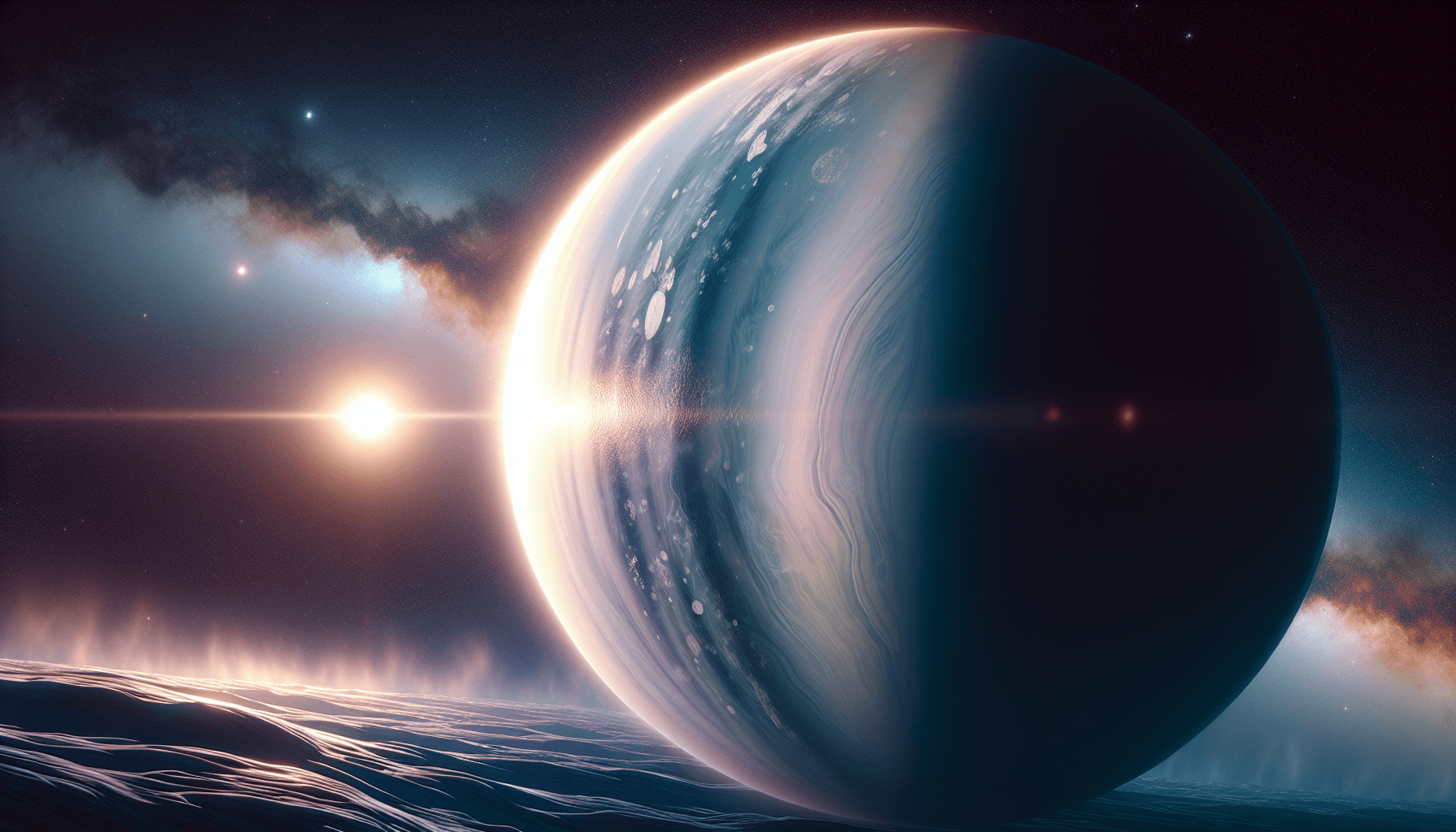
A Glimpse into Alien Weather: JWST's Icy Revelation
The cosmos continues to astound us, and the James Webb Space Telescope (JWST) is proving to be humanity's most extraordinary eye on the universe. In a truly stunning revelation, scientists have confirmed the detection of ice clouds high within the atmosphere of a distant, giant exoplanet. This groundbreaking discovery offers unprecedented insights into the complex meteorological systems of worlds far beyond our solar system, challenging our understanding of planetary climates.
This isn't just another data point; it's a direct observation that paints a vivid picture of weather patterns on an alien world. The finding underscores JWST's unparalleled ability to probe the atmospheric compositions of exoplanets, pushing the boundaries of what was previously thought possible in space observation.
Unveiling Distant Atmospheres with Infrared Vision
The JWST, a marvel of modern engineering, operates primarily in the infrared spectrum. This allows it to peer through cosmic dust and gas, capturing the faint thermal signatures and spectral fingerprints of distant objects. By analyzing the light filtering through an exoplanet's atmosphere as it transits its host star, astronomers can decipher its chemical makeup.
In this particular instance, the telescope's highly sensitive instruments detected specific spectral signatures indicative of various forms of ice. While the exact composition of the ice (e.g., water, methane, ammonia) is subject to further analysis, the presence of these crystalline structures points to a dynamic and active atmospheric environment.
What Ice Clouds Tell Us About Alien Worlds
The detection of ice clouds on a giant exoplanet carries profound implications for our understanding of planetary formation and evolution. On Earth, clouds are fundamental to our climate and water cycle. Discovering similar, albeit exotic, cloud formations on distant worlds helps scientists:
- Understand Atmospheric Dynamics: How heat is distributed and circulated in alien atmospheres.
- Infer Climate Conditions: Provide clues about temperatures, pressures, and the presence of volatile compounds.
- Refine Formation Models: Offer insights into the conditions under which these gas giants formed and evolved.
- Assess Habitability Potential: While giant planets themselves are unlikely to host life, their moons might, and understanding the parent planet's atmosphere is a crucial step.
This discovery provides concrete evidence of complex weather systems existing far beyond our solar neighborhood, indicating that the universe is teeming with diverse and intricate planetary environments.
A Glimpse at a "Giant": Beyond Our Solar System's Familiar Faces
While the specific exoplanet's name might be technical, the term "giant alien planet" typically refers to gas giants much like Jupiter or Saturn, but often far larger, hotter, or orbiting their stars much closer. These colossal worlds are characterized by their massive gaseous envelopes, lacking a solid surface in the way terrestrial planets do.
The presence of ice clouds on such a world suggests that even in extreme conditions, processes akin to those forming clouds on Earth — condensation and crystallization — are at play. This highlights the universality of certain astrophysical phenomena, even when manifested in vastly different environments.
The Future of Exoplanet Exploration
This momentous finding is just one of many anticipated breakthroughs from the JWST. As the telescope continues its mission, astronomers expect to uncover even more secrets about exoplanet atmospheres, including the potential for biosignatures – indicators of life – on smaller, rocky worlds.
The detection of ice clouds on this distant giant exoplanet not only deepens our appreciation for the universe's complexity but also fuels our curiosity, propelling humanity forward in its eternal quest to understand our place among the stars. Each new discovery brings us closer to unraveling the mysteries of creation and potentially, the existence of life beyond Earth.
How this article was made
- Sources
- ScienceDaily
- Generated on:
- Apr 23, 2026
This content is produced by Acerbo.AI's AI editorial pipeline: source gathering, rewriting and imagery are automated. Editorial oversight stays human.
Related Articles
JWST Uncovers Mysterious 'Red Dots': Glimpse of Universe's First Stars on Brink of Cosmic Collapse?
The James Webb Space Telescope has unveiled enigmatic 'little red dots' in the distant cosmos, believed by scientists to be the universe's earliest stars or proto-galaxies, poised at a critical evolutionary juncture. This groundbreaking discovery offers an unprecedented look into the dawn of cosmic history.
Cosmic Relic Unearthed: James Webb Telescope Reveals Interstellar Comet 3I/ATLAS is Nearly as Old as the Universe
The James Webb Space Telescope (JWST) has made a groundbreaking discovery, identifying interstellar comet 3I/ATLAS as a potential relic from the early universe, almost as old as spacetime itself.
AI Breakthrough Unveils Over 100 Hidden Planets in NASA Archives, Including Rare and Extreme Worlds
A powerful AI has sifted through vast NASA datasets, uncovering more than 100 previously undetected exoplanets, including a diverse array of rare and extreme worlds, marking a new era in cosmic discovery.