
Revolutionary X-ray Telescope Set to Unveil Moon's Chemical Secrets
A groundbreaking lightweight X-ray telescope is poised to create the Moon's first complete chemical map, revolutionizing lunar science and future exploration.
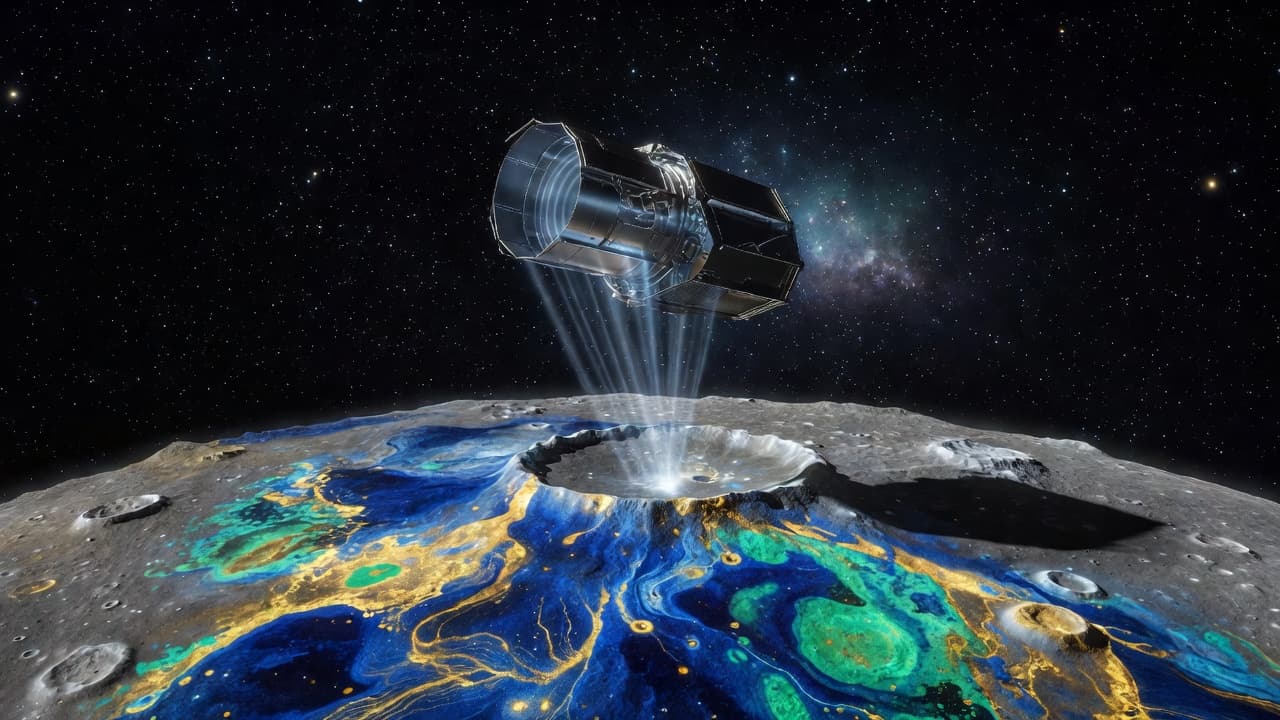
Unveiling the Moon's Hidden Chemistry: A New Era of Lunar Exploration
For centuries, humanity has gazed upon the Moon, a celestial neighbor shrouded in mystery. While we've walked its surface and brought back samples, a comprehensive understanding of its global chemical composition remains elusive. This is poised to change dramatically with the advent of a groundbreaking lightweight X-ray telescope, designed specifically to produce the Moon's first complete, high-resolution chemical map. This innovative instrument promises to revolutionize our knowledge of lunar geology, resource potential, and even the Moon's mysterious origins.
The Science Behind the Lunar Chemical Map
The core technology behind this ambitious project is X-ray fluorescence spectroscopy, a powerful analytical technique. When cosmic X-rays or solar X-rays strike the lunar surface, they interact with the atoms present in the Moon's regolith (surface material). These interactions cause the atoms to emit secondary, characteristic X-rays at specific energy levels. By detecting and analyzing these emitted X-rays, scientists can precisely identify the elements present and their relative abundances across the lunar landscape.
Traditional X-ray telescopes are often massive and complex, making them challenging for deep space missions. The breakthrough here lies in the telescope's "lightweight and compact design", making it feasible for deployment on future lunar orbiters or landers. This miniaturization doesn't compromise its scientific capabilities, allowing for unprecedented detail in elemental mapping.
Why a Complete Chemical Map Matters
A global chemical map of the Moon is far more than just an academic exercise; it's a critical tool for unlocking numerous lunar secrets and supporting future human endeavors. Here's why:
- Understanding Lunar Formation: The distribution of elements like iron, titanium, magnesium, and aluminum can provide crucial clues about how the Moon formed, evolved, and differentiated over billions of years. It could help settle debates surrounding the giant impact hypothesis.
- Identifying Valuable Resources: Future lunar bases will require local resources. A detailed chemical map can pinpoint areas rich in vital elements such as oxygen (locked in oxides), silicon for manufacturing, and potentially even rare earth elements. This is crucial for "in-situ resource utilization (ISRU)".
- Characterizing Lunar Environments: Understanding the precise elemental composition across various geological features – craters, maria, highlands – will inform us about impact events, volcanic activity, and space weathering processes.
- Supporting Future Missions: Detailed maps will guide landing site selections for both robotic and crewed missions, ensuring optimal locations for scientific research, resource extraction, or establishing long-term habitats.
Technological Innovation for Lunar Discovery
The development of this lightweight X-ray telescope represents a significant leap in space instrumentation. Its ability to operate efficiently in the harsh lunar environment, detecting faint X-ray signals, is a testament to advanced engineering. The compact nature reduces launch costs and integration complexities, paving the way for more frequent and ambitious lunar missions.
This instrument will enable scientists to create a truly global inventory of the Moon's surface elements. Unlike previous missions that provided localized or lower-resolution data, this new generation of X-ray telescope promises a "holistic view", akin to creating a complete chemical blueprint of our closest celestial neighbor.
A Glimpse into the Future of Lunar Exploration
The prospect of the Moon's first complete chemical map opens up exciting new avenues for planetary science and exploration. It will serve as an indispensable guide for the Artemis program and other international initiatives aiming to establish a sustained human presence on the Moon. From understanding the Moon's deep past to facilitating humanity's future in space, this lightweight X-ray telescope is set to be a cornerstone of lunar discovery, fundamentally reshaping our understanding of the Moon and its potential.
How this article was made
- Sources
- ScienceDaily
- Generated on:
- Jun 11, 2026
This content is produced by Acerbo.AI's AI editorial pipeline: source gathering, rewriting and imagery are automated. Editorial oversight stays human.
Related Articles
Cosmic Cannibals: Astronomers Uncover Two Actively Feeding Supermassive Black Holes in the Early Universe
A groundbreaking discovery reveals two actively feeding supermassive black holes in the universe's nascent stages, challenging theories of cosmic evolution and galaxy formation.
Cosmic Detective Work: Second-Generation Planet Cracks Hubble's Long-Standing Mystery
Astronomers have unveiled a groundbreaking discovery: a 'second-generation' exoplanet whose unique formation mechanism provides the missing link to solve a perplexing cosmic enigma observed by the Hubble Space Telescope for years.
Cosmic Revelation: Have Scientists Finally Glanced at Dark Matter?
A recent scientific development suggests researchers may have detected dark matter, the universe's most enigmatic substance. This potential breakthrough could redefine cosmology and particle physics.