
Unlocking Cosmic Secrets: JUNO Experiment Delivers Unprecedented Neutrino Precision
The JUNO experiment in China has unveiled its first major results, providing the most precise measurement to date of neutrino oscillation parameters, marking a significant leap in fundamental physics.
The Elusive Neutrino: A Cosmic Mystery
For decades, neutrinos have remained one of the universe's most enigmatic particles. Often dubbed "ghost particles" due to their feeble interaction with matter, these tiny entities are incredibly abundant, constantly streaming through us from the sun, supernovae, and nuclear reactors. Understanding their fundamental properties is crucial for unraveling some of the biggest mysteries in particle physics and cosmology, including the matter-antimatter asymmetry of the universe.
Now, the Jiangmen Underground Neutrino Observatory (JUNO) in China has taken a monumental step forward. After years of meticulous construction and calibration, the JUNO collaboration has released its first major scientific results, delivering an unprecedentedly precise measurement of neutrino oscillation parameters. This achievement promises to refine our understanding of these elusive particles and their profound implications for fundamental science.
The Dance of Neutrino Oscillation
One of the most astonishing discoveries about neutrinos is their ability to change "flavors" – electron, muon, and tau – as they travel through space. This phenomenon, known as neutrino oscillation, implies that neutrinos must possess a tiny, non-zero mass, contrary to early predictions. The rate at which neutrinos oscillate depends on the differences in the squares of their masses (mass-squared differences) and their mixing angles.
Precisely measuring these oscillation parameters is paramount. Previous experiments have provided estimates, but JUNO's sheer scale and innovative design allow for a level of accuracy previously unattainable. This new data significantly tightens the constraints on these parameters, paving the way for a clearer picture of the neutrino's role in the Standard Model of particle physics.
JUNO's Groundbreaking Achievement: A New Era of Precision
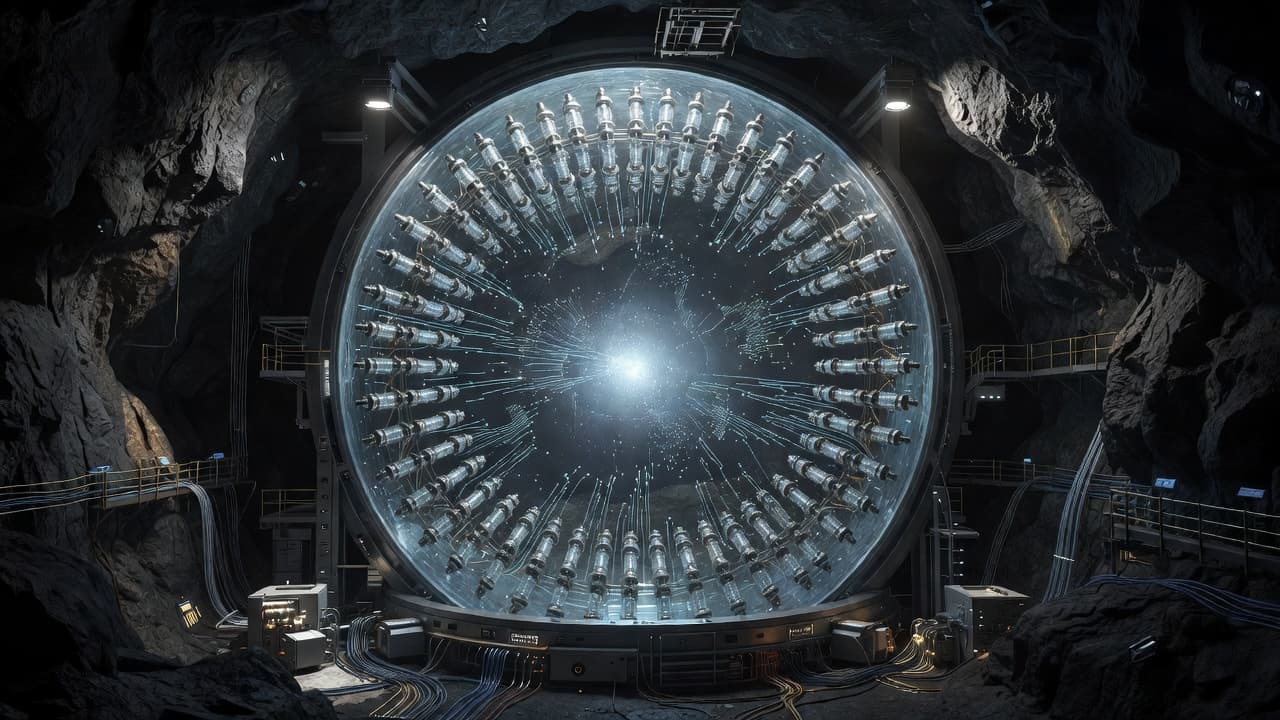
The JUNO detector, located 700 meters underground to shield it from cosmic rays, is a marvel of modern experimental physics. At its heart lies a massive 20-kiloton spherical acrylic vessel filled with liquid scintillator, an organic liquid that emits light when neutrinos interact with it. Surrounding this sphere are over 18,000 photomultiplier tubes (PMTs) designed to detect these faint light signals with exquisite sensitivity.
The collaboration's initial findings represent the most precise determination of the neutrino mass-squared differences to date. By observing neutrinos emitted from two powerful nuclear power plants located approximately 53 kilometers away, JUNO can precisely measure how these neutrinos oscillate over distance. This level of precision is critical for distinguishing between different theoretical models and for addressing one of the most pressing questions in neutrino physics: the neutrino mass hierarchy.
Towards Solving the Neutrino Mass Hierarchy
The neutrino mass hierarchy refers to the ordering of the three neutrino mass states. Do they follow a "normal" hierarchy, where two light masses are followed by a heavier one, or an "inverted" hierarchy, where two heavier masses are followed by a lighter one? Resolving this question has profound implications for our understanding of fundamental symmetries and the origin of neutrino masses.
While JUNO's first results haven't definitively settled the mass hierarchy, the unprecedented precision in mass-squared differences significantly strengthens the foundation for future investigations. The data will be combined with results from other experiments, refining global analyses and bringing physicists closer to a definitive answer. This collective effort could lead to breakthroughs in understanding the fundamental building blocks of the universe.
Implications for Fundamental Physics and Beyond
The precision measurements from JUNO not only advance our knowledge of neutrinos but also serve as a crucial test for the Standard Model of particle physics. Any deviation from its predictions could signal new physics beyond our current understanding, potentially revealing new particles or forces.
- Refining Oscillation Parameters: JUNO's data provides the most accurate values for Δm²₂₁ and |Δm²₃₂|, essential for all neutrino experiments.
- Constraining New Physics: Tighter constraints on neutrino properties help limit the parameter space for theoretical models involving sterile neutrinos or other exotic particles.
- Astrophysical Insights: A better understanding of neutrinos from terrestrial sources also aids in interpreting astrophysical neutrinos from cosmic events like supernovae.
These initial results from JUNO represent a triumph of international scientific collaboration and engineering. They herald a new era of precision neutrino physics, pushing the boundaries of human knowledge and bringing us closer to understanding the universe's most elusive fundamental particles. As JUNO continues to collect data, the scientific community eagerly anticipates further revelations that could reshape our understanding of the cosmos.
How this article was made
- Sources
- ScienceDaily
- Generated on:
- Jun 13, 2026
This content is produced by Acerbo.AI's AI editorial pipeline: source gathering, rewriting and imagery are automated. Editorial oversight stays human.
Related Articles
Cosmic Cannibals: Astronomers Uncover Two Actively Feeding Supermassive Black Holes in the Early Universe
A groundbreaking discovery reveals two actively feeding supermassive black holes in the universe's nascent stages, challenging theories of cosmic evolution and galaxy formation.
Cosmic Detective Work: Second-Generation Planet Cracks Hubble's Long-Standing Mystery
Astronomers have unveiled a groundbreaking discovery: a 'second-generation' exoplanet whose unique formation mechanism provides the missing link to solve a perplexing cosmic enigma observed by the Hubble Space Telescope for years.
Cosmic Revelation: Have Scientists Finally Glanced at Dark Matter?
A recent scientific development suggests researchers may have detected dark matter, the universe's most enigmatic substance. This potential breakthrough could redefine cosmology and particle physics.