
Unlocking Time's Mystery: Scientists Connect "Time Crystal" to Real Quantum Device
Scientists have achieved a quantum breakthrough, successfully connecting a theoretical 'time crystal' to a real quantum device. This paves the way for advanced quantum computing and ultra-precise sensing.
Unlocking Time's Mystery: Scientists Connect "Time Crystal" to Real Quantum Device
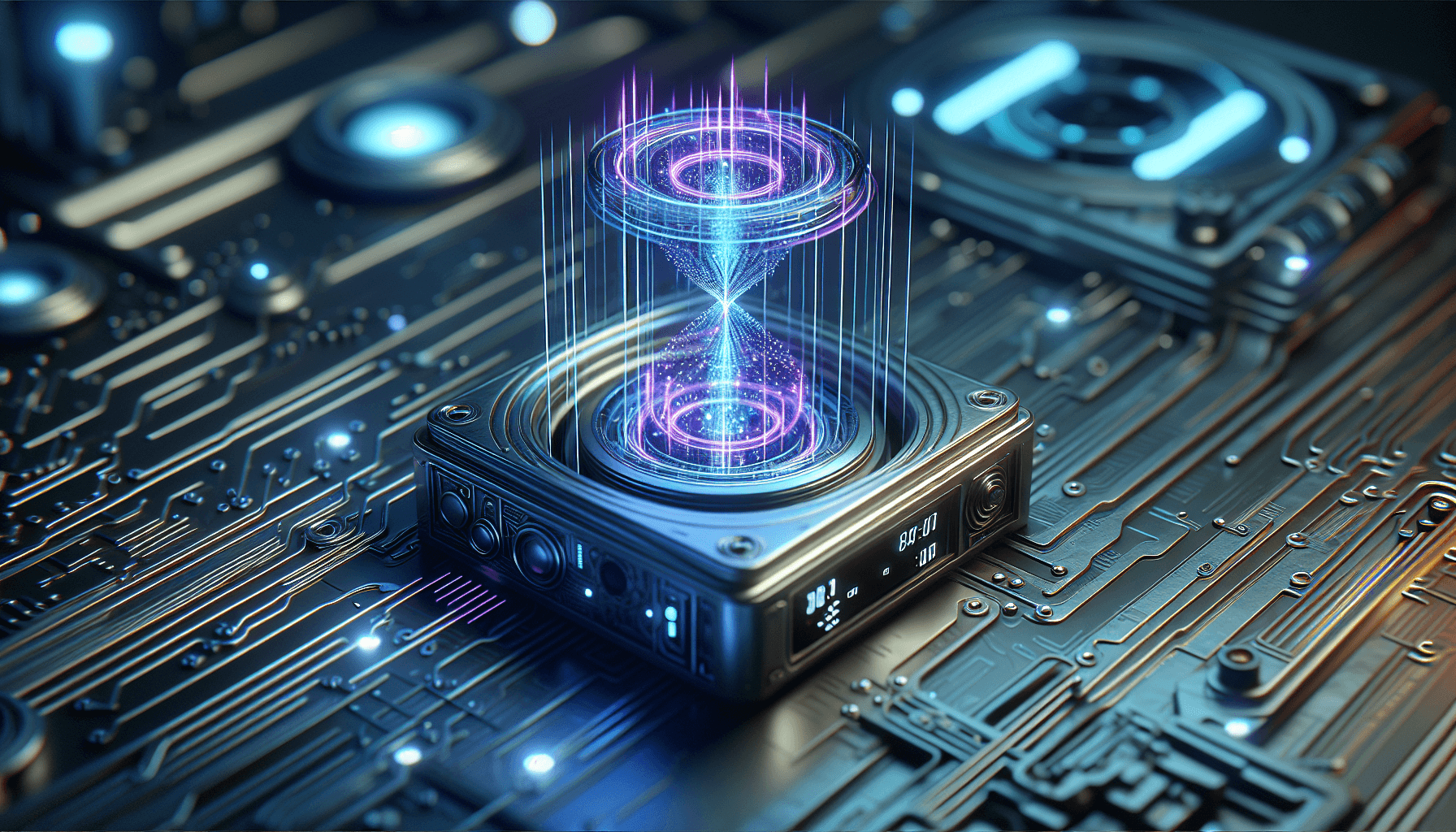
In a groundbreaking stride for quantum physics, an international team has successfully connected a theoretical "time crystal" to a tangible quantum device. This breakthrough moves time crystals from abstract theory into a practical domain, paving the way for advancements in quantum technology.
This discovery deepens our comprehension of the universe's most mysterious dimension, promising novel capabilities in ultra-precise sensing and next-generation quantum computing.
What Exactly is a Time Crystal?
Imagine a regular crystal with atoms in a repeating spatial pattern. A time crystal is its temporal analogue: a unique state of matter exhibiting a repeating pattern not in space, but in time. Unlike ordinary static crystals, time crystals perpetually oscillate, or "tick," even in their lowest energy state (the ground state), without external energy input.
This characteristic defies conventional thermodynamic laws. Time crystals are a non-equilibrium phase of matter, existing outside thermal equilibrium and maintaining periodic motion indefinitely. First theorized by Nobel laureate Frank Wilczek in 2012, they challenged long-held assumptions about physical systems.
The Quantum Leap: From Theory to Device
The recent breakthrough demonstrates a time crystal's robust properties within a real quantum device. Previous demonstrations involved isolated systems; this development signifies a crucial step towards harnessing time crystals for practical applications.
Researchers achieved this by manipulating interacting quantum particles—likely superconducting qubits or trapped ions. By applying specific sequences of laser pulses or microwave fields, they coaxed these particles into a stable, time-crystalline state, exhibiting persistent, self-sustaining periodic motion directly observable and controllable within the device architecture.
Maintaining the delicate coherence required for quantum phenomena is challenging. The ability to observe and control a time crystal within a functional device underscores remarkable progress in engineering robust quantum systems.
Potential Applications in Quantum Technology
Integrating time crystals into quantum devices opens exciting possibilities:
- Enhanced Quantum Computing: Time crystals could offer novel approaches for quantum memory, error correction, or new computational paradigms. Their stability and periodic nature might provide a robust backbone for storing and processing quantum information.
- Ultra-Precise Sensing: The stable, periodic "ticking" of time crystals makes them ideal candidates for developing extraordinarily sensitive sensors, such as atomic clocks with unprecedented accuracy or gyroscopes detecting minute changes.
- Fundamental Physics Research: Studying time crystals in a controlled device environment provides a unique laboratory to explore exotic aspects of quantum mechanics, non-equilibrium thermodynamics, and even the nature of spacetime itself.
The Road Ahead: Challenges and Future Prospects
While this is a monumental step, the journey has just begun. Scaling up these time crystal devices, maintaining coherence, and integrating them seamlessly into complex quantum architectures remain significant challenges. Scientists are focused on refining control mechanisms and exploring diverse quantum platforms.
This breakthrough is more than a scientific curiosity; it's a tangible advance in engineering the quantum world. By connecting time crystals to real devices, scientists deepen our understanding of fundamental physics and lay critical groundwork for a future where quantum technologies could revolutionize everything. The "ticking" of time crystals may well be the sound of the next great technological revolution.
How this article was made
- Sources
- ScienceDaily
- Generated on:
- May 10, 2026
This content is produced by Acerbo.AI's AI editorial pipeline: source gathering, rewriting and imagery are automated. Editorial oversight stays human.
Related Articles
Unveiling the Invisible: Your $100 Gateway to Cosmic Mysteries
Scientists have developed an incredibly affordable particle detector, costing just $100, that allows anyone to observe cosmic rays raining down from space, opening new avenues for citizen science and education.

Unveiling the Amazon's Emerald Enigma: Scientists Discover a Mysterious New Frog Species
A recent expedition deep within the Amazon rainforest has led to the thrilling discovery of a previously unknown frog species, highlighting the incredible biodiversity still hidden.

Quantum Mystery Deepens: CERN Uncovers Unprecedented Gluon Behavior
CERN scientists have observed gluons, the fundamental particles binding atomic nuclei, exhibiting unexpected behavior deep within matter, challenging long-held theories of the strong nuclear force.