
Devonian Time Capsule: China Unearths World's Oldest Amber
A groundbreaking discovery in northern China has unveiled the world's oldest definitive amber, dating back an astonishing 385 million years. This Middle Devonian relic offers unprecedented insights into Earth's ancient forests and the evolution of tree resin.
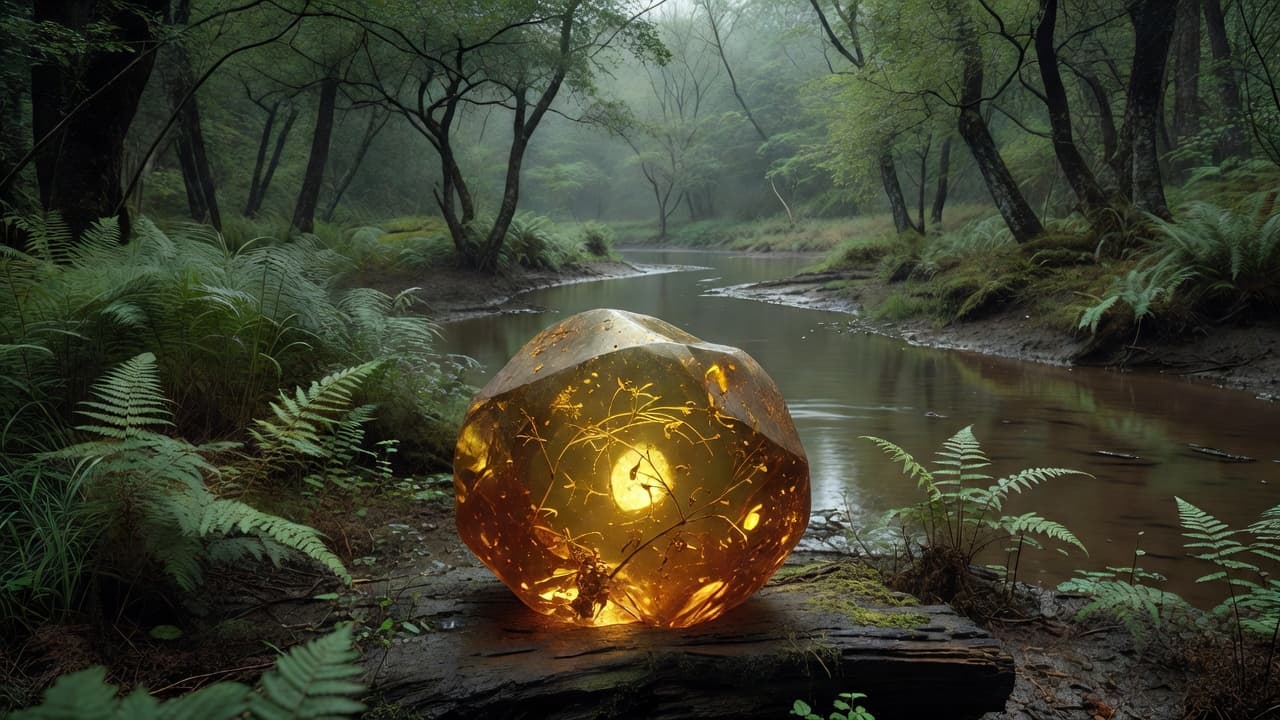
A Glimpse into the Deep Past: China's Devonian Amber
In a discovery that is set to rewrite chapters in Earth's ancient history, researchers in northern China have unearthed what is now definitively recognized as the world's oldest piece of amber. Dating back an astonishing 385 million years to the Middle Devonian period, this remarkable fossilized tree resin offers an unprecedented window into a pivotal era when life on land was just beginning to flourish and diversify.
The find, made by an international team of scientists from the Nanjing Institute of Geology and Palaeontology, Chinese Academy of Sciences, and the Natural History Museum, London, pushes back the known timeline for amber formation by a staggering 150 million years. Previously, the oldest undisputed amber hailed from the Late Triassic, approximately 230 million years ago. This new Chinese specimen fundamentally challenges our understanding of ancient ecosystems and the evolutionary strategies of early plants.
Unearthing a Prehistoric Treasure in Gansu
The precious amber was discovered in the Daxigou area, near Linxia City in China's Gansu Province. While relatively small, its scientific significance is immense. Amber, formed from tree resin that has hardened over millions of years, often preserves organic matter, offering direct evidence of ancient flora and fauna. In this case, the amber itself is the primary evidence, revealing the very act of resin production from trees that existed long before dinosaurs roamed the Earth.
Scientists have meticulously analyzed the amber, employing advanced techniques to confirm its age and composition. The research indicates that this ancient resin was produced by a type of primitive tree, possibly a conifer-like species belonging to the family Araucariaceae, similar to the modern genus Agathis. This suggests that complex chemical defense mechanisms, like resin production, evolved much earlier than previously thought in the plant kingdom.
The Devonian World: An Era of Transformation
The Middle Devonian period, often dubbed the "Age of Fishes," was a time of dramatic environmental and biological change. While marine life thrived, terrestrial environments were undergoing a profound transformation. Early vascular plants were colonizing land, gradually forming the first true forests. The discovery of this 385-million-year-old amber provides tangible evidence of these pioneering forests and the trees that comprised them.
The ability to produce resin was a crucial evolutionary adaptation for these early trees. Resin serves multiple purposes, including protecting trees from insect pests, fungal infections, and physical damage. The presence of such an ancient resin implies that trees in the Devonian period were already facing similar environmental pressures and had developed sophisticated biological responses.
Rewriting the Story of Plant Evolution
This groundbreaking find has significant implications for paleobotany and our understanding of plant evolution. It demonstrates that the biological processes required for resin synthesis were present in trees during the Devonian period, a time when many fundamental plant characteristics were still evolving. Key insights include:
- Early Resin Production: Confirms that trees were producing complex resins much earlier than previously believed, indicating advanced physiological capabilities.
- Ancient Forest Ecosystems: Provides direct evidence of the existence of resin-producing trees in the earliest forest ecosystems.
- Evolutionary Defense Mechanisms: Highlights the antiquity of chemical defense strategies in plants against environmental threats.
The discovery not only extends the chronological record of amber but also offers a tangible link to the earliest stages of forest development on Earth. It underscores the incredible resilience and adaptive capacity of life, even in its most nascent forms.
Future Insights from a Primordial Droplet
The 385-million-year-old amber from China is more than just a geological curiosity; it's a profound scientific treasure. It opens new avenues for research into the chemical composition of ancient resins, the types of trees that produced them, and the environmental conditions of the Devonian period. Scientists will continue to scrutinize this ancient droplet, hoping to unlock further secrets about the dawn of terrestrial ecosystems and the long, intricate journey of life on our planet. This discovery serves as a powerful reminder of the deep, often hidden, history beneath our feet, waiting to be revealed.
How this article was made
- Sources
- Sci.News
- Generated on:
- Jul 18, 2026
This content is produced by Acerbo.AI's AI editorial pipeline: source gathering, rewriting and imagery are automated. Editorial oversight stays human.
Related Articles
Cosmic Cannibals: Astronomers Uncover Two Actively Feeding Supermassive Black Holes in the Early Universe
A groundbreaking discovery reveals two actively feeding supermassive black holes in the universe's nascent stages, challenging theories of cosmic evolution and galaxy formation.
Cosmic Detective Work: Second-Generation Planet Cracks Hubble's Long-Standing Mystery
Astronomers have unveiled a groundbreaking discovery: a 'second-generation' exoplanet whose unique formation mechanism provides the missing link to solve a perplexing cosmic enigma observed by the Hubble Space Telescope for years.
Cosmic Revelation: Have Scientists Finally Glanced at Dark Matter?
A recent scientific development suggests researchers may have detected dark matter, the universe's most enigmatic substance. This potential breakthrough could redefine cosmology and particle physics.