
Gliese 12 b: Astronomers Discover Potentially Habitable Super-Earth Just 25 Light-Years Away
A new 'Super-Earth' exoplanet, Gliese 12 b, has been found just 25 light-years from us. Orbiting a cool red dwarf star within its habitable zone, this temperate world is a prime candidate for understanding planetary atmospheres and the search for life.
A New Frontier: Discovering Gliese 12 b
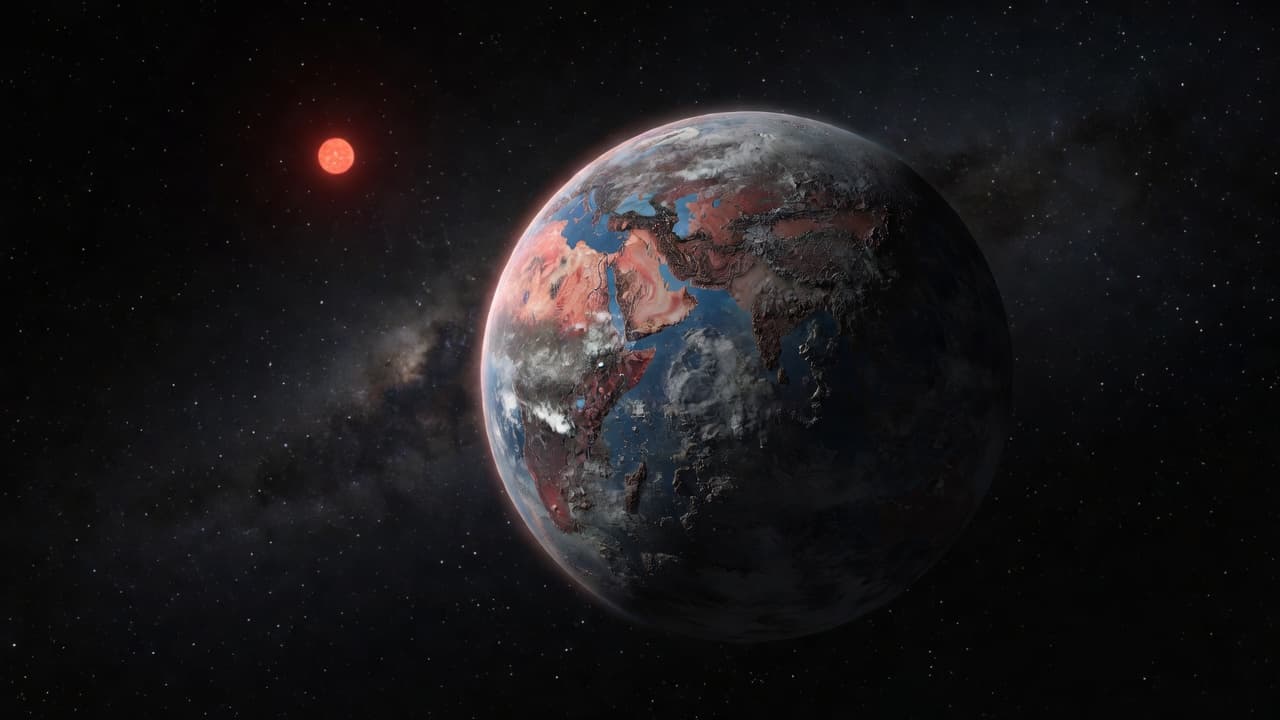
The ongoing quest to uncover worlds beyond our solar system has yielded another breathtaking discovery: Gliese 12 b. This intriguing exoplanet, a 'Super-Earth' with a potentially temperate climate, has been found orbiting a cool red dwarf star, Gliese 12, a mere 25 light-years away in the constellation Pisces. Its remarkable proximity and position within its star's habitable zone make it one of the most exciting targets yet in the search for extraterrestrial life and understanding planetary evolution.
Scientists are particularly thrilled by Gliese 12 b's characteristics: it's roughly the size of Venus, receives a similar amount of stellar radiation to Earth, and offers an unprecedented opportunity for detailed atmospheric studies. This discovery marks a significant step forward in our understanding of planetary diversity and the conditions necessary for life.
Meet Gliese 12 b: Our Nearest Temperate Neighbor?
Gliese 12 b is classified as a Super-Earth, meaning it's larger than Earth but smaller than ice giants like Neptune. Its estimated radius is about 0.96 times that of Earth, making it comparable in size to Venus. The exoplanet completes an orbit around its parent star, Gliese 12, every 12.8 days. Gliese 12 itself is a red dwarf, a type of star much smaller and cooler than our Sun, which allows Gliese 12 b to orbit relatively close while still maintaining a mild temperature.
Without an atmosphere, the planet's surface temperature is estimated to be around 42°C (107°F). While this might seem warm, it's significantly cooler than many other known exoplanets and falls within a range where a suitable atmosphere could regulate temperatures, potentially allowing for the existence of liquid water – a fundamental requirement for life as we know it.
The Goldilocks Zone: A Recipe for Potential Habitability
Central to Gliese 12 b's allure is its location within the habitable zone, often referred to as the 'Goldilocks Zone.' This is the region around a star where conditions are theoretically just right for liquid water to exist on a planet's surface. Gliese 12 b receives approximately 1.6 times the radiation Earth does from the Sun, which is less than what Venus receives, suggesting it might have avoided a runaway greenhouse effect.
This delicate balance of stellar radiation is crucial. If a planet is too close to its star, water boils away; too far, and it freezes solid. Gliese 12 b appears to occupy this 'just right' sweet spot, making the potential for a stable, life-supporting environment a tantalizing prospect for future study.
The Atmospheric Enigma: Earth-like or Venus-like?
While its location is promising, the true habitability of Gliese 12 b hinges on one critical, yet unknown, factor: its atmosphere. The presence and composition of an atmosphere could either foster a stable climate with liquid water or lead to a scorching, Venus-like environment with an extreme greenhouse effect. Understanding this will be key to unlocking the planet's secrets.
This is where cutting-edge instruments like the James Webb Space Telescope (JWST) come into play. Scientists are eager to use JWST to analyze Gliese 12 b's atmospheric composition, searching for signs of water vapor, oxygen, or other potential biosignatures. Its proximity makes it an ideal candidate for such detailed spectroscopic studies, offering a unique window into how planets around red dwarf stars evolve.
How We Found This New World
The discovery of Gliese 12 b was a collaborative scientific triumph, primarily leveraging data from NASA's Transiting Exoplanet Survey Satellite (TESS) and ground-based observatories such as the Subaru Telescope. The primary detection method used was the transit method. Astronomers observed minuscule, periodic dips in the brightness of Gliese 12 as the planet passed directly in front of it, blocking a fraction of its starlight. These precise measurements allowed scientists to determine the planet's size and orbital period.
Crucially, the host star, Gliese 12, appears to be relatively quiet. Many red dwarfs are known for their powerful flares, which can strip away planetary atmospheres over time. The calmness of Gliese 12 increases the likelihood that Gliese 12 b might have retained a substantial atmosphere for billions of years, enhancing its potential for habitability.
A Glimpse into the Future of Exoplanet Research
Gliese 12 b is more than just another entry in the rapidly expanding exoplanet catalog; it represents a crucial benchmark in our quest to understand the prevalence and diversity of planetary systems, particularly those around the most common type of star in our galaxy, M-dwarfs. Its accessibility for follow-up observations means we could soon gain unprecedented insights into how planets around cool stars form, evolve, and whether they can sustain life.
The findings from Gliese 12 b will significantly inform our models of planetary formation and atmospheric dynamics, helping us refine our search strategies for truly Earth-like worlds. This discovery brings humanity one exciting step closer to answering the age-old question: are we alone in the universe?
The discovery of Gliese 12 b stands as a monumental achievement in exoplanetary science. Its ideal combination of proximity, size, and location within the habitable zone positions it as a prime candidate for groundbreaking atmospheric studies. As powerful telescopes like JWST turn their gaze towards this intriguing world, we stand on the precipice of potentially unlocking profound secrets about the conditions necessary for life beyond our home planet.
How this article was made
- Sources
- Sci.News
- Generated on:
- Jul 6, 2026
This content is produced by Acerbo.AI's AI editorial pipeline: source gathering, rewriting and imagery are automated. Editorial oversight stays human.
Related Articles
Astronomers Detect First Atmosphere on Rocky Habitable Zone Exoplanet
A monumental discovery pushes humanity closer to finding life beyond Earth: astronomers have found a definitive atmosphere on a rocky exoplanet within its star's habitable zone.
Cosmic Leap: First Atmosphere Confirmed on Rocky Habitable Zone Exoplanet
Astronomers have achieved a monumental first: confirming an atmosphere around a rocky exoplanet orbiting within its star's habitable zone, significantly boosting the search for life beyond Earth.

JWST Stuns Scientists: Ice Clouds Found on Distant Giant Exoplanet
The James Webb Space Telescope has made a groundbreaking discovery, detecting clear evidence of ice clouds high in the atmosphere of a massive exoplanet. This finding provides unprecedented insights into alien weather systems and planetary formation.