
Physicists Forge Exotic 'Fermi Sea' Matter: A Quantum Leap in Understanding
Scientists have successfully created an exotic new form of matter known as the 'Fermi Sea,' opening new avenues in quantum physics and our understanding of the universe's fundamental building blocks.
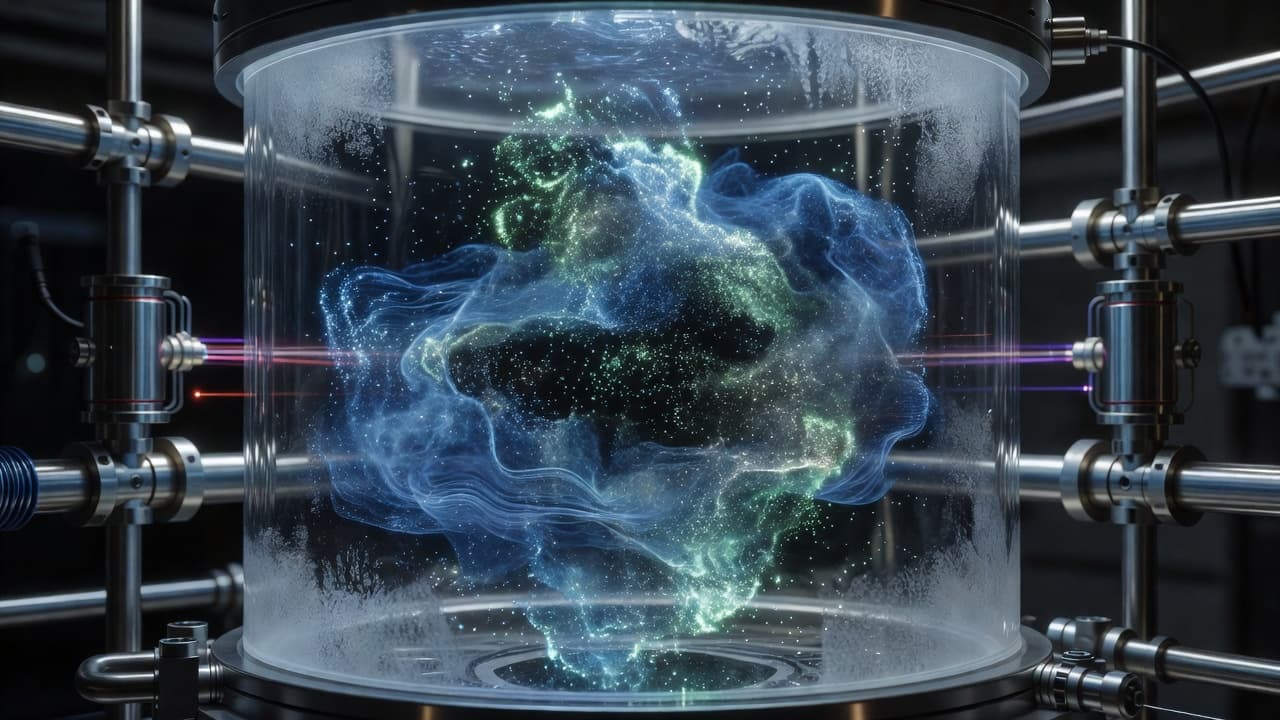
In a monumental stride for quantum physics, scientists have successfully engineered an exotic new form of matter, colloquially dubbed the "Fermi Sea." This groundbreaking achievement marks a significant advancement in our quest to understand the universe's most fundamental building blocks and the peculiar rules governing them. Far from a mere laboratory curiosity, this newly created state of matter offers unprecedented opportunities to explore quantum phenomena that underpin everything from neutron stars to advanced technological materials.
Unveiling the Quantum Ocean: What is a Fermi Sea?
At its core, a Fermi Sea is a concept rooted deeply in quantum mechanics, specifically relating to particles known as fermions. Unlike bosons, which can occupy the same quantum state, fermions are governed by the strict Pauli Exclusion Principle. This fundamental rule dictates that no two identical fermions can occupy the same quantum state simultaneously.
Imagine a vast ocean where each wave represents a unique energy level. As you add fermions to this "ocean," they dutifully fill up the lowest available energy states, one by one, much like filling a swimming pool from the bottom up. Once all the lower states are occupied, the fermions begin to fill higher energy levels. The collective state of these filled energy levels, up to a certain maximum energy (the Fermi energy), is what constitutes a Fermi Sea. This concept is crucial for understanding the behavior of electrons in metals, the stability of white dwarfs, and the density of neutron stars.
Forging the Exotic: How Scientists Created It
Creating a Fermi Sea in a controlled laboratory environment is an immense technical challenge. While the exact details of the recent breakthrough are complex, such experiments typically involve cooling atoms to temperatures mere fractions of a degree above absolute zero – a realm known as ultracold quantum gases. By precisely manipulating these ultracold atomic clouds using lasers and magnetic fields, physicists can coax the atoms into behaving as a collective system of fermions.
The process often involves:
- Laser Cooling: Slowing down atoms using highly tuned laser light to reduce their kinetic energy to near-zero.
- Evaporative Cooling: Removing the most energetic atoms from a magnetic or optical trap, further lowering the average temperature of the remaining atoms to extreme lows.
- Optical Lattices: Using standing waves of laser light to create a periodic potential, effectively mimicking a crystal lattice for the atoms, allowing precise control over their arrangement.
Through these sophisticated techniques, researchers can create a system where billions of ultracold fermionic atoms settle into their lowest available quantum states, forming a macroscopic manifestation of a Fermi Sea. This allows for direct observation and manipulation of quantum behaviors that are otherwise theoretical or inferred, providing a unique window into quantum reality.
Why Does the Fermi Sea Matter?
The successful creation of an artificial Fermi Sea is more than just a scientific curiosity; it's a powerful new tool for fundamental research. By studying this exotic matter, physicists can gain deeper insights into phenomena that are notoriously difficult to observe directly in nature or predict computationally. For instance, it can help us understand:
- The properties of superconductors, materials that conduct electricity with zero resistance, potentially leading to energy-efficient technologies.
- The behavior of matter under extreme conditions, such as inside neutron stars and other astrophysical objects, where matter is incredibly dense.
- The fundamental limits of quantum computing and the potential for new quantum technologies by simulating complex many-body quantum systems.
Furthermore, these ultracold atomic systems act as "quantum simulators," allowing scientists to model complex quantum systems that are intractable for even the most powerful supercomputers. This opens doors to designing new materials with tailored quantum properties, from more efficient energy storage to advanced sensors and novel electronic devices.
A New Era of Quantum Discovery
The creation of the Fermi Sea represents a pivotal moment in condensed matter physics and quantum science. It underscores humanity's remarkable ability to manipulate matter at its most fundamental level, pushing the boundaries of what was once considered purely theoretical. As researchers continue to probe the intricacies of this exotic new form of matter, we can anticipate a cascade of discoveries that will not only deepen our understanding of the universe but also pave the way for revolutionary technological advancements. The quantum ocean has been charted, and its depths are now ripe for exploration.
How this article was made
- Sources
- ScienceAlert
- Generated on:
- Jul 5, 2026
This content is produced by Acerbo.AI's AI editorial pipeline: source gathering, rewriting and imagery are automated. Editorial oversight stays human.
Related Articles

Scientists Uncover "Fractional Fermi Sea": A New Frontier in Quantum Physics with Ultracold Atoms
Researchers have engineered a groundbreaking new quantum state, the 'Fractional Fermi Sea,' using ultracold atoms, offering unprecedented insights into complex quantum phenomena and materials.

Quantum Leap: Scientists Unlock New Control Over Superconductivity
A groundbreaking discovery reveals how microscopic imperfections and atomic vibrations can precisely control superconductivity, paving the way for revolutionary quantum technologies.

Quantum Leap: Scientists Observe Metal Lump in Two Places Simultaneously, Shattering Records
Scientists have achieved a record-breaking quantum experiment, observing a tiny metal object existing in two distinct locations at once. This breakthrough pushes the limits of quantum mechanics.