
JUNO Delivers First Major Neutrino Breakthrough: Unveiling the Universe's Hidden Secrets
The Jiangmen Underground Neutrino Observatory (JUNO) has achieved a significant milestone, delivering its first major breakthrough in the study of elusive neutrinos. This advancement promises to deepen our understanding of fundamental physics and the cosmos.
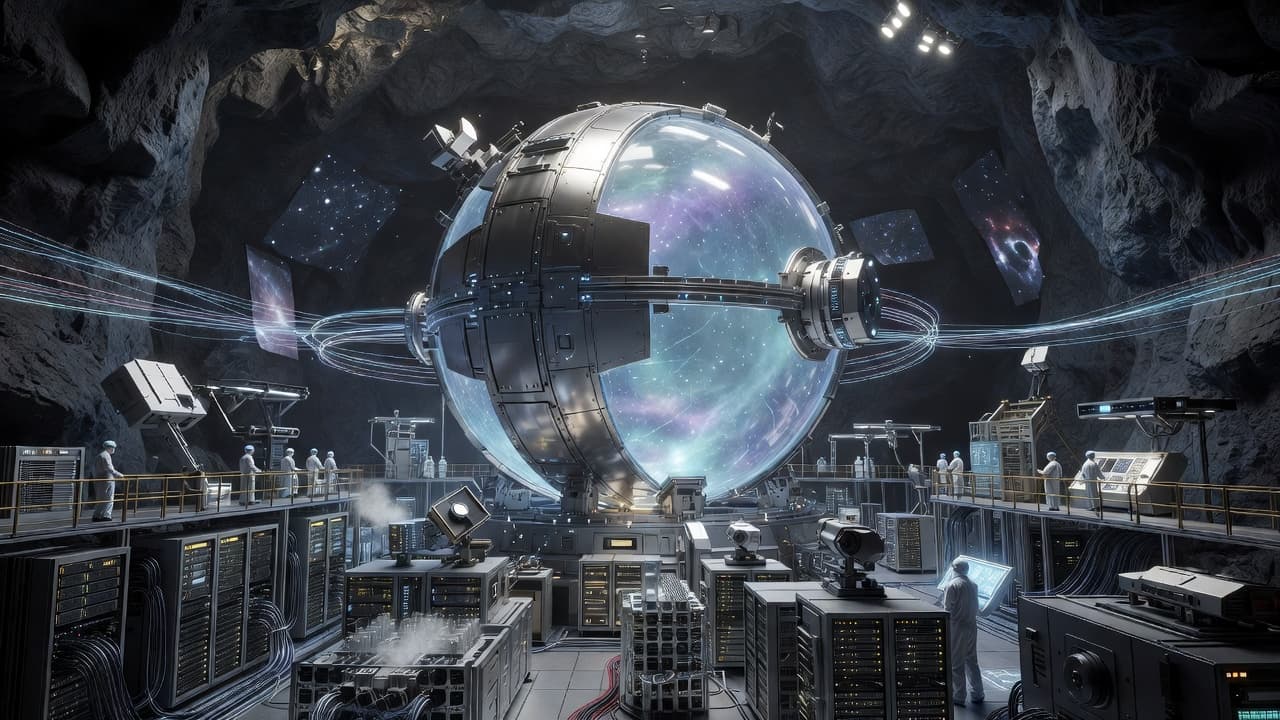
Unmasking the Universe's Elusive Messengers
In the quiet depths beneath the earth, scientists are listening for the universe's most elusive messengers: neutrinos. These "ghost particles" hold fundamental clues about the cosmos, from the heart of stars to the very origins of matter. The Jiangmen Underground Neutrino Observatory (JUNO) in China has just announced its first major breakthrough, marking a significant step forward in this quest to unravel some of physics' most profound mysteries. This initial success from one of the world's most ambitious neutrino experiments promises to reshape our understanding of these enigmatic particles and the universe they inhabit.
The Enigma of Neutrinos: Tiny Particles, Big Questions
Neutrinos are subatomic particles with almost no mass and no electric charge, interacting so weakly with matter that billions pass through us every second unnoticed. They are produced in extreme cosmic events, like supernovae, and in nuclear reactions, such as those powering our sun and nuclear reactors. Despite their abundance, their properties remain largely mysterious. One of the biggest puzzles is neutrino oscillation, where neutrinos change between three "flavors" (electron, muon, and tau) as they travel. This phenomenon proves neutrinos have mass, a fact not predicted by the original Standard Model of particle physics.
Understanding neutrinos is crucial for several reasons. They are vital probes for studying the sun's interior, the mechanisms of supernovae, and even the early universe. Their peculiar behavior could also hold the key to explaining why there is more matter than antimatter in the universe, a fundamental imbalance necessary for our existence.
JUNO: A Glimpse into the Deep Underground
The JUNO experiment is a monumental undertaking, located approximately 700 meters underground in Jiangmen, China. This deep location shields the detector from cosmic rays, allowing scientists to focus solely on the faint signals of neutrinos. At its heart is a colossal 20,000-ton sphere filled with liquid scintillator, surrounded by an array of over 17,000 large photomultiplier tubes (PMTs) designed to detect the tiny flashes of light produced when a neutrino interacts with the liquid.
- Primary Goals: JUNO's main objectives include determining the neutrino mass hierarchy – the ordering of the neutrino masses – and precisely measuring neutrino oscillation parameters with unprecedented accuracy.
- Technological Marvel: The detector's sheer size, the purity of its scintillator, and the advanced PMT technology make it a cutting-edge facility capable of achieving a remarkable energy resolution.
Decoding the First Breakthrough: Precision and Promise
While specific details of the "first major neutrino breakthrough" are often technical, such an announcement typically signifies a significant achievement in the experiment's operational phase. This could mean JUNO has successfully:
- Achieved and validated its designed detector performance, confirming its exceptional sensitivity and energy resolution.
- Collected its first significant datasets, demonstrating the ability to detect reactor antineutrinos with high precision.
- Made initial measurements that are consistent with, or even refine, existing neutrino oscillation parameters, paving the way for the ultimate goal of determining the mass hierarchy.
This breakthrough is not just a technical validation; it signifies that JUNO is now fully operational and ready to deliver on its ambitious scientific agenda. It underscores the immense potential of the experiment to push the boundaries of particle physics.
Beyond the Standard Model: New Physics Horizons
The Standard Model of particle physics describes the fundamental forces and particles that make up the universe, but it doesn't account for everything. Neutrinos, with their mass and oscillation properties, are already a crack in this model. JUNO's precise measurements could further expose these cracks, potentially leading to the discovery of new physics beyond the Standard Model.
By studying neutrinos with unparalleled accuracy, JUNO could help answer questions about the nature of dark matter, the expansion of the universe, and whether there are undiscovered particles or forces at play. It's a testament to human ingenuity and the relentless pursuit of knowledge that such an experiment can probe the very fabric of reality.
The Future of Neutrino Astronomy
The initial breakthrough from JUNO is just the beginning. Over the coming years, as JUNO continues to collect data, scientists anticipate a wealth of new discoveries. The collaboration of thousands of physicists from around the world is poised to unlock secrets that could redefine our understanding of the cosmos. This experiment, alongside others globally, is ushering in a new era of neutrino astronomy, where these ghost particles become our eyes to phenomena otherwise invisible.
A New Era for Particle Physics
JUNO's first major neutrino breakthrough is a momentous occasion for the international scientific community. It solidifies the observatory's role as a powerhouse in particle physics research and brings us closer to solving some of the universe's most enduring mysteries. As JUNO continues its vigilant watch, physicists worldwide eagerly await the profound insights that these elusive neutrinos will undoubtedly reveal, promising a future rich with scientific discovery and a deeper appreciation for the intricate workings of our universe.
How this article was made
- Sources
- ScienceDaily
- Generated on:
- Jun 14, 2026
This content is produced by Acerbo.AI's AI editorial pipeline: source gathering, rewriting and imagery are automated. Editorial oversight stays human.
Related Articles
Cosmic Cannibals: Astronomers Uncover Two Actively Feeding Supermassive Black Holes in the Early Universe
A groundbreaking discovery reveals two actively feeding supermassive black holes in the universe's nascent stages, challenging theories of cosmic evolution and galaxy formation.
Cosmic Detective Work: Second-Generation Planet Cracks Hubble's Long-Standing Mystery
Astronomers have unveiled a groundbreaking discovery: a 'second-generation' exoplanet whose unique formation mechanism provides the missing link to solve a perplexing cosmic enigma observed by the Hubble Space Telescope for years.
Cosmic Revelation: Have Scientists Finally Glanced at Dark Matter?
A recent scientific development suggests researchers may have detected dark matter, the universe's most enigmatic substance. This potential breakthrough could redefine cosmology and particle physics.