
NASA's Perseverance Rover Uncovers Organic Carbon Clues in Martian Rocks
NASA's Perseverance rover is meticulously examining organic carbon in Mars' Jezero Crater, bringing scientists closer to understanding the Red Planet's potential for ancient life and habitability.
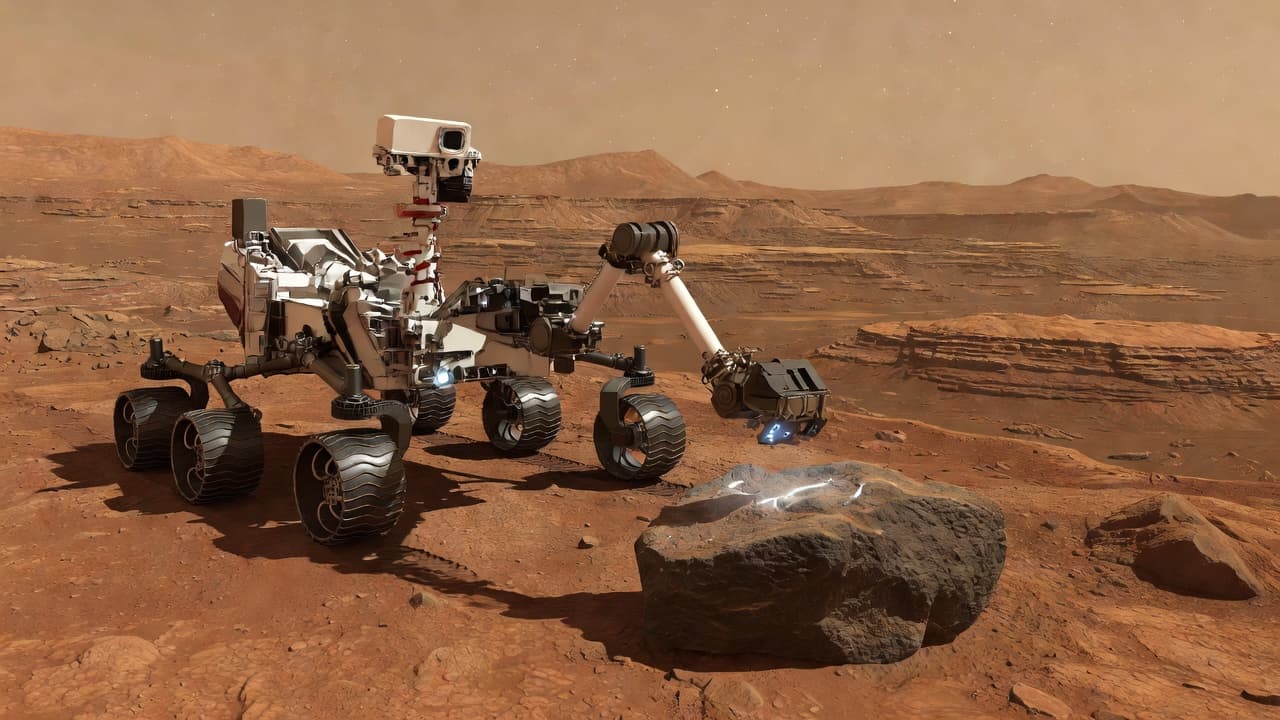
Mars: The Enduring Quest for Life Beyond Earth
The quest to uncover signs of past life on Mars has taken another intriguing turn as NASA's Perseverance rover intensifies its examination of organic carbon within the ancient rocks of Jezero Crater. This meticulous investigation represents a crucial step in understanding whether the Red Planet once harbored conditions favorable for life, pushing the boundaries of astrobiology.
Launched in 2020, Perseverance landed in February 2021 with a primary mission to seek signs of ancient microbial life and collect Martian rock and regolith samples. Its current focus on organic molecules is particularly significant, as these compounds are the fundamental building blocks of life as we know it.
Perseverance's Detailed Martian Rock Analysis
Equipped with an array of sophisticated instruments, including SHERLOC (Scanning Habitable Environments with Raman & Luminescence for Organics & Chemicals), Perseverance is able to conduct detailed chemical analyses of Martian rocks and soils. These instruments allow the rover to identify and map organic molecules with unprecedented precision, even from within rock interiors.
The rover's recent activities involve abrading rock surfaces and using its instruments to peer into the freshly exposed material. This direct investigation allows scientists to differentiate between organic carbon that might have originated from ancient Martian biological processes and that which could have arrived via meteorites or formed through geological activity.
The Significance of Organic Carbon on Mars
Finding organic carbon on Mars is not direct proof of life, but it is an essential prerequisite. Organic molecules contain carbon-hydrogen bonds and are fundamental to all known terrestrial life. Their presence in a once-habitable environment like Jezero Crater — which hosted a lake and river delta billions of years ago — significantly bolsters the case for Mars having once supported microbial ecosystems.
Scientists are particularly interested in the context of these discoveries. The organic compounds found so far are embedded within sedimentary rocks that formed in water, suggesting they could have been preserved alongside potential biosignatures. This makes the rock samples collected by Perseverance invaluable.
Jezero Crater: A Prime Astrobiological Target
Jezero Crater was chosen as Perseverance's landing site precisely because of its rich geological history. Evidence suggests it was once a lakebed fed by a river, creating an environment where water, minerals, and energy sources could have converged – conditions ideal for the emergence and sustenance of life.
The various layers of rock within the crater act like pages in a history book, each potentially holding clues about Mars' past climate and habitability. The organic carbon discoveries add another compelling chapter to this ancient narrative, indicating that the ingredients for life were present.
Paving the Way for Mars Sample Return
The ultimate goal of Perseverance's mission, and indeed a cornerstone of NASA's Mars exploration program, is the Mars Sample Return (MSR) campaign. The rover is diligently collecting and caching these precious rock and regolith samples in sealed tubes on the Martian surface.
These samples, including those containing organic carbon, are intended to be retrieved by future missions and brought back to Earth for in-depth analysis. Terrestrial laboratories possess a far greater array of instruments and techniques than can be sent to Mars, offering the definitive means to test for undeniable biosignatures and unravel the complex history of organic matter on the Red Planet.
What Lies Ahead for Martian Exploration
The ongoing work of Perseverance, with its detailed scrutiny of organic carbon, continues to build a robust foundation for future Martian exploration. Each discovery, each sample collected, moves humanity closer to answering one of the most profound questions: Are we alone in the universe? The insights gleaned from Jezero Crater promise to redefine our understanding of planetary habitability and the potential for life beyond Earth.
How this article was made
- Sources
- Reuters
- Rewriting model:
- gemini-2.5-flash
- Image generated with:
- xAI Grok
- Generated on:
- Jul 29, 2026
This content is produced by Acerbo.AI's AI editorial pipeline: source gathering, rewriting and imagery are automated. Editorial oversight stays human.
Related Articles

Cosmic Cannibals: Astronomers Uncover Two Actively Feeding Supermassive Black Holes in the Early Universe
A groundbreaking discovery reveals two actively feeding supermassive black holes in the universe's nascent stages, challenging theories of cosmic evolution and galaxy formation.

Cosmic Detective Work: Second-Generation Planet Cracks Hubble's Long-Standing Mystery
Astronomers have unveiled a groundbreaking discovery: a 'second-generation' exoplanet whose unique formation mechanism provides the missing link to solve a perplexing cosmic enigma observed by the Hubble Space Telescope for years.

Cosmic Revelation: Have Scientists Finally Glanced at Dark Matter?
A recent scientific development suggests researchers may have detected dark matter, the universe's most enigmatic substance. This potential breakthrough could redefine cosmology and particle physics.