
JUNO Observatory Unlocks New Secrets of Neutrino Oscillations
The Jiangmen Underground Neutrino Observatory (JUNO) has achieved a significant milestone in measuring neutrino oscillations, pushing the boundaries of particle physics.
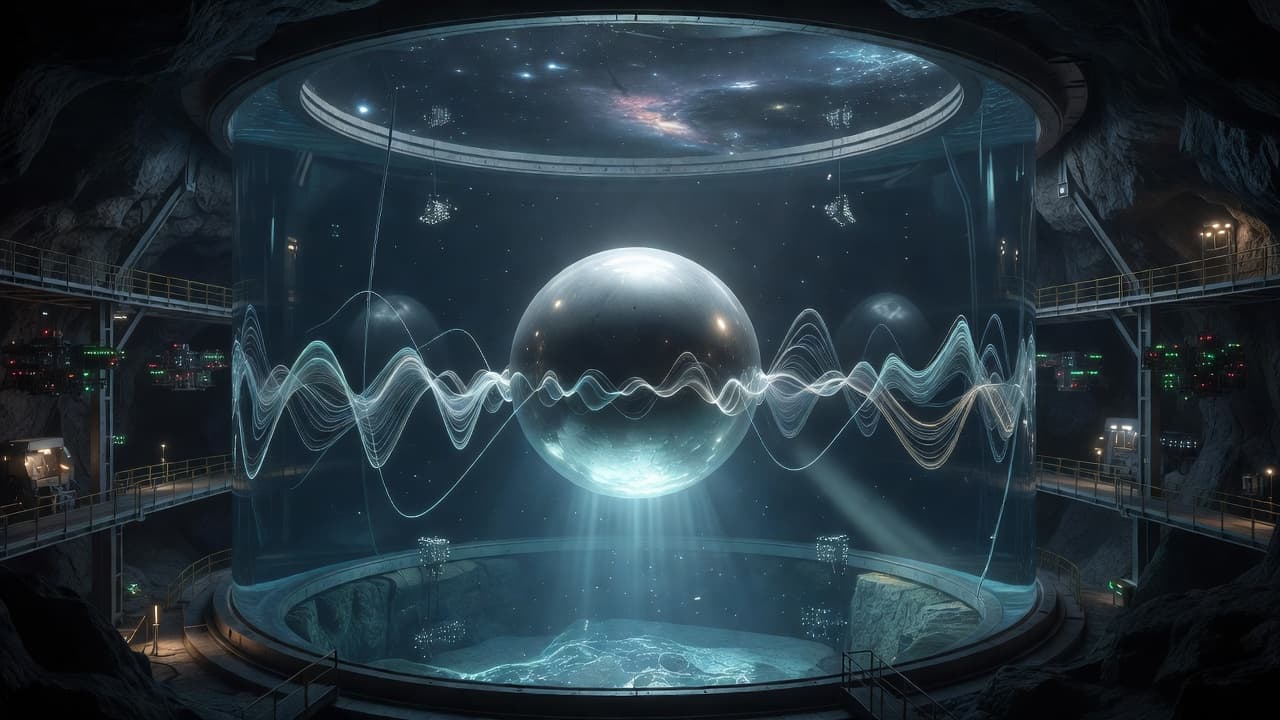
Unveiling the Universe's Ghost Particles: JUNO's Latest Breakthrough
In the quiet depths beneath the Earth, an extraordinary scientific endeavor is unfolding, aiming to unravel some of the universe's most profound mysteries. The Jiangmen Underground Neutrino Observatory (JUNO) has announced a major breakthrough in measuring neutrino oscillations, marking a pivotal moment in particle physics. This development brings scientists closer to understanding these elusive "ghost particles" and their fundamental role in the cosmos.
Neutrinos are subatomic particles with almost no mass and no electric charge, interacting incredibly weakly with matter. Billions of them pass through us every second, originating from the Sun, supernovae, and nuclear reactors, yet they are notoriously difficult to detect. Their peculiar ability to change "flavor" as they travel – a phenomenon known as neutrino oscillation – holds crucial clues about the fundamental laws of physics, including the elusive neutrino mass hierarchy.
The Elusive Neutrino: A Cosmic Mystery
For decades, neutrinos have presented a fascinating puzzle. They exist in three known 'flavors': electron, muon, and tau neutrinos. The discovery that these flavors are not static but can transform into one another during their journey through space was a revolutionary concept, earning the Nobel Prize in Physics in 2015. This oscillation implies that neutrinos must possess mass, albeit incredibly tiny, challenging the initial predictions of the Standard Model of particle physics.
Understanding the precise parameters of these oscillations is critical for refining our knowledge of the Standard Model and potentially pointing towards new physics beyond it. It's akin to deciphering the genetic code of the universe's most abundant massive particles.
JUNO: A Giant Leap in Detection
The Jiangmen Underground Neutrino Observatory, located in southern China, is one of the most ambitious neutrino experiments globally. Buried 700 meters underground to shield it from cosmic rays, its centerpiece is a massive 20-kiloton liquid scintillator detector. This colossal spherical tank is designed to detect the faint flashes of light produced when neutrinos interact with the scintillator fluid, allowing scientists to meticulously study their properties.
JUNO's primary goal is to determine the neutrino mass hierarchy – essentially, whether the mass ordering of the three neutrino flavors is "normal" or "inverted." This fundamental characteristic has profound implications for cosmology, astrophysics, and the search for new physics.
Deciphering Neutrino Oscillations with Unprecedented Precision
The recent breakthrough from JUNO represents a significant advancement in precisely measuring the parameters governing these neutrino oscillations. By observing reactor antineutrinos from two nuclear power plants located approximately 53 kilometers away, JUNO can detect how these particles oscillate over a medium baseline. The sheer size and sensitivity of the detector allow for an unprecedented level of statistical accuracy and control over systematic uncertainties.
This enhanced precision is crucial for distinguishing between different oscillation scenarios and narrowing down the possibilities for the neutrino mass hierarchy. The data collected by JUNO provides a clearer picture of how these ghostly particles morph, offering invaluable insights into their intrinsic properties and interactions.
The Breakthrough: What JUNO Achieved
While specific details of the initial breakthrough are still emerging, the announcement signifies JUNO's success in achieving highly accurate measurements of key oscillation parameters. This precision is vital because even tiny differences in these values can favor one mass hierarchy over another. This milestone validates JUNO's cutting-edge design and its potential to deliver on its ambitious scientific goals.
The ability to precisely measure these oscillations paves the way for a definitive determination of the neutrino mass hierarchy. Such a discovery would not only fill a significant gap in the Standard Model but also influence theories about leptogenesis – the process by which the universe developed its matter-antimatter asymmetry.
Beyond the Standard Model: The Future of Neutrino Research
JUNO's initial success marks a critical step forward in the global effort to understand neutrinos. The data gathered will complement findings from other major neutrino experiments worldwide, creating a more comprehensive picture of these enigmatic particles. The journey to fully comprehend neutrinos is far from over, but JUNO's contributions are indispensable.
Future analyses from JUNO are expected to yield even more precise measurements and potentially reveal new phenomena. This ongoing research promises to push the boundaries of human knowledge, offering tantalizing glimpses into the fundamental structure of the universe and the forces that govern it.
Peering Deeper into the Cosmic Fabric
The "first major breakthrough" by the JUNO collaboration is a testament to human ingenuity and our relentless pursuit of knowledge. By meticulously observing the universe's most elusive particles, JUNO is not just measuring oscillations; it's providing a new lens through which to view the fundamental fabric of reality. This scientific triumph brings us closer to solving the long-standing mystery of neutrino mass and may unlock unforeseen insights into the origins and evolution of our cosmos.
How this article was made
- Sources
- ScienceDaily
- Generated on:
- Jun 16, 2026
This content is produced by Acerbo.AI's AI editorial pipeline: source gathering, rewriting and imagery are automated. Editorial oversight stays human.
Related Articles
Quantum Mystery Deepens: CERN Uncovers Unprecedented Gluon Behavior
CERN scientists have observed gluons, the fundamental particles binding atomic nuclei, exhibiting unexpected behavior deep within matter, challenging long-held theories of the strong nuclear force.
Venom's Own Cure: Rattlesnake Blood Holds Key to Revolutionary Antivenom
Scientists have unearthed a groundbreaking new antivenom directly from rattlesnake blood, offering a potent and potentially safer treatment for snakebite victims worldwide.

Giant Strides: Ancient Footprints Uncover a Colossal Human Ancestor from 1.4 Million Years Ago
A monumental discovery of 1.4-million-year-old footprints is rewriting the narrative of human evolution, revealing that our ancient hominin relatives were significantly larger than previously believed.