
Oxford Physicists Unlock New 'Schrödinger's Cat' Quantum State, Pushing Boundaries of Reality
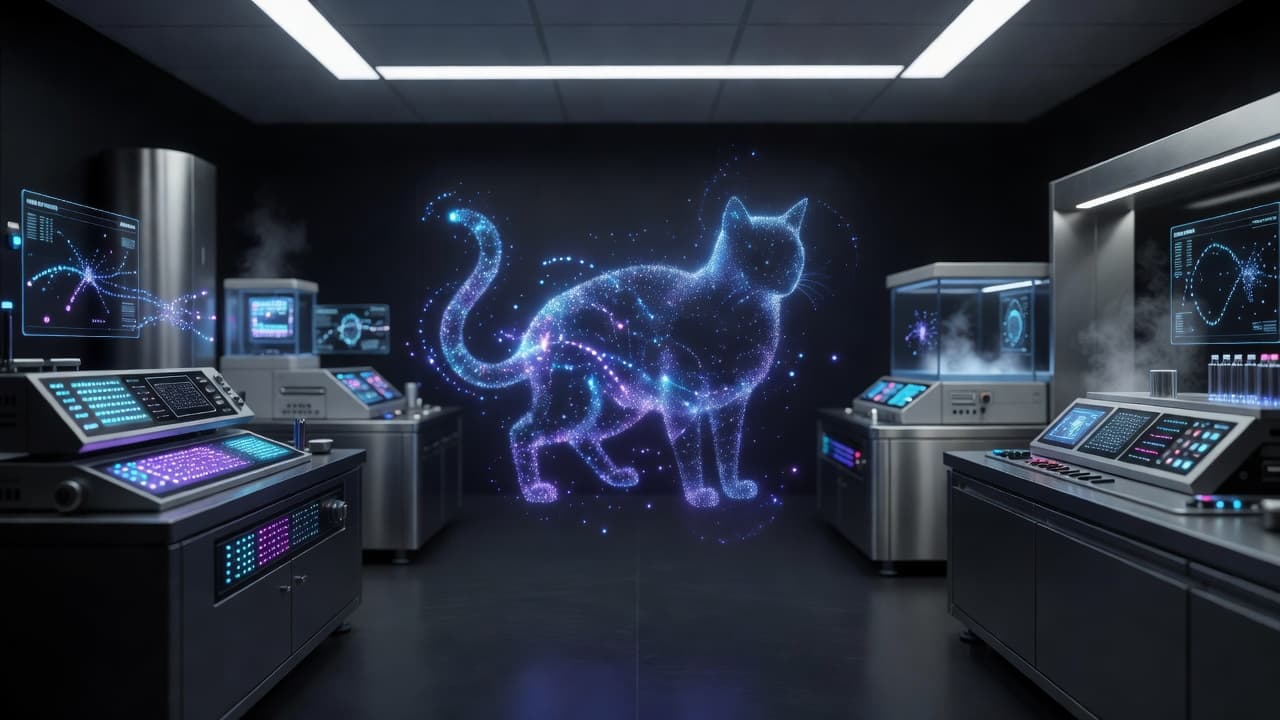
Oxford physicists have engineered a novel quantum state akin to Schrödinger's Cat, demonstrating superposition in a new way that could revolutionize quantum computing and our understanding of reality.

Unveiling the Quantum Paradox: A New 'Schrödinger's Cat' Emerges
For decades, Schrödinger's Cat has been the iconic thought experiment illustrating the bizarre nature of quantum mechanics, where a hypothetical feline exists in a superposition of both 'alive' and 'dead' states simultaneously until observed. Now, scientists at Oxford University have taken a significant leap, announcing the creation of a new quantum state that mirrors this paradox, pushing the boundaries of how we understand and manipulate the fundamental fabric of reality.
This groundbreaking achievement doesn't involve actual cats in boxes, but rather sophisticated systems engineered to exhibit quantum superposition in unprecedented ways. It represents a crucial step in extending quantum phenomena, typically observed only at the atomic or subatomic level, into more complex or 'macroscopic' realms.
The Enduring Enigma of Superposition
At the heart of quantum mechanics lies the principle of superposition, which states that a quantum system can exist in multiple states concurrently until a measurement forces it to 'collapse' into one definite state. Schrödinger's Cat was devised to highlight the counter-intuitive implications of this concept when scaled up to everyday objects.
- Quantum Superposition: A particle can be in two places at once.
- Entanglement: Two particles become linked, sharing the same fate regardless of distance.
- Measurement Problem: The act of observation seems to 'force' a quantum system into a definite state.
The challenge for physicists has always been to create and maintain these fragile quantum states, especially as systems become larger or interact with their environment, a process known as decoherence, which causes quantum properties to vanish.
Oxford's Groundbreaking Achievement: Engineering a Novel Quantum State
The Oxford team's breakthrough lies in their ability to engineer a novel quantum state that exhibits 'cat-like' superposition with enhanced robustness or in a new type of system. While specific details of the experimental setup are intricate, the essence is the successful creation of a system where two distinctly different states coexist simultaneously before observation.
This achievement is not merely a replication of previous quantum demonstrations; it represents a significant advance in our capacity to control and isolate quantum systems from environmental interference. By doing so, they have opened new avenues for exploring the transition from the quantum world to the classical world we experience.
Bridging the Quantum-Classical Divide
The implications of creating such a robust and new 'Schrödinger's Cat' state are profound, impacting both fundamental physics and technological innovation. It offers a powerful new tool for:
- Quantum Computing: Enabling more stable and complex quantum bits (qubits), which are the building blocks of quantum computers. This could lead to breakthroughs in computation far beyond classical machines.
- Enhanced Sensing: Developing ultra-precise sensors for medical imaging, navigation, and fundamental scientific experiments, leveraging the extreme sensitivity of quantum states.
- Fundamental Physics: Providing a unique laboratory to test the limits of quantum mechanics and explore theories about gravity's interaction with quantum phenomena, as well as the nature of reality itself.
Understanding and manipulating these complex quantum states is paramount for unlocking the full potential of quantum technologies and deepening our understanding of the universe's most perplexing laws.
The Future is Quantum
The work by Oxford physicists marks a pivotal moment in quantum research. By pushing the boundaries of 'Schrödinger's Cat' states, they are not only advancing our theoretical understanding but also laying critical groundwork for practical applications that could redefine industries and solve some of humanity's greatest challenges. As research continues, we can expect further fascinating insights into the quantum realm, bringing us closer to a future shaped by the extraordinary power of quantum mechanics.
How this article was made
- Sources
- ScienceDaily
- Generated on:
- Jun 19, 2026
This content is produced by Acerbo.AI's AI editorial pipeline: source gathering, rewriting and imagery are automated. Editorial oversight stays human.
Related Articles
Oxford Breakthrough: Physicists Forge Unprecedented Schrödinger's Cat-Like Quantum State
Oxford physicists have achieved a monumental feat, creating a novel quantum state akin to the famous Schrödinger's Cat paradox. This breakthrough pushes the boundaries of quantum mechanics, opening new doors for understanding the universe and advancing future technologies.

Quantum Leap: Scientists Observe Metal Lump in Two Places Simultaneously, Shattering Records
Scientists have achieved a record-breaking quantum experiment, observing a tiny metal object existing in two distinct locations at once. This breakthrough pushes the limits of quantum mechanics.

Scientists Uncover "Fractional Fermi Sea": A New Frontier in Quantum Physics with Ultracold Atoms
Researchers have engineered a groundbreaking new quantum state, the 'Fractional Fermi Sea,' using ultracold atoms, offering unprecedented insights into complex quantum phenomena and materials.