
Black Hole Energy Unlocked: Scientists Recreate Penrose Process in Lab
In a groundbreaking experiment, researchers have successfully recreated the physics of extracting energy from a spinning black hole using a stationary laboratory device, validating Roger Penrose's theoretical process.
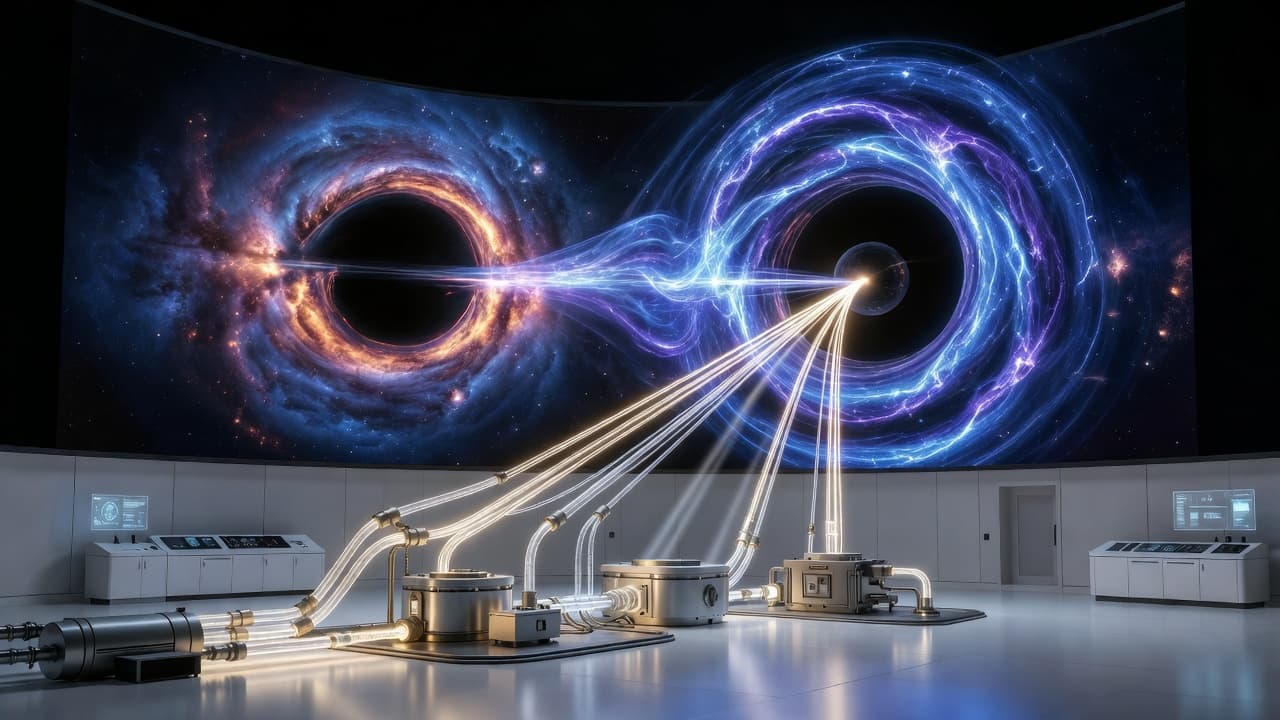
Unlocking Cosmic Power: Scientists Simulate Black Hole Energy Extraction
For decades, the idea of harnessing the immense power of black holes has captivated scientists and science fiction enthusiasts alike. Now, what was once purely theoretical has taken a significant step towards experimental validation. In a remarkable breakthrough, researchers have successfully recreated the fundamental physics of extracting energy from a spinning black hole, not in the depths of space, but within a controlled laboratory setting using a stationary device.
This pioneering experiment offers unprecedented insights into one of the most extreme phenomena in the universe, validating a theory proposed over half a century ago and opening new avenues for understanding gravity and energy at its most fundamental levels.
The Enigma of the Penrose Process
At the heart of this discovery lies the "Penrose Process," a concept first theorized by Nobel laureate Roger Penrose in 1969. Penrose proposed that a rotating black hole possesses a region just outside its event horizon, known as the ergosphere. Within the ergosphere, spacetime itself is dragged along by the black hole's rotation, making it impossible to remain stationary relative to a distant observer.
The Penrose Process describes how a particle entering the ergosphere could split into two. One particle would fall into the black hole, but crucially, the other particle could escape with more energy than the original incoming particle possessed. This 'extra' energy would be drawn directly from the black hole's rotational energy, causing the black hole to slow its spin. It's a method for extracting energy from the very fabric of spacetime distorted by a supermassive object.
Recreating the Impossible on Earth
The challenge has always been how to test such an extreme cosmic phenomenon without an actual black hole. The recent breakthrough demonstrates that it's possible to simulate the core physics. Using a sophisticated, stationary laboratory device, scientists meticulously constructed an environment that mimics the crucial conditions of a black hole's ergosphere, particularly the frame-dragging effect essential for the Penrose Process to occur.
While the exact details of the experimental setup are complex, the principle involves creating a system where energy can be amplified by interacting with a rotating field or medium, analogous to how particles gain energy from a black hole's spin. This experimental recreation provides empirical evidence for a process previously confined to the realms of theoretical astrophysics.
Implications for Astrophysics and Beyond
This achievement carries profound implications across several scientific disciplines:
- Validation of Theory: It provides strong experimental backing for Penrose's original theory, solidifying our understanding of black hole mechanics and extreme gravitational environments.
- Deepening Understanding: By observing these phenomena in a controlled environment, researchers can gain new insights into the fundamental properties of spacetime, gravity, and quantum mechanics under conditions that are otherwise inaccessible.
- Novel Energy Concepts: While not an immediate solution for terrestrial energy needs, this research could inspire entirely new approaches to energy generation by exploring how energy can be extracted from rotational systems or manipulated at a fundamental level.
- Advancing Analog Gravity: The experiment contributes significantly to the field of analog gravity, where laboratory systems are used to model gravitational phenomena, offering a powerful tool for exploring otherwise untestable astrophysical theories.
The Road Ahead: Bridging Lab and Cosmos
It's important to note that recreating the physics in a lab is distinct from actually building a device to extract energy from a real black hole. The scale, energy densities, and gravitational forces involved in cosmic black holes are astronomically larger than anything achievable on Earth. However, this experiment serves as a vital proof of concept, demonstrating that the underlying principles are sound and measurable.
Future research will likely focus on refining these experimental setups, exploring different aspects of black hole physics, and pushing the boundaries of what can be simulated in a laboratory. The ultimate goal remains to further unravel the mysteries of the cosmos and potentially unlock new understandings of energy itself.
A Glimpse into the Future of Energy
This groundbreaking work represents a monumental step in experimental physics and astrophysics. By successfully simulating the Penrose Process, scientists have brought the enigmatic power of black holes a little closer to human comprehension. It's a testament to human ingenuity, pushing the boundaries of what we thought was possible and perhaps, one day, inspiring entirely new paradigms for energy and our interaction with the universe.
How this article was made
- Sources
- ScienceDaily
- Generated on:
- Jul 13, 2026
This content is produced by Acerbo.AI's AI editorial pipeline: source gathering, rewriting and imagery are automated. Editorial oversight stays human.
Related Articles
Cosmic Breakthrough: Scientists Witness the Birth of a Magnetar, the Universe's Strongest Magnet, for the First Time
A monumental discovery in astrophysics as scientists observe the formation of a magnetar, validating general relativity's predictions and opening new frontiers in understanding cosmic extremes.

Quantum Leap in Energy: Scientists Unveil a Battery That Defies Traditional Charging Physics
A groundbreaking quantum battery has been developed, challenging conventional charging rules and promising a future of unprecedented energy storage and delivery.

Graphene's Quantum Secret: Seemingly Defying Physics to Harvest Energy
A groundbreaking discovery in material science reveals graphene's astonishing ability to harness thermal energy, challenging conventional understanding and opening doors for future clean power.