
IBM & NASA Unleash Open-Source AI for Lunar Exploration
IBM and NASA have collaboratively launched the Lunar Foundation Model, an open-source AI designed to process vast lunar data, accelerate discovery, and aid future Moon missions.
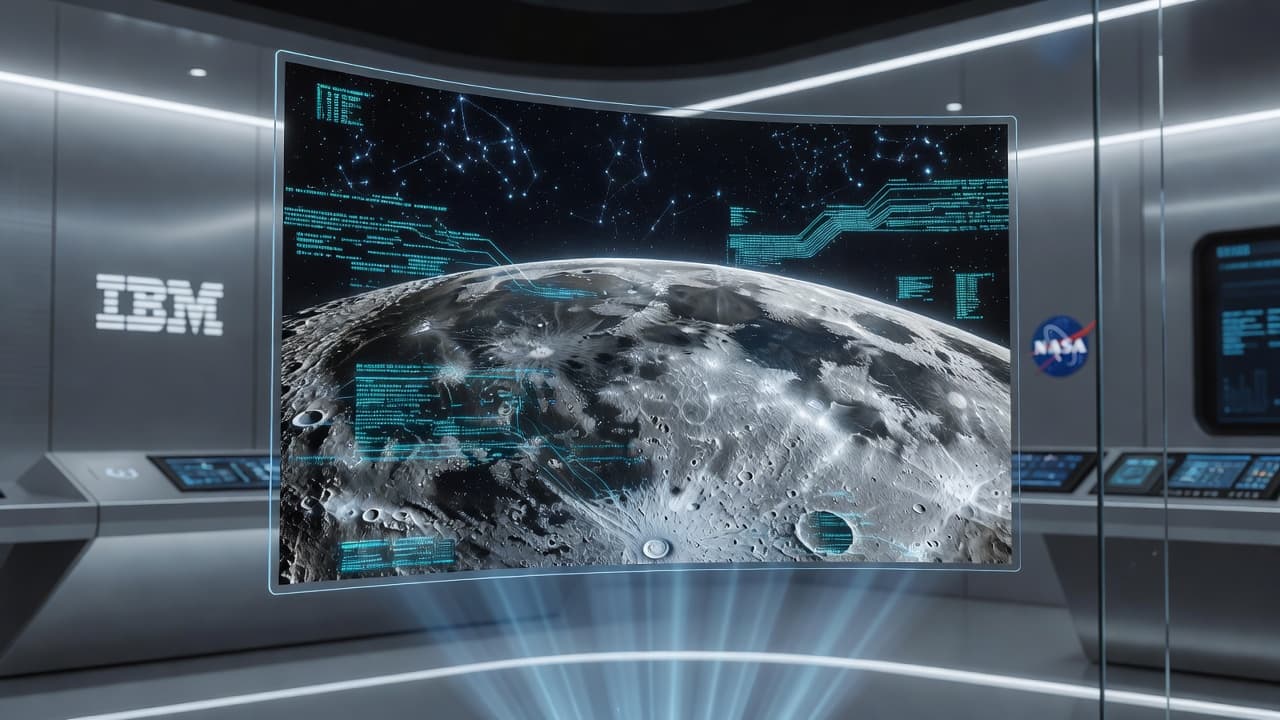
The Dawn of AI-Powered Lunar Exploration
The quest to return to the Moon and establish a lasting human presence is reaching new heights, driven not just by rockets and rovers, but by the burgeoning power of artificial intelligence. In a landmark collaboration, tech giant IBM and the National Aeronautics and Space Administration (NASA) have unveiled the Lunar Foundation Model (LFM), an open-source AI designed to revolutionize our understanding and exploration of Earth's closest celestial neighbor. This groundbreaking initiative marks a significant leap forward in leveraging advanced AI for space science, promising to unlock unprecedented insights from decades of lunar data.
Unlocking Lunar Secrets with Intelligent Analysis
The Lunar Foundation Model is no ordinary software; it's a sophisticated AI system built upon vast datasets of lunar imagery, geological surveys, sensor readings, and scientific literature. Its primary function is to process and interpret the immense volume of data collected from past and ongoing lunar missions, from Apollo to the more recent Lunar Reconnaissance Orbiter. By doing so, the LFM can identify patterns, anomalies, and crucial insights that might be missed by human analysis alone, vastly accelerating the pace of discovery.
Imagine an AI capable of autonomously mapping the Moon's surface with unprecedented detail, identifying potential water ice deposits in shadowed craters, or even pinpointing optimal landing sites for future manned missions. This is precisely the kind of capability the LFM brings to the table, transforming raw data into actionable intelligence. It promises to accelerate the pace of scientific discovery and inform strategic decisions for upcoming lunar endeavors, including NASA's ambitious Artemis program.
The Power of Foundation Models in Space Science
Foundation models represent a paradigm shift in AI, characterized by their immense scale and ability to be adapted for a wide range of downstream tasks. The LFM leverages this architecture by being pre-trained on a comprehensive corpus of lunar data, enabling it to understand the nuances of lunar geology, terrain, and environmental conditions. This foundational understanding makes it incredibly versatile for various analytical applications, from resource identification to hazard assessment.
For scientists and mission planners, the LFM offers a powerful tool to simulate lunar environments, predict material behaviors, and even assist in the design of lunar habitats. Its ability to learn from and adapt to new data ensures that it will become an increasingly invaluable asset as more information is gathered from ongoing and future missions, supporting humanity's long-term goals for lunar habitation and exploration.
An Open-Source Leap for Global Collaboration
Crucially, the Lunar Foundation Model is being released as an open-source project. This strategic decision by IBM and NASA underscores a commitment to global scientific collaboration and rapid innovation. By making the LFM accessible to researchers, universities, and space agencies worldwide, the initiative aims to foster a collaborative ecosystem where experts can contribute to its development, refine its capabilities, and apply it to their own specific research questions.
The open-source nature means that the model can evolve much faster than a proprietary system. It encourages transparency, peer review, and the collective advancement of lunar science. This democratized approach to space AI has the potential to unlock unforeseen discoveries and accelerate humanity's journey back to and beyond the Moon, creating a shared resource for the international space community.
IBM and NASA: A Synergy for Space Innovation
This partnership unites IBM's deep expertise in artificial intelligence and large-scale data processing with NASA's unparalleled wealth of space data and mission experience. IBM’s contribution of its cutting-edge AI technology and research capabilities, combined with NASA’s scientific rigor and access to invaluable lunar datasets, creates a powerful synergy poised to push the boundaries of space exploration. It exemplifies how public-private partnerships can drive monumental advancements in fields critical to humanity's future.
Paving the Way for Future Lunar Missions
The release of the open-source Lunar Foundation Model represents a pivotal moment in space exploration. By harnessing the power of AI, IBM and NASA are not just making lunar data more accessible; they are creating an intelligent companion for humanity's next giant leaps. As we look towards future missions, this AI promises to be an indispensable guide, helping us decipher the Moon's mysteries and pave the way for a sustained human presence beyond Earth, ultimately serving as a stepping stone for deeper space exploration.
How this article was made
- Sources
- IBM Newsroom
- Rewriting model:
- gemini-2.5-flash
- Image generated with:
- xAI Grok
- Generated on:
- Sep 12, 2026
This content is produced by Acerbo.AI's AI editorial pipeline: source gathering, rewriting and imagery are automated. Editorial oversight stays human.
Related Articles
Breakthrough in 31-Year-Old Math Enigma by Microsoft Researchers
Microsoft researchers have made significant strides in solving a long-standing mathematical puzzle that has baffled experts for decades.

Beyond Borders: AI and Cloud Sovereignty Redefine Digital Control
Discussions on AI and cloud sovereignty are evolving past simple data residency, now encompassing algorithmic control, jurisdictional challenges, and the AI supply chain's strategic importance.
Microsoft's AI Leap: New Hardware & Windows Redefine Computing
Microsoft's latest event unveiled a groundbreaking fusion of AI-optimized hardware and deeply integrated Windows features, signaling a transformative era for personal computing. Explore how AI is set to revolutionize your digital experience.