
Cosmic Cannibals: Astronomers Uncover Two Actively Feeding Supermassive Black Holes in the Early Universe
A groundbreaking discovery reveals two actively feeding supermassive black holes in the universe's nascent stages, challenging theories of cosmic evolution and galaxy formation.
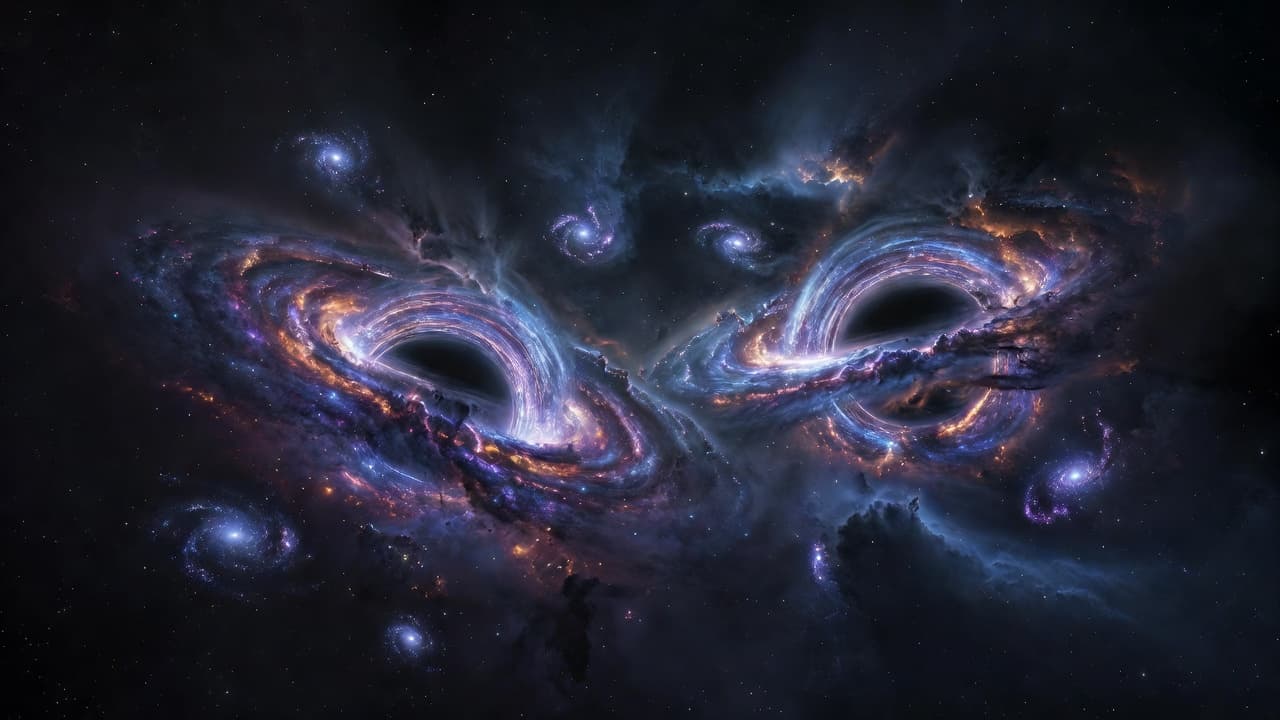
Cosmic Cannibals: Astronomers Uncover Two Actively Feeding Supermassive Black Holes in the Early Universe
Imagine a time when the universe was barely a toddler, just a few hundred million years old, a mere fraction of its current age. In this cosmic infancy, astronomers have made a startling discovery: two supermassive black holes (SMBHs) that were not only present but actively gorging on matter. This groundbreaking finding pushes the boundaries of our understanding of black hole formation and the evolution of galaxies during the universe's nascent stages.
The detection of these cosmic behemoths, caught in the act of 'feeding' so early after the Big Bang, presents a significant challenge to existing astrophysical theories. It suggests that these enigmatic objects grew far more rapidly than previously thought possible, hinting at unknown mechanisms that accelerated their development in the universe's chaotic youth.
Unveiling Distant Cosmic Giants
The discovery was made possible through sophisticated observations combining data from powerful telescopes. While specific instruments like the Chandra X-ray Observatory are adept at detecting the high-energy X-rays emitted by matter falling into a black hole, other telescopes like the Hubble Space Telescope or the James Webb Space Telescope (JWST) would provide crucial context in visible and infrared light, helping to identify their host galaxies. This multi-wavelength approach is essential for peering back into the universe's distant past.
When a supermassive black hole actively feeds, it creates an incredibly energetic phenomenon known as an Active Galactic Nucleus (AGN) or, in its most luminous form, a quasar. The matter spiraling into the black hole forms an accretion disk, heating up to millions of degrees and emitting vast amounts of radiation across the electromagnetic spectrum, making these distant objects observable despite their immense distance.
The Early Universe Enigma
The early universe, often referred to as the "Cosmic Dawn," was a tumultuous period characterized by the formation of the first stars and galaxies. Finding fully formed, actively feeding supermassive black holes during this era is particularly perplexing. Current models struggle to explain how black holes could accumulate so much mass so quickly.
One prevailing theory suggests that SMBHs grow by accreting gas and dust from their surroundings, and through mergers with other black holes. However, for black holes to reach supermassive status so early, they would either need extremely efficient accretion rates, or they might have formed from the direct collapse of massive gas clouds, bypassing the stellar-mass black hole phase entirely. This new discovery adds compelling evidence to the debate, pushing scientists to reconsider the origins of these cosmic engines.
Fueling Galactic Growth and Evolution
The relationship between supermassive black holes and their host galaxies is a complex and symbiotic one. While black holes grow by consuming matter, the energy released during this feeding process can significantly impact the evolution of their surrounding galaxy. This "feedback" can either trigger star formation by compressing gas or, conversely, quench it by heating and expelling gas, preventing new stars from forming.
The presence of actively feeding SMBHs in the early universe suggests that this intricate co-evolutionary dance began much earlier than previously confirmed. Understanding their activity during this formative period is crucial for piecing together the complete picture of how galaxies, including our own Milky Way, came to be.
Implications for Cosmic Models
This discovery serves as a powerful new constraint for cosmological simulations and theoretical models. Scientists will now need to adjust their simulations to account for the rapid growth of these early black holes. It opens new avenues of research into the conditions of the early universe that could have fostered such accelerated growth, potentially involving denser gas environments or different stellar populations.
Future observations, particularly with instruments capable of even deeper looks into the cosmic past, will be vital. The continued search for more such early universe black holes will help astronomers build a more robust statistical sample, further refining our understanding of how these monstrous objects influenced the structure and evolution of the entire cosmos.
A Glimpse into the Universe's Formative Years
The detection of two actively feeding supermassive black holes in the early universe is more than just another astronomical finding; it's a profound revelation that challenges established paradigms and ignites new questions. It underscores the dynamic and often surprising nature of the cosmos, urging us to continually refine our models and push the boundaries of observation.
This discovery provides an invaluable glimpse into the formative years of our universe, offering critical insights into the initial conditions that shaped galaxies and the colossal black holes at their hearts. As technology advances, we can anticipate even more astonishing discoveries that will continue to unravel the universe's deepest mysteries.
How this article was made
- Sources
- Phys.org
- Rewriting model:
- gemini-2.5-flash
- Image generated with:
- xAI Grok
- Generated on:
- 58 min ago
This content is produced by Acerbo.AI's AI editorial pipeline: source gathering, rewriting and imagery are automated. Editorial oversight stays human.
Related Articles
Cosmic Revelation: Have Scientists Finally Glanced at Dark Matter?
A recent scientific development suggests researchers may have detected dark matter, the universe's most enigmatic substance. This potential breakthrough could redefine cosmology and particle physics.
Cosmic Breakthrough: Scientists Witness the Birth of a Magnetar, the Universe's Strongest Magnet, for the First Time
A monumental discovery in astrophysics as scientists observe the formation of a magnetar, validating general relativity's predictions and opening new frontiers in understanding cosmic extremes.
JWST Uncovers Mysterious 'Red Dots': Glimpse of Universe's First Stars on Brink of Cosmic Collapse?
The James Webb Space Telescope has unveiled enigmatic 'little red dots' in the distant cosmos, believed by scientists to be the universe's earliest stars or proto-galaxies, poised at a critical evolutionary juncture. This groundbreaking discovery offers an unprecedented look into the dawn of cosmic history.