
Unlocking AI's Future: Penn Researchers Forge Hybrid Light-Matter Particles for Lightning-Fast Computing
University of Pennsylvania scientists have engineered groundbreaking hybrid light-matter particles, promising radical acceleration and energy efficiency for next-gen AI.
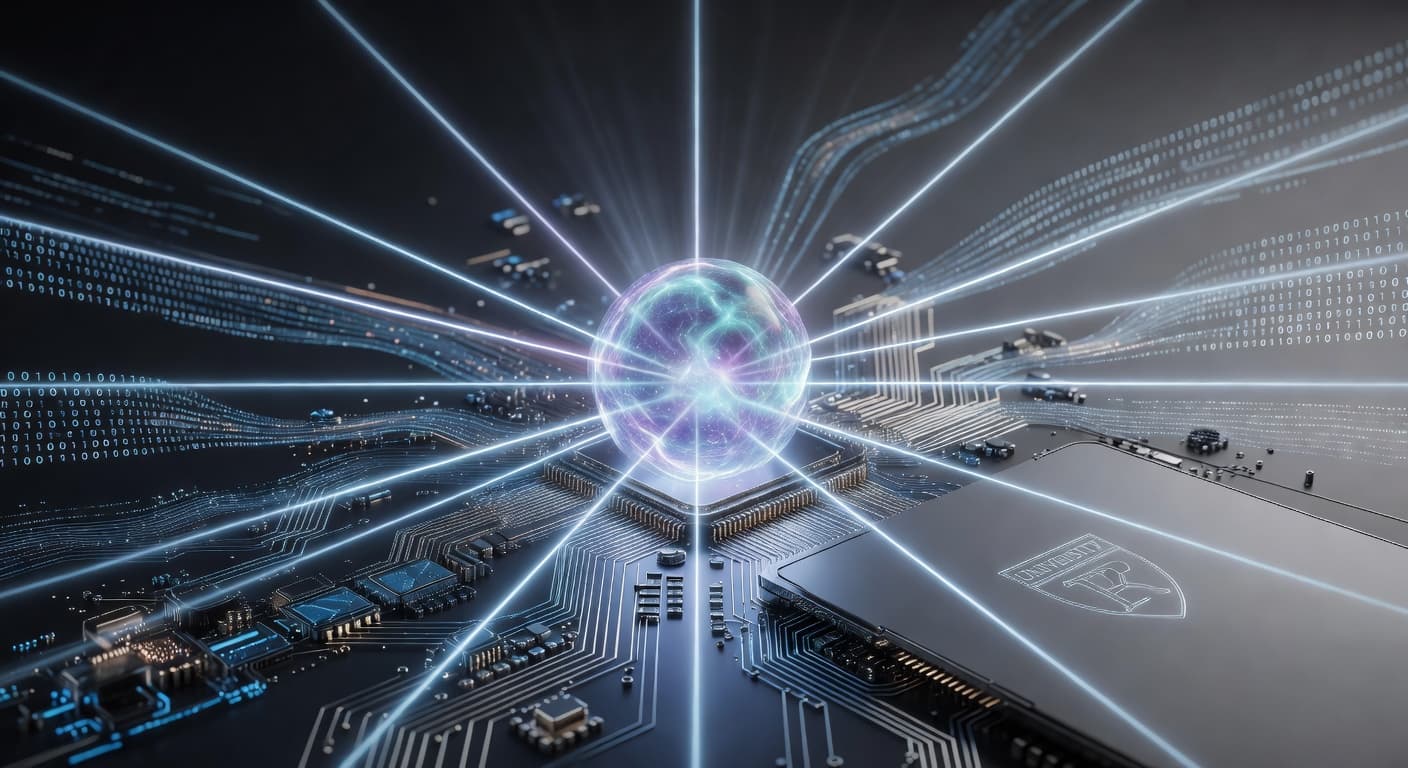
Revolutionizing AI: The Dawn of Light-Speed Computation
Artificial intelligence is rapidly transforming our world, from powering smart devices to revolutionizing scientific discovery. However, the relentless pursuit of more powerful AI comes with a significant challenge: the immense computational demands and energy consumption of current hardware. As AI models grow more complex, the need for faster, more efficient processing becomes critical.
Now, a team of pioneering researchers at the University of Pennsylvania has unveiled a revolutionary breakthrough that could fundamentally reshape the future of artificial intelligence. They have successfully created a novel hybrid light-matter particle, a quasiparticle with the potential to dramatically speed up AI computing while significantly reducing its energy footprint.
What is a Hybrid Light-Matter Particle?
At the heart of this innovation lies a unique entity that defies traditional classification. This hybrid particle combines the best attributes of both light (photons) and matter (excitons or electrons). Unlike pure photons, which interact very little with their environment, or electrons, which are slowed by resistance, these hybrids offer a compelling middle ground.
Imagine a particle that can travel at speeds approaching light while also interacting robustly with its environment, allowing for complex information processing. This is precisely what these Penn researchers have engineered, often referred to in scientific circles as a *polariton* or a similar light-matter coupled state.
Bridging Light and Electrons for Smarter AI
The creation of such a particle involves an intricate dance between light and matter. Researchers typically trap light within a specially designed material, such as a semiconductor, where it strongly couples with the material's electrons. This strong interaction causes the photon and the electron excitation to essentially merge, forming a new, stable hybrid entity.
The beauty of this hybrid is its dual nature: it carries information at the speed of light, yet its matter component allows for manipulation and interaction necessary for computational tasks. This opens up entirely new paradigms for how information can be processed within computing systems, moving beyond the limitations of purely electronic circuits.
How Does This Breakthrough Boost AI?
The implications of this technology for artificial intelligence are nothing short of transformative. Traditional silicon-based processors, while incredibly powerful, are reaching fundamental limits in terms of speed and energy consumption due to heat generation and the physical constraints of electron movement.
By leveraging the unique properties of these light-matter hybrids, AI systems could potentially process information at speeds orders of magnitude faster than current technology. This acceleration could unlock capabilities for real-time complex AI tasks that are currently impossible, from advanced robotics and autonomous systems to instantaneous data analysis and high-fidelity simulations.
Beyond Traditional Electronics: A New Computing Paradigm
The shift from purely electronic computation to one that incorporates light-matter interactions promises several key advantages:
- Unprecedented Speed: Information can travel much faster than electrons, drastically reducing processing times.
- Energy Efficiency: Light-based computation inherently generates less heat than electronic components, leading to lower energy consumption.
- Parallel Processing: The wave-like nature of light allows for the potential of highly parallel computations, where multiple operations occur simultaneously.
- Novel Architectures: This technology could enable entirely new types of neural network architectures optimized for light-matter interaction.
The Penn Team's Specific Achievement
While the concept of light-matter interaction isn't entirely new, the Penn team's specific achievement lies in their ability to engineer and control these hybrid particles in a way that makes them viable for practical computing applications. Their work represents a significant step forward from theoretical concepts to tangible experimental realization.
Their innovative approach involved carefully designing and fabricating nanoscale structures that facilitate the strong coupling between light and matter. This precise engineering allows for the creation of stable, controllable hybrid entities that can be manipulated to perform logical operations, laying the groundwork for future AI processors.
Implications and Future Outlook
Beyond the immediate acceleration of AI algorithms, this technology holds the promise of fundamentally reshaping how we design and build computing hardware across various sectors. From data centers to edge computing devices, the potential for faster, cooler, and more powerful processors is immense.
The research at Penn paves the way for a new generation of photonic AI chips that could redefine the boundaries of what artificial intelligence can achieve. While still in its early stages, this breakthrough offers a tantalizing glimpse into a future where AI systems are not only smarter but also significantly more sustainable.
Revolutionizing AI's Footprint
One of the most pressing concerns in the scaling of AI is its carbon footprint, driven by the massive energy demands of training and running complex models. These light-matter particles offer an inherently more energy-efficient pathway for information processing, potentially leading to a greener, more sustainable future for artificial intelligence.
The creation of this hybrid light-matter particle by Penn researchers marks a pivotal moment in the quest for next-generation computing. It underscores a bold vision where the speed of light and the versatility of matter combine to power the AI systems of tomorrow, propelling us into an era of unprecedented computational power and efficiency.
How this article was made
- Sources
- ScienceDaily
- Generated on:
- May 19, 2026
This content is produced by Acerbo.AI's AI editorial pipeline: source gathering, rewriting and imagery are automated. Editorial oversight stays human.
Related Articles
AI Computing Revolution: Scientists Forge Hybrid Light-Matter Particle for Ultra-Fast Performance
Scientists have engineered a revolutionary hybrid light-matter particle, promising to dramatically accelerate AI computing and unlock unprecedented performance and energy efficiency.

AI Just Unlocked New Physics: A Groundbreaking Discovery in Extreme States of Matter
Artificial intelligence has unveiled novel physical laws governing extreme states of matter, revolutionizing our understanding of the universe's fundamental building blocks.

NVIDIA's $4 Billion Bet on Photonics: Illuminating the Future of AI Data Centers
NVIDIA invests $4B in photonics to overcome AI data center scaling challenges, leveraging light for faster, more efficient data transfer and cementing its leadership in AI infrastructure.