
Google's Gemini 2.5 Pro Unleashes 'Deep Think' Mode, Outpaces Rivals in Science Benchmarks
Google's latest AI, Gemini 2.5 Pro, powered by its groundbreaking 'Deep Think' reasoning mode, has reportedly surpassed OpenAI's GPT-5.5 and Anthropic's Fable 5 in critical science benchmarks, marking a significant leap in AI capabilities.

Google's Gemini 2.5 Pro: A New Era of AI Reasoning Dawns
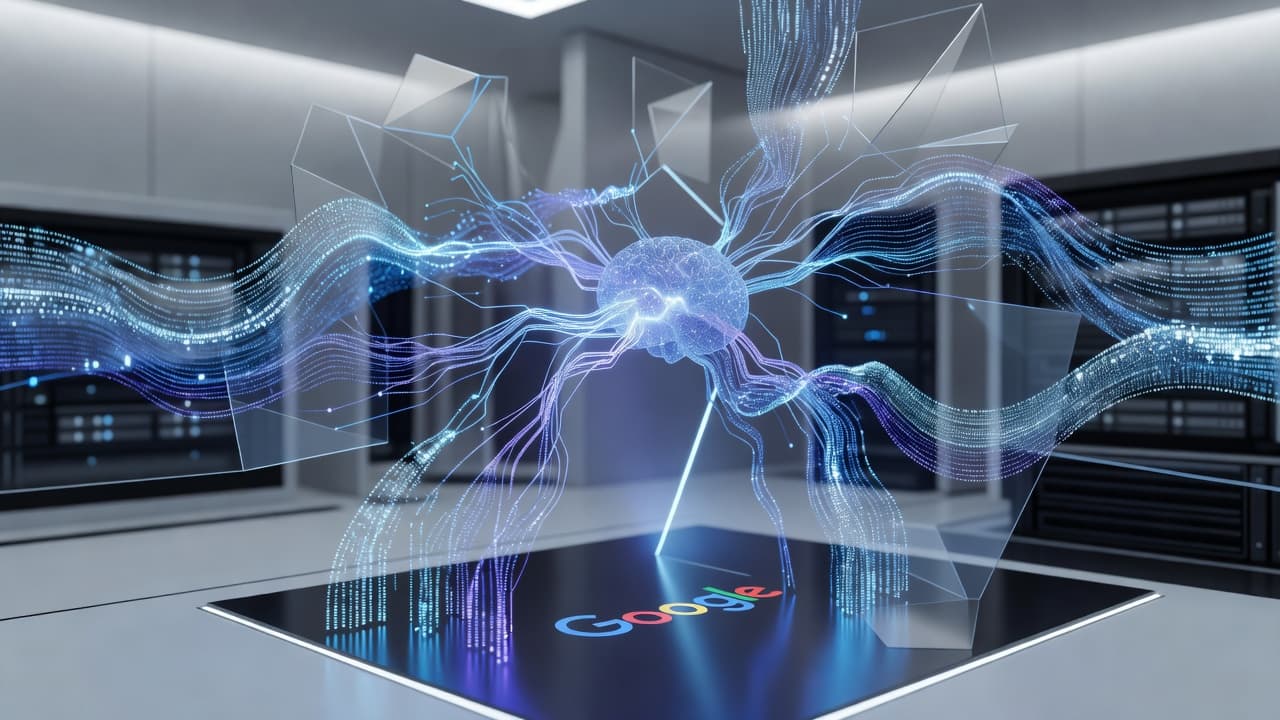
In a significant development shaking the artificial intelligence landscape, Google has officially launched Gemini 2.5 Pro, its latest and most advanced multimodal AI model. This iteration introduces a revolutionary feature dubbed 'Deep Think' reasoning mode, which appears to be setting new performance standards. Early reports indicate that Gemini 2.5 Pro, specifically with its Deep Think capabilities, has outperformed formidable competitors such as OpenAI's GPT-5.5 and Anthropic's Fable 5 across crucial science benchmarks, signaling a pivotal moment in the ongoing AI race.
The announcement underscores Google's relentless pursuit of AI excellence, pushing the boundaries of what large language models (LLMs) can achieve. This advancement is particularly noteworthy given the intense competition among tech giants to develop increasingly capable and intelligent AI systems.
Unpacking the Power of 'Deep Think' Reasoning
At the heart of Gemini 2.5 Pro's impressive performance lies its innovative Deep Think reasoning mode. While specific technical details are still emerging, the moniker itself suggests an AI engineered for more profound, intricate, and multi-step cognitive processing. Unlike earlier models that might excel at pattern recognition or information retrieval, Deep Think appears designed to tackle complex problems requiring sustained logical deduction, hypothesis generation, and nuanced understanding – skills traditionally associated with advanced human intellect.
This mode likely enables Gemini 2.5 Pro to better synthesize vast amounts of information, identify subtle connections, and construct coherent arguments, making it exceptionally adept at scientific inquiry. It moves beyond mere data processing to more sophisticated forms of understanding and problem-solving.
Dominating Science Benchmarks: A Competitive Edge
The claim that Gemini 2.5 Pro has surpassed OpenAI's GPT-5.5 and Anthropic's Fable 5 on 'science benchmarks' is particularly impactful. Science benchmarks are rigorous tests designed to evaluate an AI's ability to understand scientific concepts, solve complex problems, and perform tasks requiring logical reasoning in domains like physics, chemistry, biology, and mathematics. These aren't simple trivia questions; they often involve interpreting experimental data, deriving conclusions, or even proposing solutions to theoretical challenges.
This reported superiority highlights Google's lead in developing AI that can genuinely contribute to scientific discovery and research. It suggests a model capable of not just regurgitating facts but engaging with scientific methodology in a more profound way.
The Implications for AI Development and Scientific Research
The emergence of an AI model with superior scientific reasoning capabilities holds immense implications for various sectors. In scientific research, Gemini 2.5 Pro could accelerate discovery by:
- Assisting in hypothesis generation: Helping researchers formulate new theories based on existing data.
- Automating data analysis: Processing and interpreting complex datasets with greater accuracy.
- Facilitating drug discovery: Identifying potential compounds and predicting their interactions.
- Enhancing educational tools: Providing more sophisticated explanations and problem-solving assistance in STEM fields.
Moreover, this development intensifies the global AI arms race. Each breakthrough pushes competitors to innovate further, leading to a rapid evolution of AI technology that promises to transform industries and everyday life.
Google's Strategic Move in the AI Landscape
This launch solidifies Google's position as a frontrunner in the highly competitive artificial intelligence arena. By focusing on advanced reasoning and excelling in critical scientific domains, Google is not just keeping pace but potentially setting a new standard for what next-generation AI models can achieve. The emphasis on 'Deep Think' suggests a strategic pivot towards AI that can augment human intelligence in complex, knowledge-intensive fields.
As Gemini 2.5 Pro rolls out, the world will be watching closely to see how its Deep Think capabilities translate into real-world applications and how it continues to shape the future of AI innovation and scientific advancement.
How this article was made
- Sources
- Crescendo AI
- Generated on:
- Jul 12, 2026
This content is produced by Acerbo.AI's AI editorial pipeline: source gathering, rewriting and imagery are automated. Editorial oversight stays human.
Related Articles
Google's Gemini 2.5 Pro Unleashes "Deep Think" Mode, Redefining AI Reasoning
Google's Gemini 2.5 Pro, featuring the new 'Deep Think' reasoning mode, has achieved record-breaking scores on scientific benchmarks, surpassing OpenAI and Anthropic. This marks a significant leap in AI reasoning capabilities, intensifying the global AI race.

Google's Gemini 2.5 Pro with 'Deep Think' Mode Redefines AI Reasoning, Surpassing Rivals in Science
Google's Gemini 2.5 Pro, featuring the innovative 'Deep Think' reasoning mode, has set new benchmarks in scientific AI, surpassing models from OpenAI and Anthropic. This advancement promises deeper, more human-like problem-solving capabilities.

Google Gemini 2.5 Pro's Deep Think Mode Dominates Science Benchmarks, Outperforming Rivals
Google's Gemini 2.5 Pro, powered by its innovative Deep Think Reasoning Mode, has set new industry standards, decisively surpassing OpenAI and Anthropic on critical science benchmarks.