
Superconductivity Breakthrough: New Material Achieves Record 151 K at Normal Pressure
Scientists have achieved a monumental breakthrough in superconductivity, discovering a material that conducts electricity without resistance at an unprecedented 151 Kelvin under normal atmospheric pressure, smashing previous records and bringing practical applications closer.
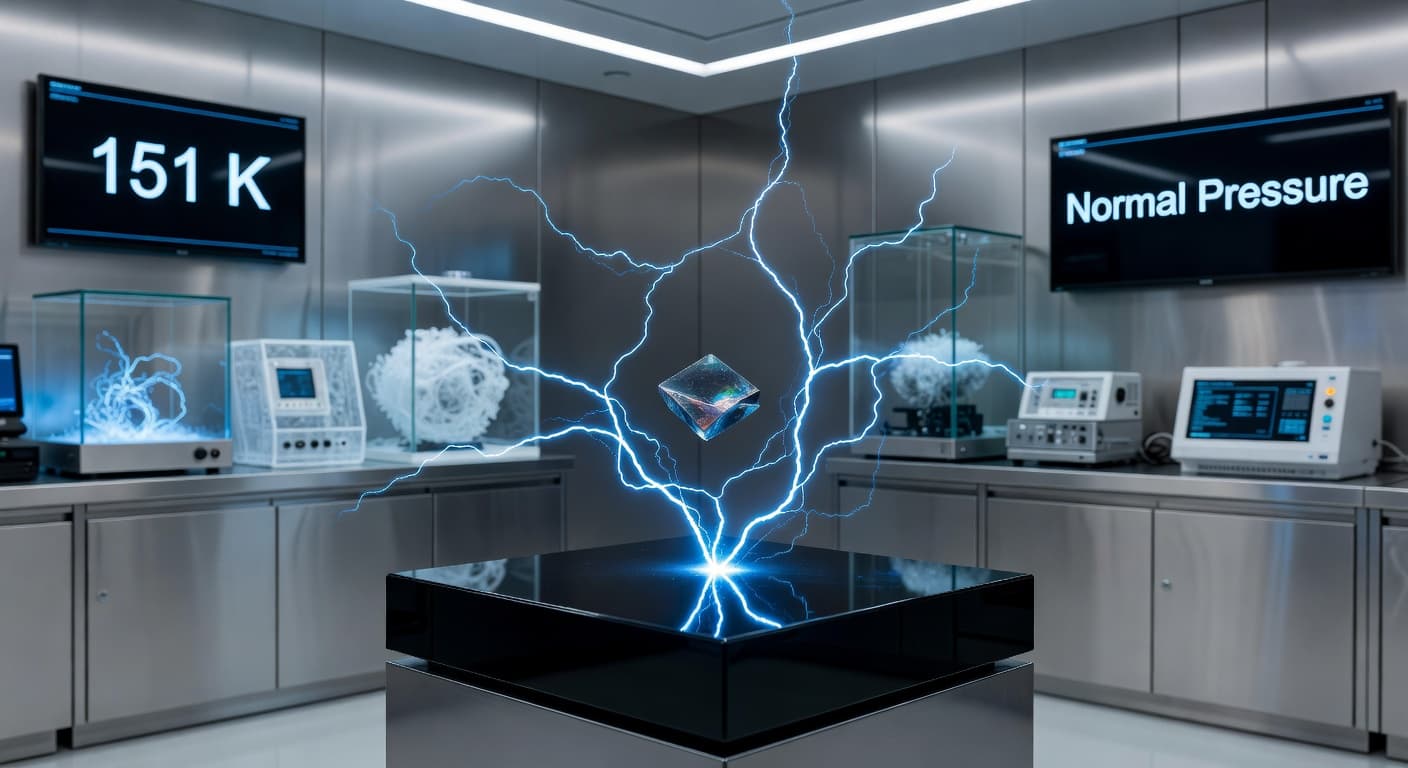
The scientific community is abuzz with a monumental announcement: researchers have successfully developed a material exhibiting superconductivity at an unprecedented 151 Kelvin (-122 degrees Celsius), all under normal atmospheric pressure. This groundbreaking achievement shatters previous records and marks a significant leap forward in the long quest for practical, high-temperature superconductors, potentially unlocking a new era of technological innovation and energy efficiency.
A New Frontier in Superconductivity Research
For decades, the dream of room-temperature superconductivity has remained elusive, often confined to extreme conditions of immense pressure or cryogenic temperatures. Superconductivity, the phenomenon where electricity flows with zero resistance, promises revolutionary applications. However, its practical implementation has been severely hampered by these demanding environmental requirements. This latest discovery brings that dream considerably closer to reality by overcoming one of the most significant barriers: the need for crushing pressures.
Achieving superconductivity at 151 K under ambient pressure is a true game-changer. While 151 K is still far from room temperature (around 293 K), it represents the highest temperature ever recorded for a superconductor operating without the need for extreme compression. This temperature range is achievable with relatively inexpensive liquid nitrogen cooling, making it a far more accessible agent than liquid helium.
Why Normal Pressure is a Game-Changer
Previous breakthroughs in high-temperature superconductivity often required pressures millions of times greater than Earth's atmosphere. For instance, some materials have shown superconductivity above room temperature, but only under conditions practically impossible to maintain outside of specialized laboratories. The new material's performance at 151 K under normal pressure fundamentally alters the landscape, moving the field from purely academic curiosities towards viable engineering possibilities.
This achievement builds upon years of intensive research into complex hydrides and other novel material compositions. While specific details about the exact material are often proprietary, the focus is clearly on designing materials with unique atomic structures that facilitate electron pairing and coherent flow at higher thermal energies, thereby overcoming resistive forces more effectively.
Revolutionary Applications on the Horizon
The potential applications of superconductors are vast and transformative. This new record-breaking material, if scalable and stable, could pave the way for numerous advancements:
- Ultra-Efficient Power Grids: Imagine electricity transmission lines that lose virtually no energy, drastically reducing global power consumption and carbon footprints.
- Advanced Electronics: Faster, more powerful, and energy-efficient computing devices, including components for quantum computers.
- Medical Imaging: More sensitive and compact MRI machines, leading to improved diagnostics and patient comfort.
- Magnetic Levitation: Efficient maglev trains offering high-speed, low-friction transportation.
- Fusion Energy: Stronger, more stable magnetic fields for confining plasma in fusion reactors.
The reduction in cooling requirements from liquid helium to liquid nitrogen, and the elimination of high-pressure apparatus, significantly lowers the cost and complexity of implementing these technologies, making widespread adoption much more feasible.
Navigating Challenges and Future Prospects
While the excitement is palpable, scientists caution that significant hurdles remain. The material's stability, ease of synthesis, scalability for industrial production, and further optimization of its superconducting properties are all critical areas for ongoing research. Identifying the precise mechanisms at play at these higher temperatures is also crucial for developing even better materials.
This discovery represents a critical stepping stone, providing invaluable insights into the fundamental physics of superconductivity. It fuels optimism that the ultimate goal of achieving robust room-temperature superconductivity at ambient pressure is not merely a distant dream but an increasingly tangible objective.
A Glimpse into a Superconducting Future
The record-shattering achievement of 151 K superconductivity at normal pressure is more than just a new number; it's a profound demonstration of human ingenuity pushing the boundaries of material science. It ignites hope for a future where energy waste is minimized, technology is revolutionized, and the very fabric of our daily lives is transformed by the power of zero resistance. As researchers continue to refine and explore these novel materials, the world eagerly awaits the next chapter in the unfolding saga of superconductivity.
How this article was made
- Sources
- ScienceDaily
- Generated on:
- May 30, 2026
This content is produced by Acerbo.AI's AI editorial pipeline: source gathering, rewriting and imagery are automated. Editorial oversight stays human.
Related Articles

Superconductivity Breakthrough: University of Houston Shatters Record at 151 K Under Ambient Pressure
University of Houston scientists have achieved a groundbreaking superconductivity record at 151 Kelvin under normal pressure, marking a significant leap towards practical, energy-efficient technologies.

Quantum Leap: Scientists Unlock New Control Over Superconductivity
A groundbreaking discovery reveals how microscopic imperfections and atomic vibrations can precisely control superconductivity, paving the way for revolutionary quantum technologies.

MXene Revolution: New Breakthrough Unleashes 160x Conductivity Boost with Perfect Atomic Order
A groundbreaking discovery in material science has propelled MXenes into a new era, achieving a staggering 160-fold increase in conductivity through unparalleled atomic precision. This could redefine future electronics.