
Superconductivity Breakthrough: University of Houston Shatters Record at 151 K Under Ambient Pressure
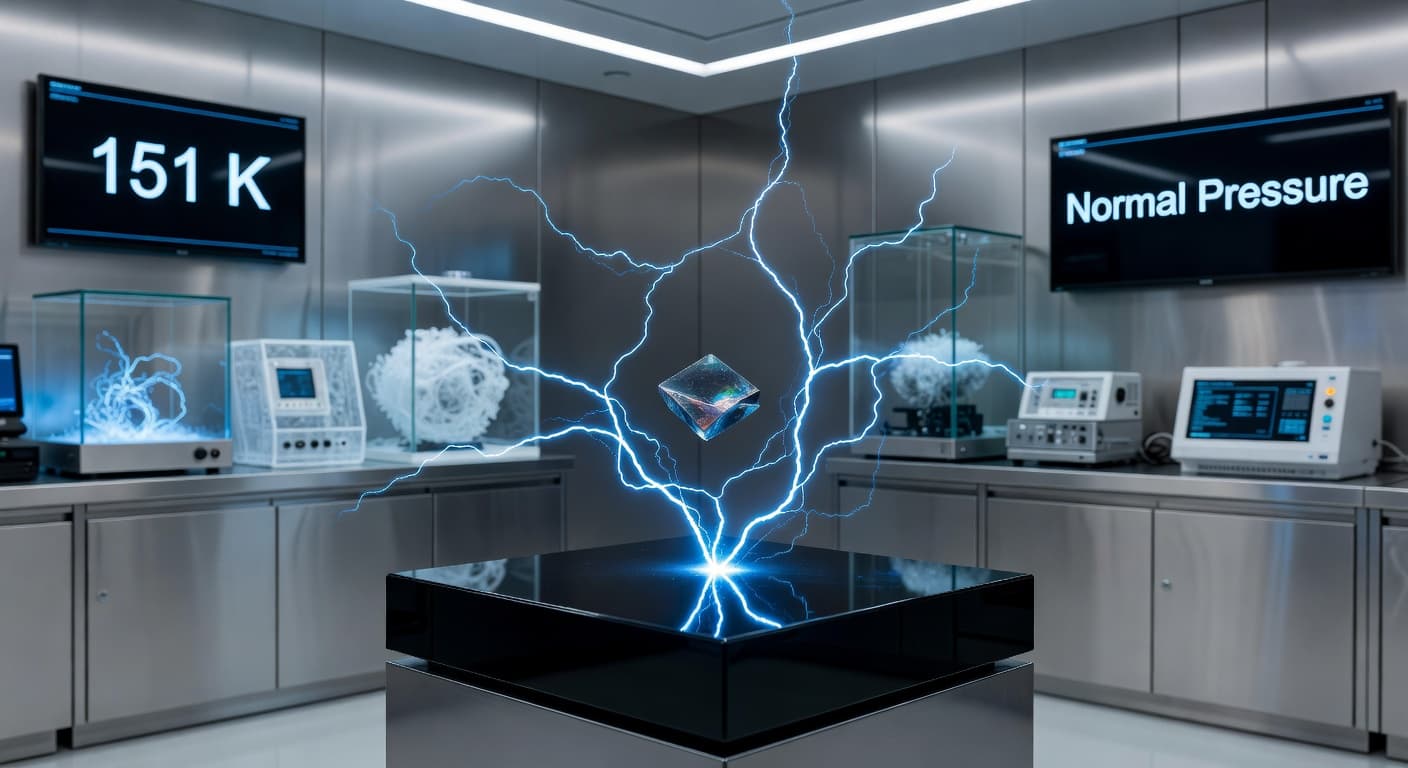
University of Houston scientists have achieved a groundbreaking superconductivity record at 151 Kelvin under normal pressure, marking a significant leap towards practical, energy-efficient technologies.

A Quantum Leap in Superconductivity Research
Scientists at the University of Houston have announced a monumental achievement in the field of superconductivity, setting a new record by demonstrating superconductivity at an unprecedented 151 Kelvin (-122.15 °C or -188 °F) under normal atmospheric pressure. This groundbreaking discovery moves the scientific community significantly closer to realizing the dream of practical, room-temperature superconductors, which could revolutionize everything from energy transmission to medical imaging and high-speed transportation.
The ability to conduct electricity with zero resistance at temperatures far above previous ambient-pressure records represents a pivotal moment. For decades, the widespread application of superconductors has been hindered by the extreme conditions—either ultra-low temperatures or immense pressures—required for their operation. This new record, achieved under conditions that are readily accessible, unlocks a realm of possibilities previously confined to theoretical discussions.
Understanding Superconductivity and Its Challenges
Superconductivity is a fascinating quantum mechanical phenomenon where certain materials, when cooled below a critical temperature, exhibit absolutely no electrical resistance. This means electricity can flow indefinitely without any energy loss. Additionally, superconductors also expel magnetic fields, a property known as the Meissner effect, which has applications in magnetic levitation.
Historically, achieving superconductivity has been a monumental challenge. Early superconductors required cooling to near absolute zero, typically using expensive and complex liquid helium. More recent high-temperature superconductors (HTS) could operate at liquid nitrogen temperatures (around 77 K), but many of these materials still demanded extremely high pressures, making them impractical for most real-world applications. The University of Houston team's success at 151 K under normal pressure addresses one of the most significant barriers.
The Significance of "Normal Pressure"
The phrase "under normal pressure" is perhaps the most critical aspect of this discovery. Previous records for high-temperature superconductivity often involved subjecting materials to pressures millions of times greater than Earth's atmosphere. Such conditions are incredibly difficult and costly to maintain outside of a laboratory setting, effectively limiting their utility.
By achieving superconductivity at 151 K without the need for extreme compression, the University of Houston researchers have opened the door to a new class of materials or a deeper understanding of existing ones that can operate under more practical circumstances. This is a game-changer for engineering and commercial viability, as it drastically reduces the complexity and cost associated with implementing superconducting technologies.
Potential Applications: A Glimpse into the Future
The implications of this breakthrough are vast and could reshape numerous industries. The ability to transmit electricity without loss would be transformative for global energy infrastructure, leading to significant reductions in energy waste and a more sustainable future. Consider the following potential applications:
- Lossless Power Grids: Eliminating energy loss during transmission, making electricity delivery far more efficient.
- Advanced Medical Imaging: More powerful and compact MRI machines that are cheaper to operate.
- High-Speed Transportation: Efficient maglev trains that float above tracks, consuming less energy and reaching higher speeds.
- Enhanced Computing: Faster, more powerful microchips and components for classical and quantum computing.
- Fusion Energy: Stronger magnetic fields for confining plasma, crucial for developing clean fusion power.
The Road Ahead: Challenges and Next Steps
While the 151 K record under normal pressure is a monumental step, the journey towards widespread application is not over. The specific material used, its stability, and scalability for manufacturing remain key areas of ongoing research. Scientists will now focus on understanding the fundamental mechanisms behind this high-temperature, ambient-pressure superconductivity, aiming to discover even warmer superconductors or to make the current materials more robust and easier to produce.
This achievement by the University of Houston team underscores the relentless pursuit of scientific innovation. It provides renewed optimism that the long-sought goal of room-temperature superconductivity, once considered science fiction, is increasingly within reach. The world watches with anticipation as this field continues to push the boundaries of what's possible, promising a future powered by unparalleled efficiency and technological advancement.
How this article was made
- Sources
- ScienceDaily
- Generated on:
- May 30, 2026
This content is produced by Acerbo.AI's AI editorial pipeline: source gathering, rewriting and imagery are automated. Editorial oversight stays human.
Related Articles
Superconductivity Breakthrough: New Material Achieves Record 151 K at Normal Pressure
Scientists have achieved a monumental breakthrough in superconductivity, discovering a material that conducts electricity without resistance at an unprecedented 151 Kelvin under normal atmospheric pressure, smashing previous records and bringing practical applications closer.

Quantum Leap: Scientists Unlock New Control Over Superconductivity
A groundbreaking discovery reveals how microscopic imperfections and atomic vibrations can precisely control superconductivity, paving the way for revolutionary quantum technologies.

Quantum Leap: Scientists Observe Metal Lump in Two Places Simultaneously, Shattering Records
Scientists have achieved a record-breaking quantum experiment, observing a tiny metal object existing in two distinct locations at once. This breakthrough pushes the limits of quantum mechanics.