
AI's Monumental Leap: Cracking One of Science's Most Enduring Mathematical Riddles
A groundbreaking AI system has achieved a monumental feat, reportedly solving a complex mathematical problem that has baffled scientists for decades, heralding a new era of discovery.
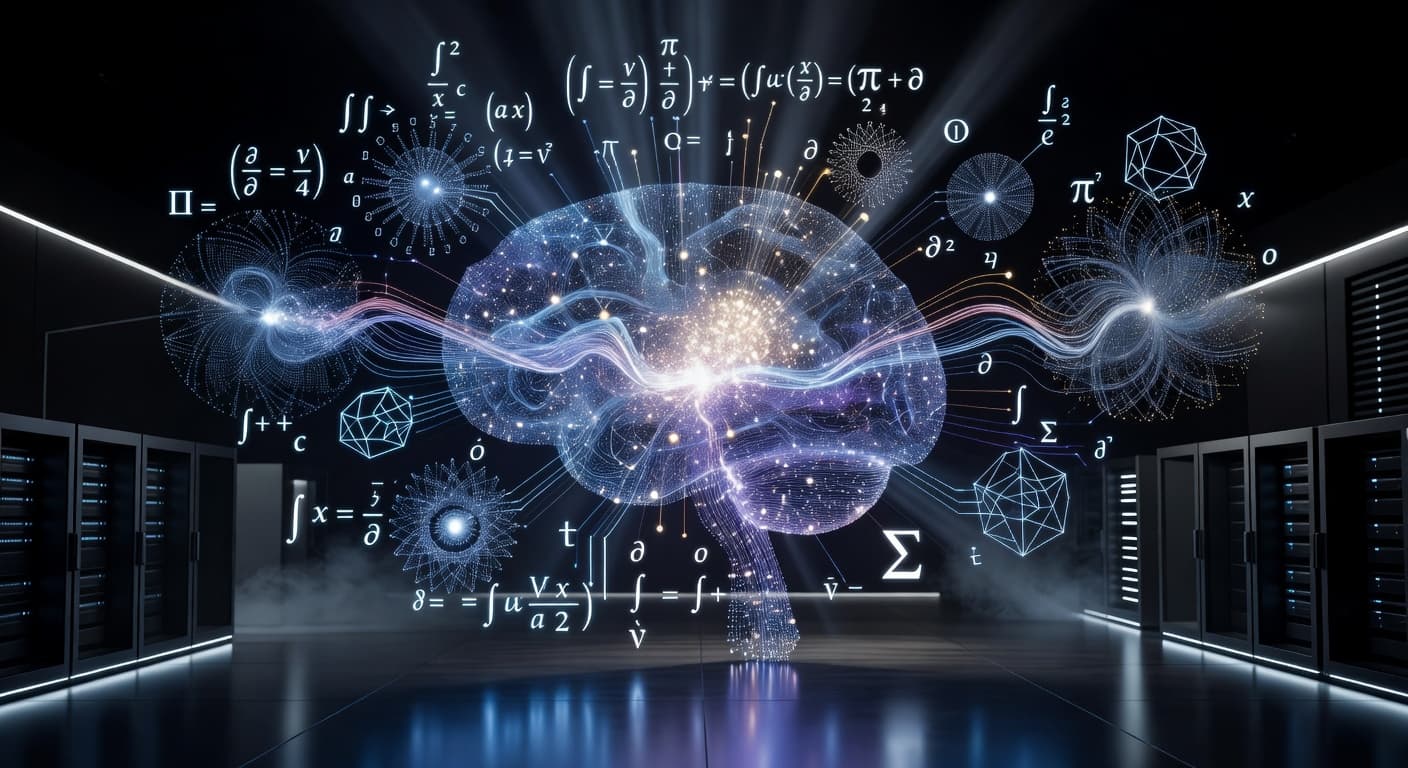
A New Dawn for Scientific Discovery: AI Unlocks Ancient Secrets
In a development poised to redefine the boundaries of human knowledge, artificial intelligence has reportedly achieved a monumental breakthrough, successfully solving one of science's most challenging and long-standing mathematical problems. This isn't merely an incremental step; it's a profound leap forward, demonstrating AI's burgeoning capacity to tackle abstract, foundational issues that have confounded the brightest human minds for decades, if not centuries. The implications for scientific research, technological innovation, and our fundamental understanding of the universe are nothing short of revolutionary.
The Enigma That Baffled Generations
The problem, often described as a cornerstone of theoretical mathematics, presented an intricate web of variables and complex relationships, resisting conventional analytical methods and immense computational power. Its solution has been sought by mathematicians and physicists alike, as it holds the key to unlocking deeper insights across various scientific disciplines. For years, progress was slow, marked by incremental advances and numerous dead ends, reinforcing its reputation as an insurmountable intellectual barrier.
How AI Rewrote the Rulebook
The breakthrough was reportedly achieved by a novel AI architecture developed by a leading research consortium. Unlike previous attempts that relied on brute-force computation or human-guided heuristic searches, this new system employed a sophisticated blend of deep learning, symbolic reasoning, and advanced pattern recognition. It was able to:
- Identify hidden structures: Uncovering subtle patterns and connections within vast datasets that eluded human perception.
- Generate novel hypotheses: Proposing entirely new mathematical frameworks and conjectures.
- Validate proofs autonomously: Systematically testing and verifying complex proofs with unprecedented speed and accuracy.
- Bridge disparate fields: Drawing insights from seemingly unrelated areas of mathematics and computer science.
This innovative approach allowed the AI to navigate an immense solution space, ultimately converging on a proof that is both elegant and robust, marking a significant departure from traditional problem-solving methodologies.
Profound Implications for Science and Beyond
The successful resolution of this mathematical enigma opens floodgates for advancements across numerous scientific fields. In theoretical physics, it could lead to new models of the universe or unified field theories. For material science, it might enable the discovery of novel compounds with unprecedented properties. Biologists could gain new tools for understanding complex biological systems, from protein folding to genetic interactions. The ripple effect of such a foundational discovery is truly immense, promising to accelerate research in ways previously unimaginable.
Beyond the Abstract: Real-World Applications
While the problem itself is highly abstract, its solution could have tangible real-world benefits. The underlying principles and methodologies developed by the AI could be adapted to solve other complex optimization challenges in engineering, logistics, and finance. Imagine more efficient drug discovery, unbreakable encryption algorithms, or even entirely new paradigms for artificial intelligence itself. The techniques honed in this pursuit of pure mathematical truth are likely to find practical applications that touch every facet of modern life.
The Future of Human-AI Collaboration
This achievement underscores the increasing power of artificial intelligence not just as a tool, but as a collaborative partner in scientific discovery. It challenges us to rethink the very nature of intelligence and problem-solving, suggesting a future where human intuition and AI's computational prowess combine to tackle humanity's most pressing questions. However, it also raises important considerations about the ethical development and responsible deployment of such powerful systems, ensuring they serve humanity's best interests.
The solving of this elusive mathematical problem stands as a testament to the relentless march of scientific progress and the transformative potential of AI. It signifies a pivotal moment, ushering in an era where the most profound mysteries of the cosmos may finally yield to the combined intellect of humans and machines, paving the way for discoveries we can only begin to imagine.
How this article was made
- Sources
- Crescendo AI
- Generated on:
- May 14, 2026
This content is produced by Acerbo.AI's AI editorial pipeline: source gathering, rewriting and imagery are automated. Editorial oversight stays human.
Related Articles
Revolutionary AI Cracks Long-Standing Mathematical Enigma, Reshaping Scientific Discovery
A groundbreaking AI system has reportedly conquered one of science's most intractable mathematical problems, signaling a monumental leap for artificial intelligence and its potential to accelerate scientific understanding across disciplines.
AI Unleashes New Era of Discovery: Conquers One of Science's Toughest Math Problems
A groundbreaking AI system has reportedly cracked a long-standing mathematical enigma, a feat previously thought impossible. This breakthrough promises to redefine scientific research and technological advancement.
AI Deciphers Decades-Old Math Enigma, Unlocking New Scientific Frontiers
A groundbreaking AI system has reportedly cracked a complex mathematical problem that has stumped human researchers for decades, promising to revolutionize fields from logistics to drug discovery.