
Cosmic Revelation: Have Scientists Finally Glanced at Dark Matter?
A recent scientific development suggests researchers may have detected dark matter, the universe's most enigmatic substance. This potential breakthrough could redefine cosmology and particle physics.
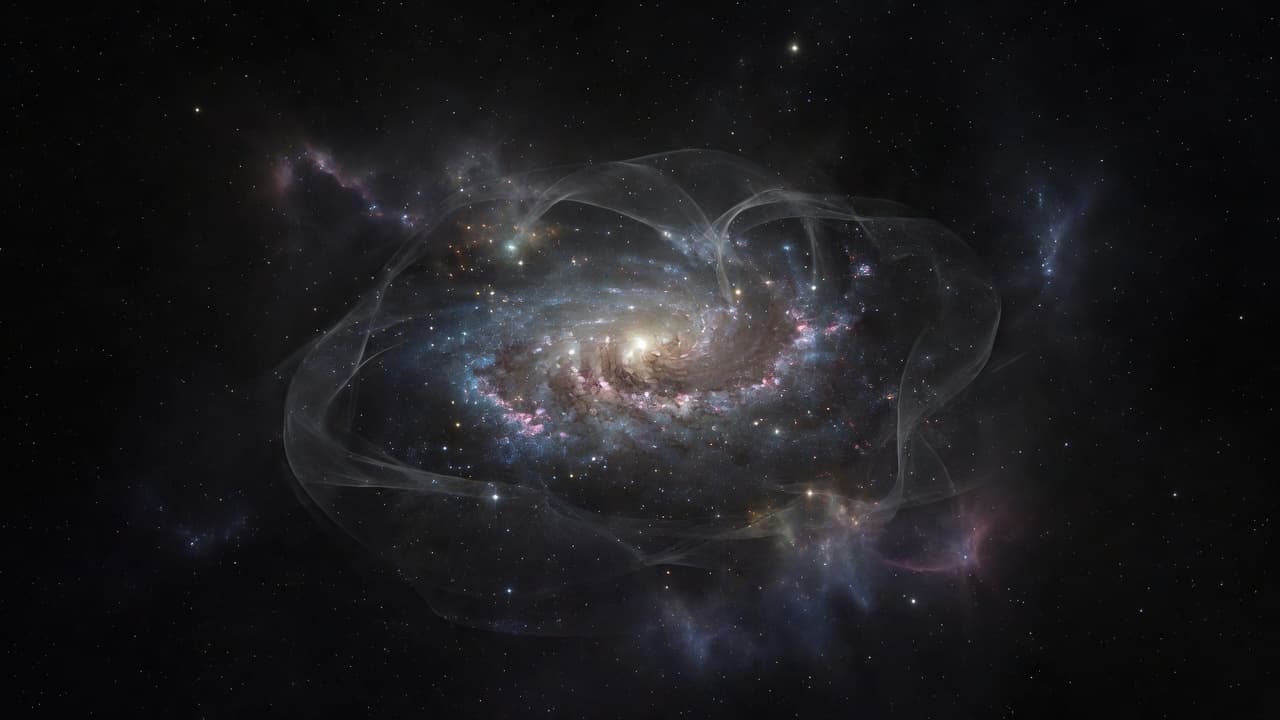
The Universe's Greatest Enigma: A Glimmer of Dark Matter?
For decades, dark matter has loomed as the universe's most profound ghost – an invisible, mysterious substance that makes up an astounding 27% of the cosmos, yet remains undetectable by conventional means. It's the silent architect, gravitationally binding galaxies and structures without ever emitting, absorbing, or reflecting light. Now, a tantalizing new development suggests that scientists may have, for the first time, caught a fleeting glimpse of this elusive entity. If confirmed, this potential breakthrough would mark a monumental shift in our understanding of the universe, opening doors to physics beyond our current comprehension.
What Exactly Is Dark Matter?
To grasp the significance of a potential detection, it's crucial to understand what dark matter is – and isn't. It's not ordinary matter (baryonic matter) like protons and neutrons that form stars, planets, and ourselves. Instead, it's a form of non-baryonic matter that interacts only through gravity and, perhaps, the weak nuclear force. This lack of electromagnetic interaction is why it's invisible; it doesn't interact with light, making it impossible to directly observe with telescopes.
Its existence is inferred from its gravitational effects on visible matter. Galaxies spin faster than they should based on their visible mass, and galaxy clusters exhibit gravitational lensing effects that require far more mass than can be accounted for by stars and gas. Dark matter provides the missing gravitational glue, forming immense "halos" around galaxies that dictate their structure and evolution.
The Elusive Hunt for the Invisible
The quest to directly detect dark matter has been one of the most challenging endeavors in modern physics. Scientists have built highly sensitive detectors, often deep underground to shield them from cosmic rays, hoping to observe a rare interaction between a dark matter particle and an atomic nucleus. These experiments typically search for Weakly Interacting Massive Particles (WIMPs), a leading theoretical candidate for dark matter, which would produce a tiny recoil detectable by specialized sensors.
Other approaches include indirect detection, looking for products of dark matter particles annihilating or decaying in space (like gamma rays or neutrinos), and collider experiments, attempting to produce dark matter particles in powerful accelerators like the Large Hadron Collider.
A Potential Breakthrough: What Does "Seeing" Mean?
When scientists say they "may have seen" dark matter, it doesn't imply a visual observation. Instead, it refers to a specific, subtle signal detected by an experiment that aligns with theoretical predictions for dark matter interactions. This could be an unexpected energy signature, a particular recoil event, or a statistical anomaly that deviates from known background noise. Such an event would be incredibly rare and difficult to distinguish from other particle interactions.
The challenge lies in rigorously verifying that any such signal is indeed from dark matter and not from mundane sources or experimental artifacts. This often involves years of data collection, meticulous analysis, and independent confirmation from multiple experiments. The scientific community operates on a high standard of proof, especially for a discovery of this magnitude.
The Profound Implications of a Discovery
If the detection of dark matter is confirmed, the ramifications for science would be immense:
- Revolutionizing Particle Physics: It would confirm the existence of particles beyond the Standard Model, opening up an entirely new sector of physics.
- Unlocking Cosmology: Our understanding of the universe's formation, evolution, and ultimate fate would become much clearer.
- New Technologies: Understanding dark matter could potentially lead to unforeseen technological advancements, much like our understanding of electromagnetism did.
- Solving Cosmic Mysteries: Many outstanding puzzles, from galaxy rotation curves to the large-scale structure of the cosmos, would finally find their definitive answer.
The Road Ahead: Verification and Beyond
While the prospect of a dark matter detection is incredibly exciting, caution and rigorous scientific scrutiny are paramount. The journey from a potential signal to a confirmed discovery is often long and arduous, requiring independent verification and the elimination of all other possible explanations. However, the mere possibility invigorates the global scientific community, pushing the boundaries of human knowledge.
The quest for dark matter exemplifies humanity's insatiable curiosity about the universe. Whether this recent hint leads to the definitive answer or just another step in a longer journey, the pursuit continues, promising to unveil some of the universe's deepest secrets and forever alter our cosmic perspective.
How this article was made
- Sources
- Science News
- Rewriting model:
- gemini-2.5-flash
- Image generated with:
- xAI Grok
- Generated on:
- 5d ago
This content is produced by Acerbo.AI's AI editorial pipeline: source gathering, rewriting and imagery are automated. Editorial oversight stays human.
Related Articles

Quantum Mystery Deepens: CERN Uncovers Unprecedented Gluon Behavior
CERN scientists have observed gluons, the fundamental particles binding atomic nuclei, exhibiting unexpected behavior deep within matter, challenging long-held theories of the strong nuclear force.
Unveiling the Invisible: Your $100 Gateway to Cosmic Mysteries
Scientists have developed an incredibly affordable particle detector, costing just $100, that allows anyone to observe cosmic rays raining down from space, opening new avenues for citizen science and education.
Cosmic Breakthrough: Scientists Witness the Birth of a Magnetar, the Universe's Strongest Magnet, for the First Time
A monumental discovery in astrophysics as scientists observe the formation of a magnetar, validating general relativity's predictions and opening new frontiers in understanding cosmic extremes.