
Cosmic Detective Work: Second-Generation Planet Cracks Hubble's Long-Standing Mystery
Astronomers have unveiled a groundbreaking discovery: a 'second-generation' exoplanet whose unique formation mechanism provides the missing link to solve a perplexing cosmic enigma observed by the Hubble Space Telescope for years.
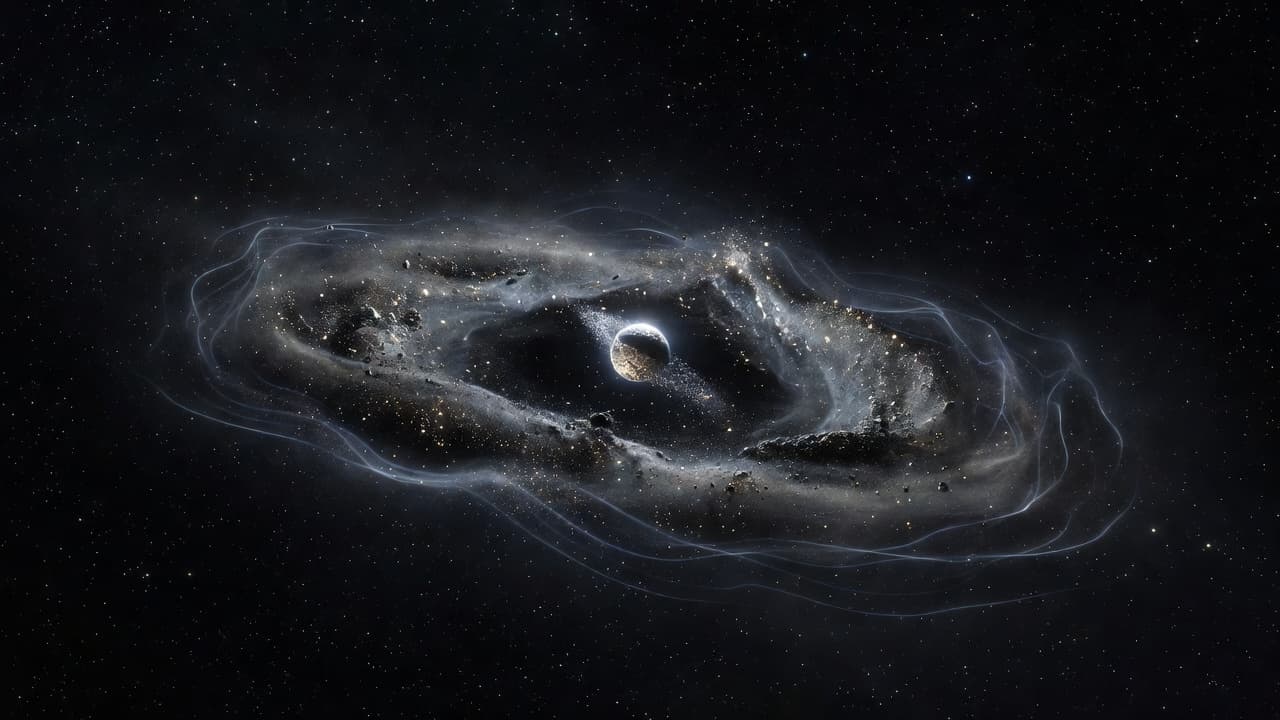
Hubble's Enduring Enigma: A Cosmic Cold Case
For decades, the Hubble Space Telescope has been humanity's eye on the cosmos, unveiling wonders and mysteries alike. Among its most perplexing observations was a peculiar, fluctuating debris disk surrounding a white dwarf star, designated WD 1856+534. This particular stellar remnant, the dense core of a star that once resembled our Sun, exhibited strange light curve variations that hinted at ongoing, dynamic processes within its immediate vicinity. Scientists had theorized various explanations, from asteroid collisions to exotic cometary activity, but none fully resolved the enduring enigma.
The erratic dimming and brightening patterns, meticulously recorded by Hubble over many years, presented a significant challenge to astrophysicists. It was a cosmic cold case, a puzzle with insufficient pieces, leaving researchers to ponder the true nature of the material orbiting a stellar corpse. This phenomenon defied conventional models of post-stellar evolution and planet formation around white dwarfs, pushing the boundaries of what we understood about the universe's recycling mechanisms.
Unveiling a "Second-Generation" World
Born from Cosmic Ashes: A New Class of Exoplanet
In a groundbreaking announcement from NASA, a team of international astronomers has finally provided the missing piece to this long-standing puzzle: the detection of a 'second-generation' planet. This extraordinary exoplanet, now named WD 1856b, stands apart from its peers. Unlike planets that form in the primordial gas and dust disks around young, vibrant stars, WD 1856b is believed to have coalesced from the very remnants of its star's violent death throes.
As WD 1856+534 exhausted its nuclear fuel, it expanded into a red giant, engulfing and destroying any inner planets in its path. Later, it shed its outer layers to become a compact white dwarf. The material from these destroyed planets, along with remaining gas and dust, then reformed into a new planetary body. This process, where a planet is essentially 'reborn' from cosmic ashes, represents a fascinating and rare pathway for planetary genesis, challenging our traditional understanding of how worlds come into being.
The Breakthrough: Connecting the Cosmic Dots
A New Perspective on an Old Puzzle
The discovery of WD 1856b, confirmed through meticulous observations and advanced spectral analysis, offers a compelling explanation for the white dwarf's puzzling debris disk. Scientists now believe that the fluctuating light curves observed by Hubble were not merely random asteroid impacts, but rather the gravitational influence and ongoing interaction of this newly formed, second-generation planet with the surrounding stellar debris.
The planet's orbit, its estimated size, and its unique composition align perfectly with the observed anomalies. It suggests that WD 1856b is actively clearing out or perturbing the debris disk, causing the very variations that baffled astronomers for so long. This cosmic ballet of a planet shaping its environment, even in the extreme conditions around a dead star, provides a definitive resolution to Hubble's persistent cold case.
Implications for Planetary Science
Rewriting Planetary Genesis and Stellar Evolution
This discovery has profound implications for astrophysics and our understanding of planet formation. It demonstrates that planets can not only survive the dramatic death of their host stars but can also *form anew* from the resulting chaos. This opens up entirely new avenues for research into exoplanet diversity and the potential for life in systems far beyond our solar system, even around white dwarfs previously thought too hostile for planetary rebirth.
The existence of second-generation planets suggests a more resilient and dynamic universe than previously imagined. It expands the habitable zone concept, potentially including regions around white dwarfs where planets could sustain liquid water and, consequently, life, for billions of years. This finding encourages scientists to re-examine other mysterious stellar phenomena with a fresh perspective, seeking similar 'reborn' worlds.
The Future of Cosmic Exploration
As new observatories like the James Webb Space Telescope continue to push the boundaries of astronomical detection, discoveries like WD 1856b will become more frequent. This breakthrough underscores the power of long-term observation and the ingenuity of scientific inquiry. It reminds us that the universe is full of surprises, constantly challenging our assumptions and expanding our cosmic horizons, paving the way for even more astonishing revelations about planetary systems far from our own.
How this article was made
- Sources
- NASA Science
- Rewriting model:
- gemini-2.5-flash
- Image generated with:
- xAI Grok
- Generated on:
- 1d ago
This content is produced by Acerbo.AI's AI editorial pipeline: source gathering, rewriting and imagery are automated. Editorial oversight stays human.
Related Articles
Cosmic Time Capsule: Students Uncover Universe's Most Pristine Star
Astronomy students have made an astonishing discovery: the most pristine star ever found, offering an unprecedented glimpse into the early universe's composition.
JWST Stuns Scientists: Ice Clouds Found on Distant Giant Exoplanet
The James Webb Space Telescope has made a groundbreaking discovery, detecting clear evidence of ice clouds high in the atmosphere of a massive exoplanet. This finding provides unprecedented insights into alien weather systems and planetary formation.
JWST Uncovers Mysterious 'Red Dots': Glimpse of Universe's First Stars on Brink of Cosmic Collapse?
The James Webb Space Telescope has unveiled enigmatic 'little red dots' in the distant cosmos, believed by scientists to be the universe's earliest stars or proto-galaxies, poised at a critical evolutionary juncture. This groundbreaking discovery offers an unprecedented look into the dawn of cosmic history.