
Enceladus's Icy Blasts: New Discoveries Reveal a Stranger, More Complex Ocean World
Recent scientific findings reveal that the icy plumes erupting from Saturn's moon Enceladus are far more complex and dynamic than previously imagined, deepening its allure as a potential abode for life.
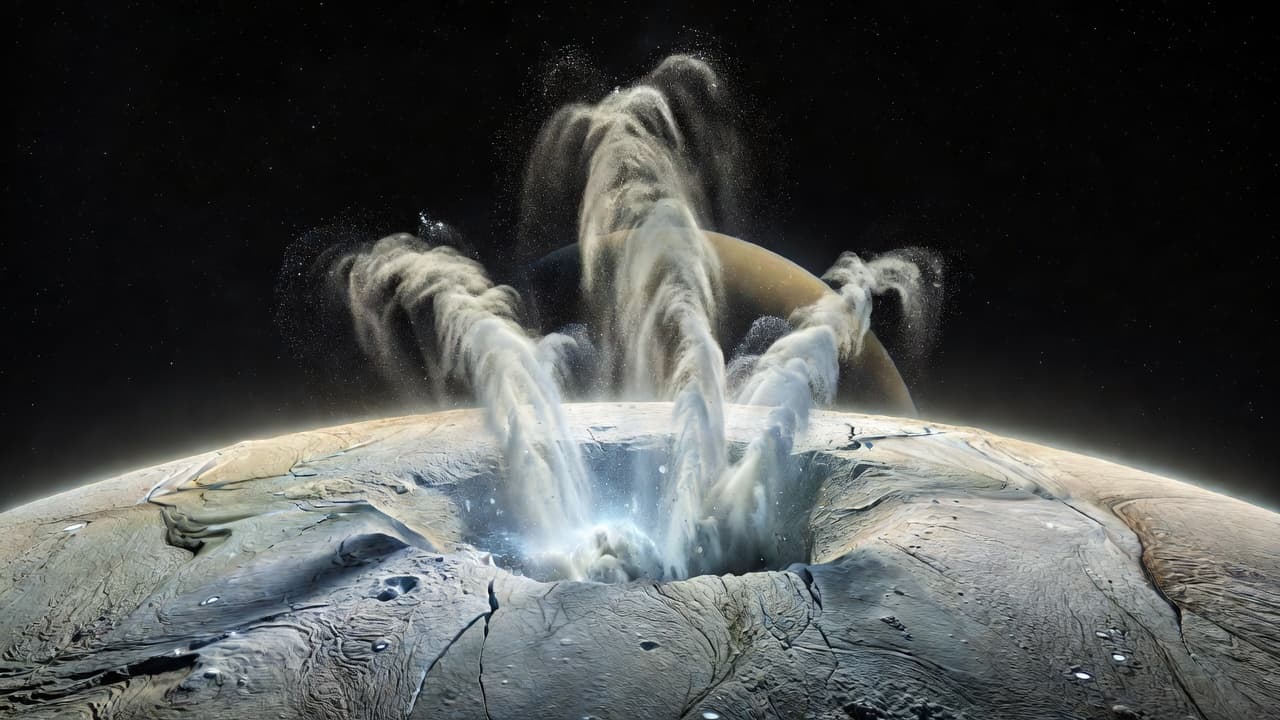
Enceladus: Saturn's Sparkling Enigma
For years, Saturn’s tiny moon Enceladus has captivated scientists with its spectacular geysers, spewing jets of ice and water vapor into space. These plumes, first observed by NASA’s Cassini spacecraft, are direct evidence of a vast, subsurface ocean beneath the moon's frozen crust. Initially, these icy blasts were understood as a relatively straightforward process, but new research is revealing a far more complex and dynamic reality, making Enceladus stranger – and more intriguing – than ever before.
The implications of these fresh discoveries are profound, reshaping our understanding of ocean worlds and significantly bolstering Enceladus’s status as a prime candidate in the search for extraterrestrial life. What was once seen as a relatively predictable phenomenon now appears to be a window into a tumultuous, chemically active environment.
Unraveling the Plume's Mysterious Composition
Scientists initially analyzed the plumes primarily for water ice and simple organic molecules. However, advanced re-analysis of Cassini data and new modeling techniques are uncovering a much richer chemical cocktail. Researchers are now finding evidence of more complex organic compounds, as well as a greater variability in the particle sizes and velocities within the plumes.
- Complex Organics: Beyond simple methane and carbon dioxide, the plumes contain heavier, more intricate organic molecules. This suggests more complex chemical reactions occurring within Enceladus's ocean, potentially fueled by hydrothermal activity.
- Dynamic Eruptions: The plumes are not static. Their intensity and composition appear to fluctuate, hinting at dynamic processes within the ocean or even shifts in the moon's internal heat.
- Unexpected Salts: The presence of certain salts in varying concentrations points to different types of rock-water interactions at the seafloor, possibly indicating diverse hydrothermal vent systems.
A More Active and Habitable Ocean?
The heightened complexity of Enceladus's plumes suggests an underlying ocean that is far more active and potentially more habitable than previously assumed. An ocean with diverse chemical pathways and dynamic energy sources significantly increases the chances of supporting microbial life.
These findings reinforce the hypothesis that Enceladus possesses hydrothermal vents on its seafloor, similar to those found in Earth's deep oceans. On Earth, these vents are teeming with unique ecosystems that thrive without sunlight, relying instead on chemical energy. If Enceladus has similar vents, the enriched chemistry in its plumes could be the byproduct of these life-sustaining environments.
The Search for Life Intensifies
Enceladus has long been considered one of the most promising locations in our solar system for astrobiology. The combination of liquid water, a heat source, and organic molecules fulfills key requirements for life. The revelation that its plumes are even more chemically diverse and dynamic only strengthens this conviction.
Scientists are now planning future missions, such as orbiters or even landers, designed to directly sample these plumes or even explore the surface near the vents. These missions would provide invaluable data, potentially confirming the presence of complex biological molecules or even microbial life itself.
Future Frontiers in Space Exploration
The ongoing revelations about Enceladus underscore the vast unknowns that still exist within our own cosmic backyard. What began as a discovery of simple ice geysers has evolved into a compelling narrative of a vibrant, chemically active ocean world. Each new piece of data from these icy blasts pushes the boundaries of our understanding, not just of Enceladus, but of the potential for life beyond Earth.
As we continue to decode the messages carried by these alien plumes, Enceladus stands as a beacon of hope and curiosity, urging humanity to delve deeper into the mysteries of the cosmos and perhaps, find answers to the most profound questions about our place in the universe.
How this article was made
- Sources
- ScienceDaily
- Rewriting model:
- gemini-2.5-flash
- Image generated with:
- xAI Grok
- Generated on:
- Sep 29, 2026
This content is produced by Acerbo.AI's AI editorial pipeline: source gathering, rewriting and imagery are automated. Editorial oversight stays human.
Related Articles
Unearthing Ancient Secrets: 'Elephant Skin' Rocks Reveal Primeval Life in the Abyss
Deep beneath the waves, scientists have uncovered 'elephant skin' rocks, bizarre geological formations now revealing fossilized remnants of ancient microbial life thriving in Earth's dark, abyssal plains.

JWST Stuns Scientists: Ice Clouds Found on Distant Giant Exoplanet
The James Webb Space Telescope has made a groundbreaking discovery, detecting clear evidence of ice clouds high in the atmosphere of a massive exoplanet. This finding provides unprecedented insights into alien weather systems and planetary formation.

Cosmic Leap: First Atmosphere Confirmed on Rocky Habitable Zone Exoplanet
Astronomers have achieved a monumental first: confirming an atmosphere around a rocky exoplanet orbiting within its star's habitable zone, significantly boosting the search for life beyond Earth.