
NASA's Roman Space Telescope Accelerates Launch to September 2026, Promising New Cosmic Revelations
NASA's Nancy Grace Roman Space Telescope is now set to launch earlier in September 2026, accelerating humanity's quest to unravel the mysteries of dark energy, exoplanets, and the universe's grand evolution.
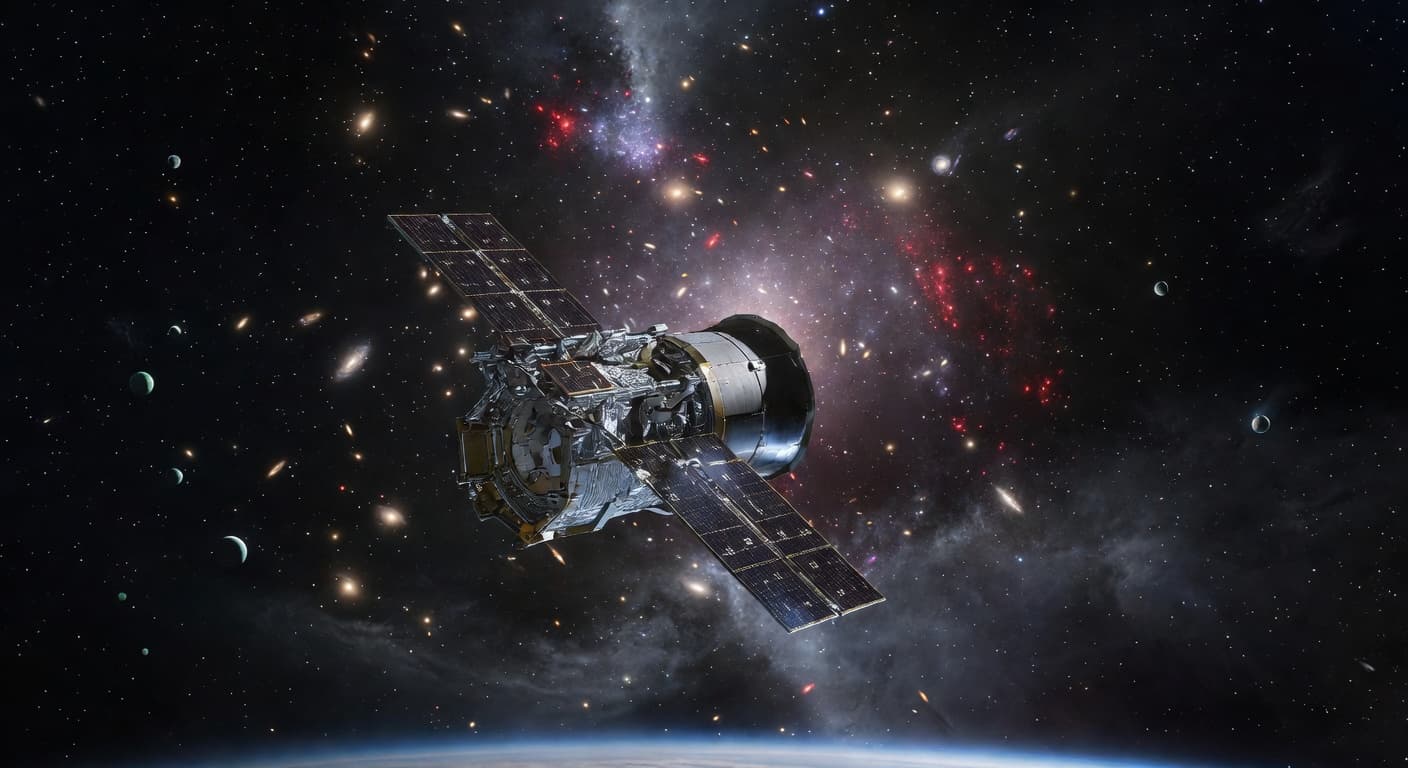
Accelerating Our Cosmic Quest: Roman Telescope Eyes Earlier Launch
In an exciting development for space enthusiasts and astrophysicists alike, NASA’s groundbreaking Nancy Grace Roman Space Telescope is now targeting an accelerated launch window of September 2026. This ambitious schedule brings humanity one step closer to unlocking some of the universe’s most profound secrets, promising a new era of discovery in cosmology and exoplanet research.
The Roman Telescope: A Vision for the Cosmos
Named in honor of Dr. Nancy Grace Roman, often hailed as the "Mother of Hubble," this next-generation observatory is poised to revolutionize our understanding of the cosmos. Unlike its predecessors, Roman boasts a colossal field of view – 100 times larger than the Hubble Space Telescope’s infrared instrument – allowing it to capture vast swathes of the sky in stunning detail. This unparalleled capability is crucial for its primary missions.
Why the Accelerated Launch Matters
The decision to advance the launch date by several months underscores the scientific community’s eagerness to deploy Roman’s unique capabilities. An earlier deployment means sooner access to critical data that could help solve long-standing puzzles about the universe’s expansion, the nature of dark energy, and the prevalence of exoplanets. This acceleration reflects confidence in the project's progress and its potential to deliver transformative science rapidly.
Unveiling the Universe's Deepest Mysteries
Roman’s scientific agenda is multifaceted and ambitious. Its primary goals include:
- Mapping Dark Energy: By observing billions of galaxies over cosmic time, Roman will create the largest-ever surveys of the universe, helping scientists understand the mysterious force accelerating its expansion.
- Discovering Exoplanets: Using the gravitational microlensing technique, it will search for thousands of exoplanets, including those similar in size to Earth, in orbits farther from their stars than current methods allow.
- Probing Galaxy Evolution: Its wide-field infrared vision will enable detailed studies of galaxy formation and evolution across billions of years, providing insights into how structures in the universe grew.
These investigations are critical to completing our cosmic census and refining our models of the universe.
Technological Marvels Aboard
At the heart of Roman's power is its 2.4-meter primary mirror, identical in size to Hubble’s, coupled with its Wide Field Instrument (WFI). The WFI is equipped with a 18-megapixel infrared camera, designed to capture sharp images over a vast area. Additionally, Roman carries a Coronagraph Instrument, a technology demonstration designed to directly image exoplanets and characterize their atmospheres by blocking out the glare of their host stars. While a tech demo, it paves the way for future exoplanet imaging missions.
A Legacy of Discovery Continues
Dr. Nancy Grace Roman’s pioneering work laid the foundation for space-based astronomy. With this telescope bearing her name, her legacy of pushing the boundaries of discovery continues. The Roman Space Telescope represents not just a new instrument, but a commitment to bold exploration and the pursuit of knowledge that defines humanity’s scientific endeavor.
Looking Ahead: A New Dawn for Astrophysics
The impending launch of the Nancy Grace Roman Space Telescope in September 2026 marks a pivotal moment for astrophysics. Its unique capabilities will complement and extend the observations made by other powerful observatories like the James Webb Space Telescope and Euclid, providing a panoramic view of the infrared universe. As we anticipate its journey into space, the scientific community is buzzing with excitement over the unprecedented data and profound insights Roman is set to deliver, promising to reshape our understanding of the cosmos for decades to come.
How this article was made
- Sources
- ScienceDaily
- Generated on:
- May 19, 2026
This content is produced by Acerbo.AI's AI editorial pipeline: source gathering, rewriting and imagery are automated. Editorial oversight stays human.
Related Articles
NASA's Roman Telescope: Unlocking the Secret of Millions of Invisible Neutron Stars
NASA's Roman Space Telescope will unveil millions of invisible neutron stars, revolutionizing our understanding of stellar evolution and the Milky Way's hidden mass with its powerful infrared vision.

2026: A Landmark Year for Scientific Breakthroughs and Major Experiments
Get ready for 2026, a pivotal year poised to witness groundbreaking scientific experiments across space, medicine, AI, and climate research, shaping our future.

2026: The Year Humanity's Boldest Scientific Experiments Take Center Stage
Prepare for a monumental year in science! 2026 is forecasted to be a period of groundbreaking experiments, from deep space exploration to AI and health breakthroughs, poised to reshape our future.