
Quantum Mystery Deepens: CERN Uncovers Unprecedented Gluon Behavior
CERN scientists have observed gluons, the fundamental particles binding atomic nuclei, exhibiting unexpected behavior deep within matter, challenging long-held theories of the strong nuclear force.
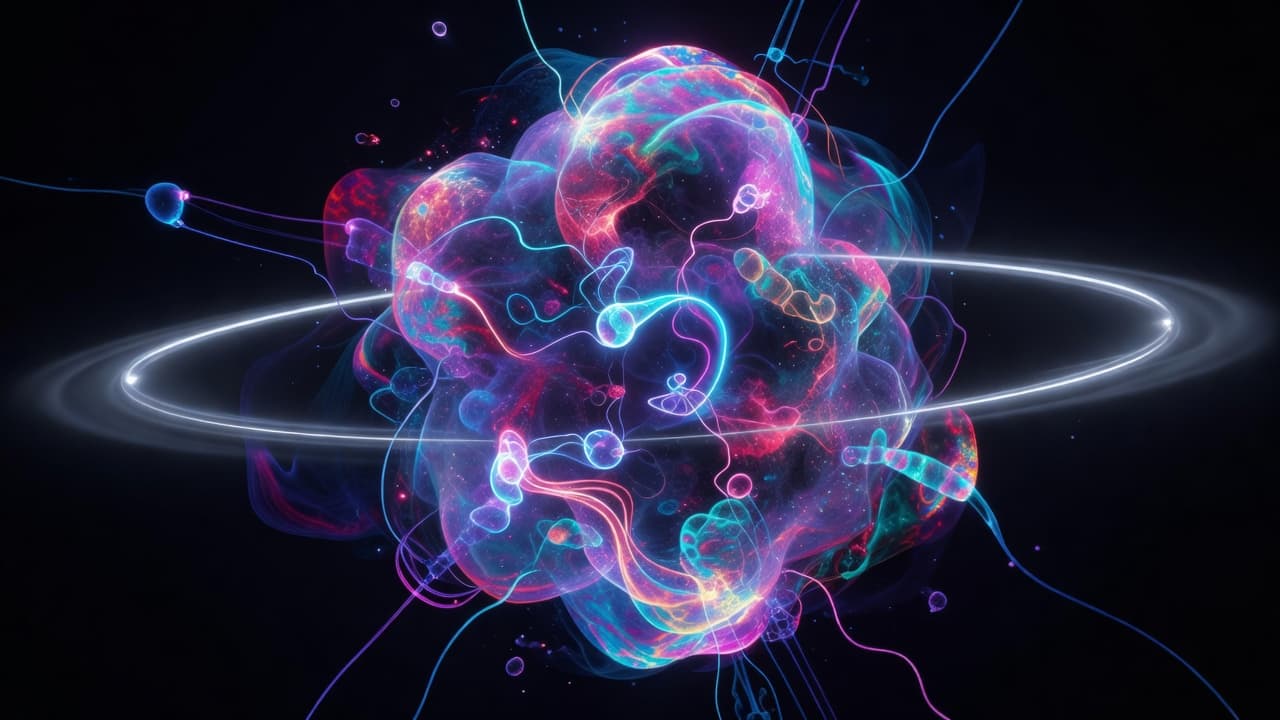
Unraveling the Quantum Enigma: A Glimpse into the Atomic Heart
In the intricate tapestry of the universe, where invisible forces dictate the very fabric of reality, scientists at CERN, the European Organization for Nuclear Research, have once again pushed the boundaries of our understanding. Deep within the chaotic heart of atomic nuclei, they've made a startling discovery: gluons, the fundamental particles responsible for the strongest force in nature, are behaving in ways that defy current theoretical predictions. This groundbreaking observation promises to reshape our view of matter at its most fundamental level.
The Unseen Architects of Matter: What Are Gluons?
To appreciate the significance of this finding, one must first understand the role of gluons. These enigmatic particles are the 'glue' that binds quarks together to form protons and neutrons – the building blocks of all atomic nuclei. They are the force carriers of the strong nuclear force, the most powerful of the four fundamental forces, responsible for holding nuclei stable against the immense electromagnetic repulsion between protons.
Under the well-established theory of Quantum Chromodynamics (QCD), gluons are expected to behave in predictable ways, mediating interactions between quarks and even interacting with themselves. However, the extreme conditions found deep inside atomic nuclei – a realm of immense density and energy – can reveal novel phenomena.
A Quantum Anomaly Deep Within
Using their cutting-edge facilities, CERN researchers conducted experiments that probed the innermost workings of atomic nuclei with unprecedented precision. What they found was a deviation from the expected script. Instead of the predicted distributions and interactions, gluons exhibited
While the specifics of the 'strange behavior' are complex, it suggests that under these extreme conditions, gluons might be interacting more intensely or in different configurations than accounted for by standard QCD calculations. This could point towards phenomena such as gluon saturation, where the density of gluons becomes so high that they effectively 'screen' each other, altering the fundamental interactions.
Challenging the Standard Model of Particle Physics
This unexpected observation is not merely an interesting anomaly; it represents a significant challenge to our existing theoretical framework for describing the strong force. Quantum Chromodynamics has been incredibly successful in explaining the behavior of quarks and gluons in many scenarios, but the new data from CERN indicates that our understanding might be incomplete, particularly in the dense environment of atomic nuclei.
The implications are profound. If our models of gluon behavior need refinement, it could necessitate a re-evaluation of how we understand the very structure of protons and neutrons, and consequently, all visible matter in the universe. It opens a new frontier for theoretical physicists to develop more comprehensive models that can accurately describe these extreme quantum environments.
Peering into the Proton's Heart: Why This Matters
Understanding the strong force is crucial not only for fundamental physics but also for comprehending the universe around us. It impacts our knowledge of the early universe, where matter existed under similar extreme conditions, and helps us model exotic objects like neutron stars, which are essentially giant atomic nuclei held together by the strong force.
The CERN discovery provides invaluable experimental data that will guide the next generation of theoretical developments, potentially leading to a deeper, more complete picture of the cosmos and its fundamental constituents. It underscores the incredible complexity and richness of the quantum realm, where even the most fundamental particles can hold surprising secrets.
The Road Ahead: Future Explorations
This finding marks the beginning, not the end, of an exciting journey. Scientists at CERN and other particle accelerators worldwide will undoubtedly launch further investigations to confirm these observations and explore their full extent. New experiments will be designed to probe these gluon dynamics with even greater precision, aiming to uncover the underlying mechanisms behind their 'strange' behavior.
The collaboration between experimentalists and theorists will be paramount. As new data emerges, theoretical physicists will work to refine QCD, perhaps even developing entirely new theoretical constructs to explain these phenomena. This iterative process of discovery and explanation is the engine of scientific progress.
CERN's latest revelation about the enigmatic behavior of gluons deep inside atomic nuclei is a powerful reminder of how much remains unknown about the universe's fundamental building blocks. It’s a compelling invitation to delve deeper into the quantum world, promising new insights into the strong force, the structure of matter, and perhaps, the very origins of our existence. The quest for knowledge continues, driven by the universe’s endless capacity to surprise us.
How this article was made
- Sources
- ScienceDaily
- Rewriting model:
- gemini-2.5-flash
- Image generated with:
- xAI Grok
- Generated on:
- Sep 12, 2026
This content is produced by Acerbo.AI's AI editorial pipeline: source gathering, rewriting and imagery are automated. Editorial oversight stays human.
Related Articles
Cosmic Cannibals: Astronomers Uncover Two Actively Feeding Supermassive Black Holes in the Early Universe
A groundbreaking discovery reveals two actively feeding supermassive black holes in the universe's nascent stages, challenging theories of cosmic evolution and galaxy formation.
Cosmic Detective Work: Second-Generation Planet Cracks Hubble's Long-Standing Mystery
Astronomers have unveiled a groundbreaking discovery: a 'second-generation' exoplanet whose unique formation mechanism provides the missing link to solve a perplexing cosmic enigma observed by the Hubble Space Telescope for years.
Cosmic Revelation: Have Scientists Finally Glanced at Dark Matter?
A recent scientific development suggests researchers may have detected dark matter, the universe's most enigmatic substance. This potential breakthrough could redefine cosmology and particle physics.