
Scientists Crack the Code of 'Breather' Laser Pulses, Unlocking New Horizons in Light Technology
A recent scientific breakthrough has demystified 'breather' laser pulses, revealing the intricate mechanisms behind their unique, stable oscillations. This discovery promises to revolutionize photonics and optical technologies.
Decoding the Enigma of 'Breather' Laser Pulses
Lasers have revolutionized countless aspects of modern life, from communication to medicine. Yet, even in this well-explored field, certain phenomena continue to baffle scientists. Among these have been the enigmatic 'breather' laser pulses – highly stable, periodically oscillating light patterns that emerge from complex optical systems. For years, their precise operational mechanisms remained a mystery, limiting their potential applications. Now, a groundbreaking scientific endeavor has finally unraveled how these mysterious pulses work, paving the way for unprecedented advancements in light manipulation.
What Exactly Are 'Breather' Laser Pulses?
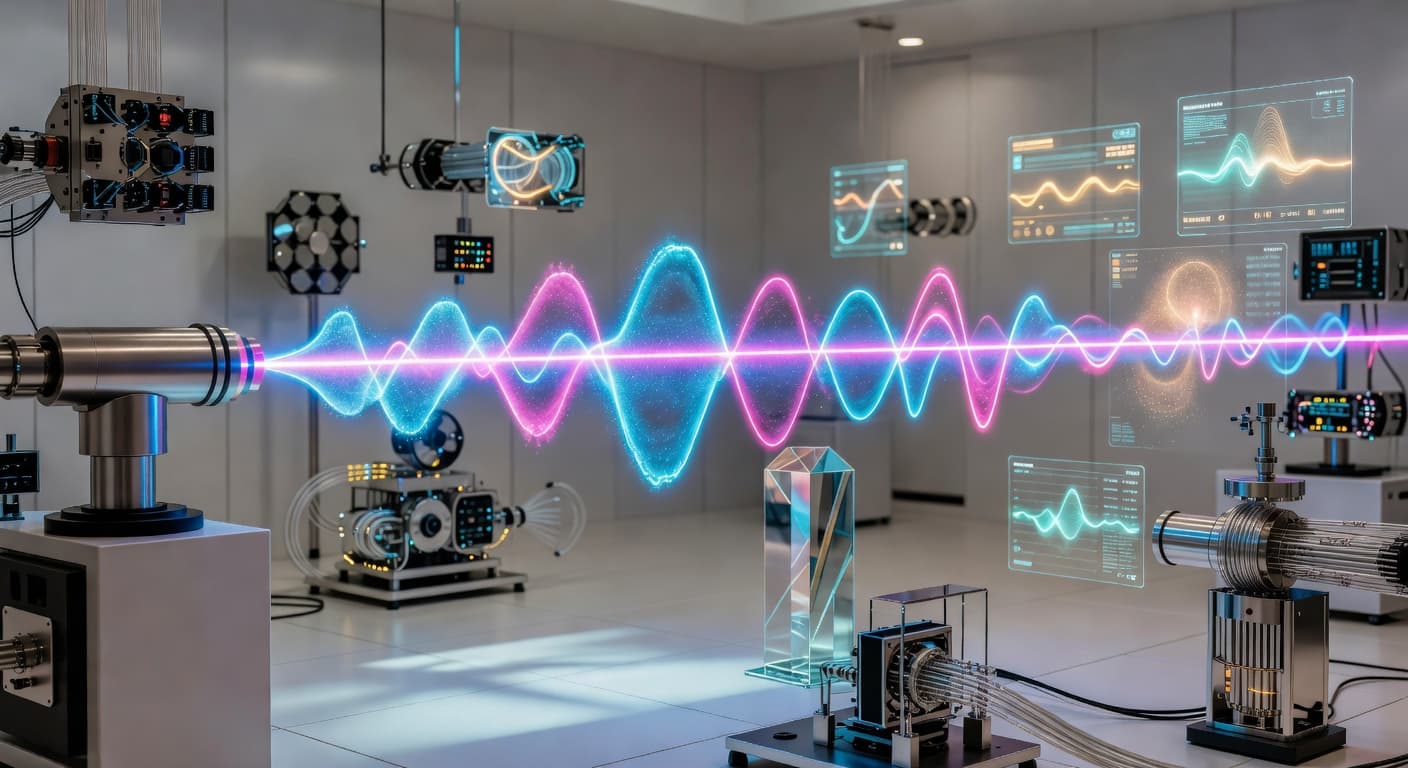
To understand the significance of this discovery, it's crucial to grasp what 'breather' pulses are. Unlike typical laser pulses that maintain a constant shape or simply decay, breathers exhibit a fascinating behavior: they periodically expand and contract, or 'breathe,' while maintaining remarkable stability over time. Imagine a wave that swells and shrinks rhythmically without dissipating – that's the essence of a breather. These unique characteristics arise from complex nonlinear interactions within the laser cavity, making them incredibly difficult to predict and control.
Their stability and peculiar dynamics have long fascinated physicists, suggesting potential for novel applications if only their underlying principles could be fully understood. Previous research had observed these pulses, but a comprehensive theoretical framework explaining their consistent behavior was lacking.
The Breakthrough: Unraveling the Mechanics
The recent breakthrough stems from a meticulous combination of advanced theoretical modeling and sophisticated experimental validation. Scientists developed new mathematical models that precisely describe the intricate interplay of light and matter within the laser system, particularly focusing on the nonlinear optical effects responsible for breather formation. These models allowed researchers to predict the conditions under which breathers would emerge and how their 'breathing' patterns would evolve.
- Advanced Theoretical Framework: New equations captured the complex, self-organizing dynamics.
- Precision Experimentation: State-of-the-art optical setups enabled real-time observation and measurement of breather characteristics, confirming theoretical predictions.
- Identification of Key Parameters: The study pinpointed the critical factors influencing breather stability and periodicity.
This deep understanding revealed that breathers are not merely random fluctuations but rather highly organized, self-sustaining structures governed by specific physical laws. The team successfully demonstrated how subtle adjustments to laser parameters could reliably generate, control, and even manipulate these previously unpredictable pulses.
Implications for Future Technology
The ability to understand and control 'breather' laser pulses opens up a wealth of possibilities across various technological sectors. Their inherent stability and unique temporal dynamics make them ideal candidates for next-generation applications:
- High-Speed Data Transmission: Breathers could enable more robust and efficient transfer of information over optical fibers, crucial for the ever-increasing demands of the internet.
- Precision Sensing and Metrology: Their stable, periodic nature could lead to ultra-sensitive sensors for medical diagnostics, environmental monitoring, or industrial inspection.
- Advanced Material Processing: Controlled breather pulses might offer new ways to sculpt materials with unprecedented precision, impacting manufacturing and nanotechnology.
- Fundamental Photonics Research: The insights gained deepen our understanding of nonlinear optics, inspiring further exploration into complex light phenomena.
A New Era of Light Manipulation
The unraveling of 'breather' laser pulses marks a significant milestone in laser physics and photonics. By demystifying these peculiar light forms, scientists have not only solved a long-standing puzzle but also equipped engineers and researchers with powerful new tools. This breakthrough promises to usher in a new era of light manipulation, where complex optical phenomena can be harnessed with precision, leading to innovations that were once confined to the realm of science fiction. The future of light technology just got a whole lot brighter.
How this article was made
- Sources
- ScienceDaily
- Generated on:
- May 24, 2026
This content is produced by Acerbo.AI's AI editorial pipeline: source gathering, rewriting and imagery are automated. Editorial oversight stays human.
Related Articles
Unraveling the Enigma: Scientists Finally Decode 'Breather' Laser Pulses
A major breakthrough in nonlinear optics has allowed scientists to finally understand and predict the mysterious behavior of 'breather' laser pulses, opening doors for advanced light technologies.

Breakthrough: Scientists Master Light in Ultra-Thin Nanoscale Layers
Scientists have achieved an unprecedented feat: trapping light within a layer incredibly thin, roughly 1,000 times narrower than a human hair. This innovation promises to revolutionize optical technologies.
Revolutionary Breakthrough: Scientists Trap Light Without Metals, Unlocking Future Tech
Physicists have achieved an unprecedented feat, discovering a novel method to confine light beyond traditional limits without relying on metals, paving the way for next-generation optical technologies.