
Unraveling the Enigma: Scientists Finally Decode 'Breather' Laser Pulses
A major breakthrough in nonlinear optics has allowed scientists to finally understand and predict the mysterious behavior of 'breather' laser pulses, opening doors for advanced light technologies.
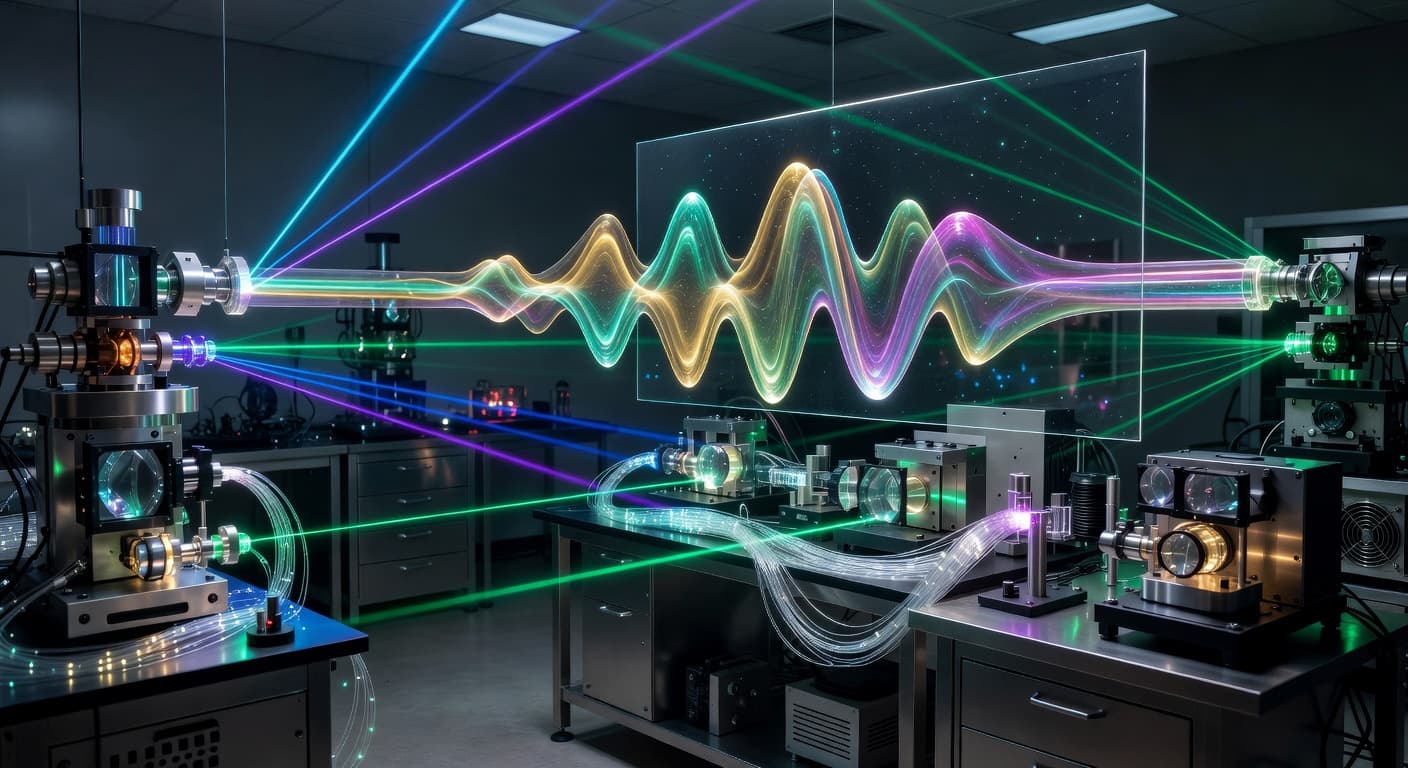
The Pulsating Mystery of Light Solved
Imagine light waves that don't just travel, but 'breathe' – expanding and contracting in a mesmerizing, yet unpredictable dance. For years, these enigmatic "breather" laser pulses have puzzled physicists, their erratic behavior defying conventional understanding. Now, a groundbreaking discovery has finally lifted the veil on this optical mystery, promising a new era in laser technology and fundamental physics.
What Exactly Are "Breather" Pulses?
These aren't your everyday laser beams. Breather pulses are a unique type of optical soliton – self-sustaining waves that maintain their shape as they propagate. What makes breathers special (and perplexing) is their periodic oscillation in intensity and width, appearing to 'breathe' as they travel, unlike stable solitons. This inherent instability made them incredibly difficult to control or predict, posing a significant challenge in nonlinear optics.
The Scientific Breakthrough Explained
Researchers have pinpointed the exact mechanisms governing these fascinating pulses. The key lies in the complex interplay of nonlinear optical effects within the medium, often specialized optical fibers. They discovered that specific conditions, combining dispersion and nonlinearity, create a delicate balance that allows for these periodic variations. This understanding moves beyond simply observing them to accurately predicting their intricate behavior, a monumental leap in the field.
From Mystery to Mastery: Unlocking Their Secrets
The scientific team developed sophisticated theoretical models and experimental setups to observe and analyze these breathers in unprecedented detail. By meticulously controlling input parameters – such as the laser's power, wavelength, and the properties of the optical medium – they were able to induce, observe, and, critically, model the breathing patterns. This detailed characterization provides the blueprint for harnessing their unique properties, transforming them from a curiosity into a controllable phenomenon.
Why This Matters: Future Applications
This isn't just a win for fundamental physics; the ability to understand and potentially control breather pulses could revolutionize several technological fields. Potential applications include:
- Advanced Telecommunications: Imagine transmitting more data over longer distances with less signal degradation. Breathers might offer new ways to encode information, enhancing fiber optic networks.
- Precision Measurement: Their unique, oscillating characteristics could lead to ultra-sensitive sensors and more accurate timing devices for scientific instruments.
- Medical Imaging & Spectroscopy: Enhanced control over light pulses could enable deeper, clearer imaging in biological tissues or more precise analysis of materials in various industries.
- Ultrafast Lasers: The principles learned could lead to the development of new types of ultrafast lasers with tailored pulse characteristics for industrial processing and scientific research.
The Road Ahead: A Dynamic Future for Light
This discovery represents a significant leap forward in our comprehension of nonlinear wave phenomena. It not only solves a long-standing puzzle but also opens up new avenues for manipulating light in ways previously thought impossible. Scientists will now explore how to actively control these breathers, paving the way for advanced optical devices and perhaps even new forms of light-based computing. The future of light just got a lot more dynamic, promising innovations that will impact science and technology for decades to come.
How this article was made
- Sources
- ScienceDaily
- Generated on:
- May 25, 2026
This content is produced by Acerbo.AI's AI editorial pipeline: source gathering, rewriting and imagery are automated. Editorial oversight stays human.
Related Articles
Scientists Crack the Code of 'Breather' Laser Pulses, Unlocking New Horizons in Light Technology
A recent scientific breakthrough has demystified 'breather' laser pulses, revealing the intricate mechanisms behind their unique, stable oscillations. This discovery promises to revolutionize photonics and optical technologies.

Breakthrough: Scientists Master Light in Ultra-Thin Nanoscale Layers
Scientists have achieved an unprecedented feat: trapping light within a layer incredibly thin, roughly 1,000 times narrower than a human hair. This innovation promises to revolutionize optical technologies.
Revolutionary Breakthrough: Scientists Trap Light Without Metals, Unlocking Future Tech
Physicists have achieved an unprecedented feat, discovering a novel method to confine light beyond traditional limits without relying on metals, paving the way for next-generation optical technologies.