
Scientists Uncover "Fractional Fermi Sea": A New Frontier in Quantum Physics with Ultracold Atoms
Researchers have engineered a groundbreaking new quantum state, the 'Fractional Fermi Sea,' using ultracold atoms, offering unprecedented insights into complex quantum phenomena and materials.

Unveiling the "Fractional Fermi Sea": A Quantum Leap in Atomic Physics
In a groundbreaking achievement that pushes the boundaries of experimental physics, researchers have successfully engineered a novel and exotic quantum state of matter dubbed the "Fractional Fermi Sea." This unprecedented discovery, achieved through the precise manipulation of ultracold atoms, opens a new window into the mysterious world of quantum mechanics and holds profound implications for our understanding of complex materials.
For decades, scientists have sought to understand and engineer matter at its most fundamental level, where classical rules break down and quantum phenomena dominate. The creation of the Fractional Fermi Sea represents a significant milestone in this quest, offering a tangible platform to explore phenomena previously confined to theoretical models and pushing the boundaries of what was thought possible in laboratory settings.
Decoding the "Fractional Fermi Sea"
The Fractional Fermi Sea is a unique state of matter characterized by the peculiar behavior of fermions – fundamental particles like electrons that obey Pauli's exclusion principle. Unlike conventional Fermi liquids, which describe the collective motion of electrons in many metals, this new state exhibits fractionalized excitations. This means that instead of interacting as whole, distinct particles, the collective behavior emerges from components that act as if they carry only a fraction of their original charge or spin.
This "fractionalization" is a hallmark of highly correlated quantum systems, where particles' interactions are so strong that they lose their individual identities and form entirely new collective entities. Imagine a sea where individual waves don't just add up, but somehow break into smaller, interconnected ripples that collectively form a completely new kind of ocean, defying simple summation. Such phenomena are notoriously difficult to observe and control outside of theoretical predictions.
Mastering the Art of Ultracold Atom Engineering
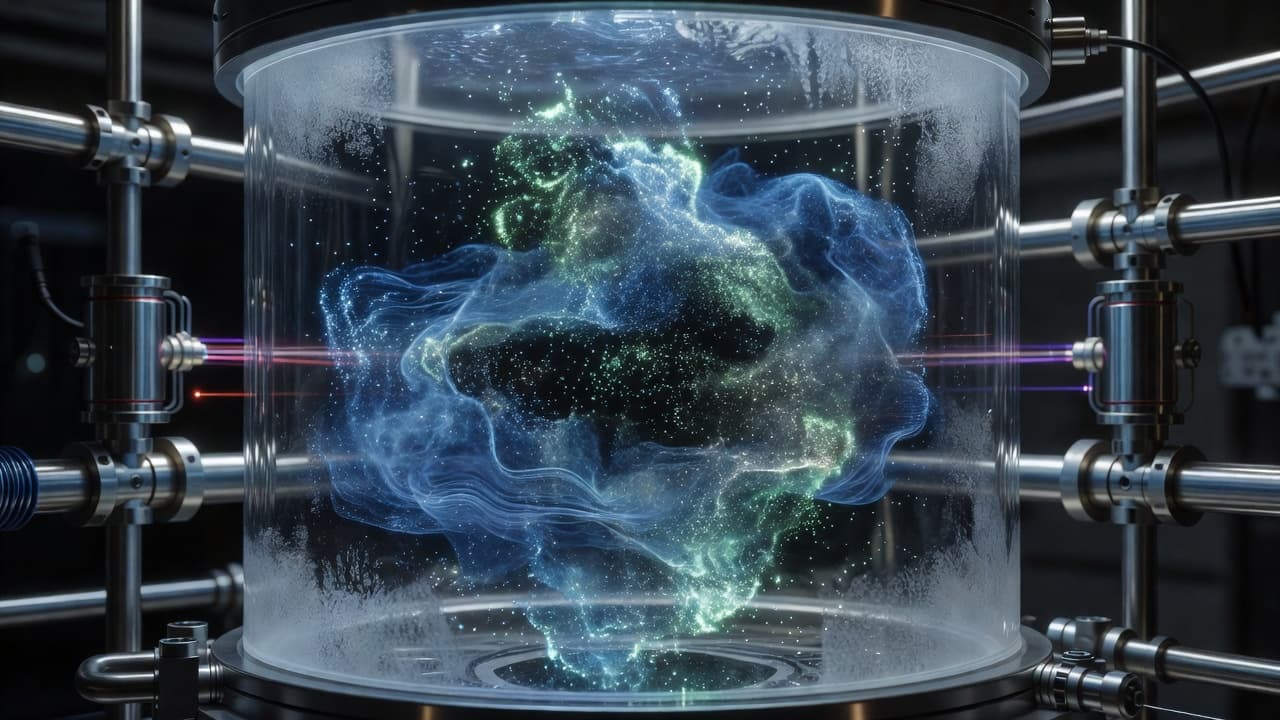
Achieving this elusive state required extraordinary experimental prowess and cutting-edge technology. Researchers cooled clouds of atoms to temperatures mere fractions of a degree above absolute zero – an environment even colder than the vast vacuum of interstellar space. At such extreme conditions, the atoms slow down to a crawl, allowing their wave-like quantum mechanical properties to become dominant and observable, free from thermal noise.
Using sophisticated laser traps and precisely controlled magnetic fields, scientists meticulously confined and manipulated these ultracold atoms. This setup effectively created a "quantum simulator," a controlled environment where complex quantum phenomena can be studied directly. The precision required for this experiment is immense, as even the slightest perturbation can disrupt the delicate quantum state, highlighting the remarkable skill of the research team.
Why This Discovery Matters: Unlocking Quantum Materials
The significance of the Fractional Fermi Sea extends far beyond academic curiosity. It offers crucial insights into some of the most perplexing phenomena in condensed matter physics, particularly the behavior of high-temperature superconductors and other exotic quantum materials. Understanding these materials, which exhibit properties like zero electrical resistance at relatively high temperatures, could revolutionize energy transmission, storage, and medical imaging.
Furthermore, this breakthrough could pave the way for advancements in quantum computing. By creating and controlling novel quantum states, scientists gain valuable tools for building more robust and powerful quantum processors. These next-generation computers promise to tackle problems currently intractable for even the most powerful classical supercomputers, from drug discovery to complex financial modeling.
- Unlocking New Physics: Provides direct experimental evidence for theoretical concepts of fractionalization and emergent properties.
- Designing Future Materials: Offers a blueprint for engineering materials with tailored quantum properties and functionalities.
- Advancing Quantum Technology: Contributes foundational knowledge critical for the development of next-generation quantum devices and simulators.
The Road Ahead: Exploring Deeper Quantum Frontiers
The successful creation of the Fractional Fermi Sea is not an endpoint but a vibrant new beginning for quantum research. Researchers are now poised to delve deeper into its intricate properties, exploring its stability, dynamics, and potential interactions with other quantum phenomena. This work promises to unlock further secrets of the quantum universe, potentially leading to unforeseen technological applications and a deeper understanding of the very fabric of reality.
This remarkable achievement underscores the power of interdisciplinary experimental physics to transform abstract theoretical concepts into tangible, observable realities, thereby pushing the boundaries of human knowledge and igniting new waves of innovation across the scientific landscape.
How this article was made
- Sources
- ScienceDaily
- Generated on:
- Jun 29, 2026
This content is produced by Acerbo.AI's AI editorial pipeline: source gathering, rewriting and imagery are automated. Editorial oversight stays human.
Related Articles
Physicists Forge Exotic 'Fermi Sea' Matter: A Quantum Leap in Understanding
Scientists have successfully created an exotic new form of matter known as the 'Fermi Sea,' opening new avenues in quantum physics and our understanding of the universe's fundamental building blocks.

Quantum Leap: Scientists Unlock New Control Over Superconductivity
A groundbreaking discovery reveals how microscopic imperfections and atomic vibrations can precisely control superconductivity, paving the way for revolutionary quantum technologies.

Quantum Leap: Scientists Observe Metal Lump in Two Places Simultaneously, Shattering Records
Scientists have achieved a record-breaking quantum experiment, observing a tiny metal object existing in two distinct locations at once. This breakthrough pushes the limits of quantum mechanics.