
Quantum Leap: Scientists Unlock New Control Over Superconductivity
A groundbreaking discovery reveals how microscopic imperfections and atomic vibrations can precisely control superconductivity, paving the way for revolutionary quantum technologies.

For decades, the promise of superconductivity—materials that conduct electricity with zero resistance—has captivated scientists. Imagine a world where power grids transmit energy without loss, computing is exponentially faster, and medical imaging is vastly more precise. The challenge, however, has always been control. Harnessing this quantum phenomenon, especially at practical temperatures, has remained an elusive goal. Until now.
A Paradigm Shift in Superconductivity Control
In a significant breakthrough, an international team of scientists has unveiled a novel method to precisely manipulate superconductivity. Their research demonstrates that by leveraging microscopic imperfections and the subtle dance of atomic vibrations within materials, it's possible to switch superconductivity on and off, or even steer its flow, with unprecedented control. This discovery marks a pivotal moment in condensed matter physics, offering a fresh perspective on utilizing quantum states.
The Elusive Nature of Superconductivity
Superconductivity occurs when certain materials, typically cooled to extremely low temperatures, allow electrons to pair up and flow freely without any resistance. This creates powerful magnetic fields and incredibly efficient electrical transmission. However, maintaining and controlling these delicate quantum states has been a major hurdle for practical applications, often requiring complex cooling systems. The ability to fine-tune this state has been a 'holy grail' for researchers.
Unlocking Control with Atomic Precision
The new method hinges on a sophisticated understanding of a material's inherent structure. Researchers found that tiny, often overlooked imperfections in the crystal lattice of superconducting materials, combined with the natural thermal vibrations of atoms, create specific conditions that can be exploited. These seemingly minor features act as nanoscale gates, influencing how electrons pair and move.
- Microscopic Imperfections: Minute variations in the material's atomic arrangement that locally alter electronic properties.
- Atomic Vibrations: Known as phonons, these collective atomic oscillations play a crucial role in electron pairing. Scientists learned how to modulate the superconducting state using these vibrations.
By carefully inducing and observing these imperfections and vibrations, the team was able to create pathways and barriers for superconducting currents, effectively "writing" and "erasing" superconducting regions within the material. This level of granular control was previously thought to be extremely difficult to achieve without altering the material's composition or applying strong external fields.
Implications for Future Technologies
This breakthrough has far-reaching implications across numerous technological sectors. The ability to precisely control superconductivity could accelerate the development of next-generation devices:
Energy Efficiency: Imagine power cables that transmit electricity over vast distances with zero energy loss. This discovery could bring such visions closer to reality, transforming global energy infrastructure.
Quantum Computing: Superconducting circuits are a cornerstone of many quantum computing architectures. Enhanced control over these quantum states means more stable and powerful qubits, pushing computational boundaries.
Advanced Medical Devices: Technologies like MRI machines, which rely on powerful superconducting magnets, could become more compact, efficient, and accessible, leading to breakthroughs in diagnostics and treatment.
Novel Materials: This research also opens doors for designing entirely new materials with tailored superconducting properties, potentially leading to room-temperature superconductors—the ultimate prize in this field.
Paving the Way for a Superconducting Era
While still in its early stages, this discovery represents a monumental step forward in our quest to harness superconductivity. It shifts the paradigm from merely observing to actively manipulating this intriguing quantum phenomenon. Future research will focus on scaling these techniques, exploring different materials, and ultimately translating laboratory success into real-world applications. The journey to a truly superconducting future is long, but with this newfound control, the path ahead looks significantly brighter, promising a revolution in technology and energy for generations to come.
How this article was made
- Sources
- ScienceDaily
- Generated on:
- Jun 5, 2026
This content is produced by Acerbo.AI's AI editorial pipeline: source gathering, rewriting and imagery are automated. Editorial oversight stays human.
Related Articles

Superconductivity Breakthrough: University of Houston Shatters Record at 151 K Under Ambient Pressure
University of Houston scientists have achieved a groundbreaking superconductivity record at 151 Kelvin under normal pressure, marking a significant leap towards practical, energy-efficient technologies.
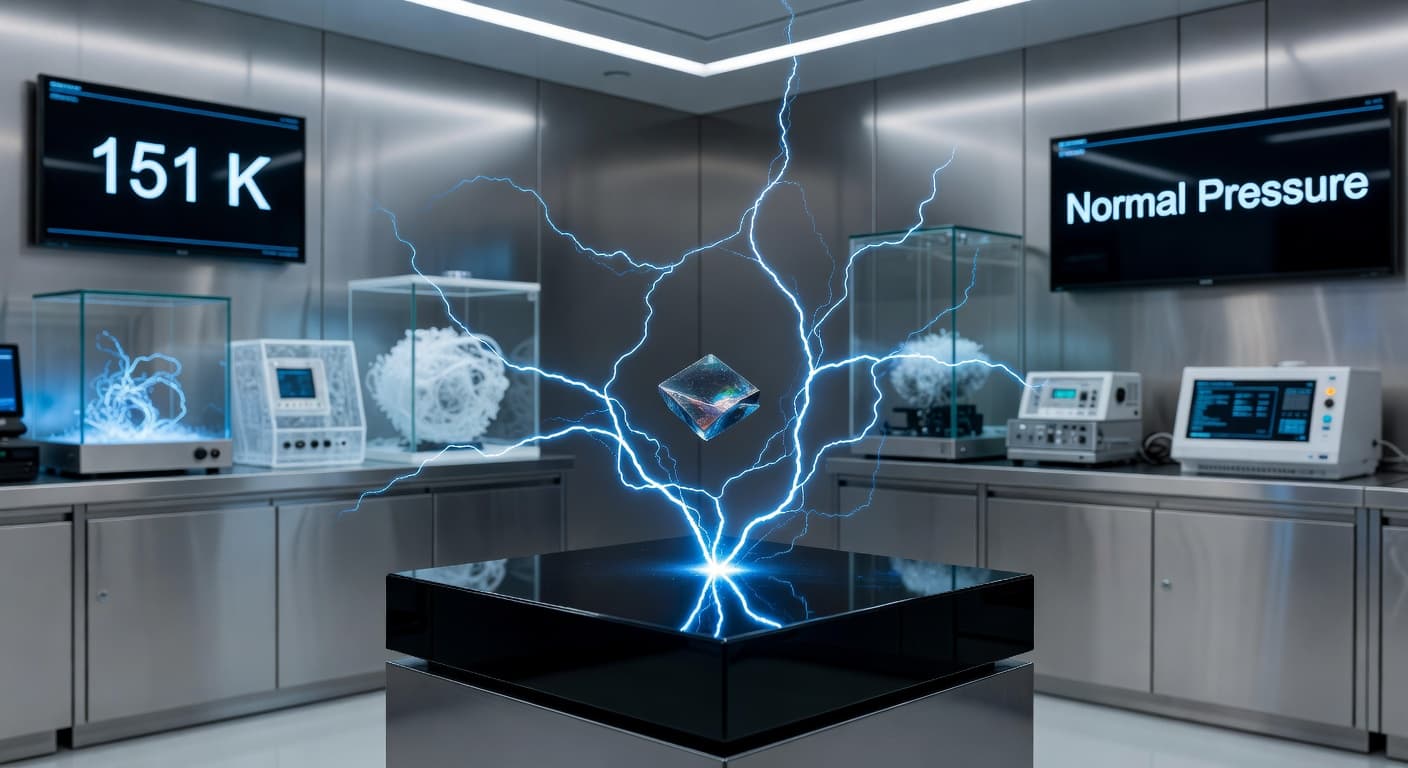
Superconductivity Breakthrough: New Material Achieves Record 151 K at Normal Pressure
Scientists have achieved a monumental breakthrough in superconductivity, discovering a material that conducts electricity without resistance at an unprecedented 151 Kelvin under normal atmospheric pressure, smashing previous records and bringing practical applications closer.

Quantum Leap: Scientists Unlock Magnons for Revolutionary Quantum Information Storage
A groundbreaking development in quantum physics sees magnons, quasiparticles of spin waves, identified as highly promising carriers for quantum information, potentially revolutionizing quantum computing and communication.