
Unveiling the Invisible: Your $100 Gateway to Cosmic Mysteries
Scientists have developed an incredibly affordable particle detector, costing just $100, that allows anyone to observe cosmic rays raining down from space, opening new avenues for citizen science and education.
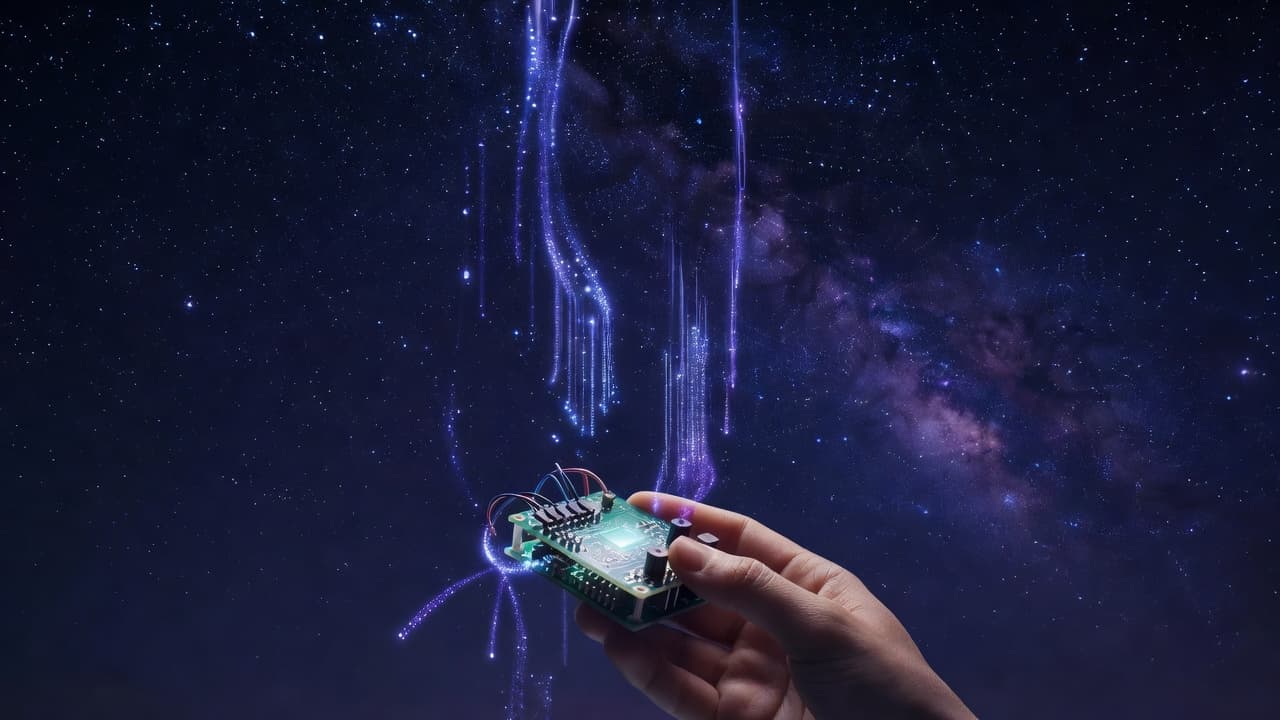
Beyond the Visible: Discovering Cosmic Rays with a Budget-Friendly Detector
Imagine peering into the universe's unseen forces, not with a multi-million dollar observatory, but with a device costing less than a weekend's groceries. This isn't science fiction; it's the reality brought forth by a groundbreaking new particle detector. For around $100, this innovative tool grants ordinary individuals the extraordinary ability to observe invisible particles constantly raining down on Earth from the depths of space.
This remarkable development is set to revolutionize how we interact with fundamental physics, transforming particle detection from an exclusive scientific pursuit into an accessible hobby and educational tool. It's a testament to ingenious engineering, making the cosmos more tangible than ever before.
Cosmic Rays: The Unseen Rain from Space
Every second, countless subatomic particles bombard our planet. These are cosmic rays, high-energy radiation originating from supernovae, black holes, and other violent celestial events across the galaxy. While the primary cosmic rays – mostly protons and atomic nuclei – collide with our atmosphere high above, they create a cascade of secondary particles. Among these, muons are the most prevalent at sea level, often described as 'heavy electrons.'
They pass through us, our buildings, and even the ground, largely unnoticed, yet they carry vital clues about the universe's most extreme phenomena. Understanding these particles helps scientists unravel mysteries about stellar evolution, dark matter, and the very fabric of space-time.
Democratizing Discovery: The $100 Detector Breakthrough
Historically, detecting such elusive particles required sophisticated, expensive equipment housed in specialized laboratories or massive observatories. The development of a detector priced at approximately $100 fundamentally changes this landscape. This affordability transforms particle physics from an exclusive domain into an accessible field, inviting enthusiasts, students, and educators worldwide to participate in scientific discovery.
It's a leap towards democratizing science, much like amateur astronomy did for stargazing centuries ago. This shift empowers a broader community to engage directly with the cutting edge of scientific exploration, fostering a deeper connection to the cosmos.
How Does Such an Affordable Device Work?
At its core, this compact detector typically utilizes a scintillator material. When a charged particle, like a muon, passes through the scintillator, it emits a tiny flash of light. A highly sensitive photodetector, such as a silicon photomultiplier (SiPM), captures this faint light. This electrical signal is then processed by a simple microcontroller, which counts the events and can even timestamp them.
The data, often displayed on a small screen or sent to a computer, reveals the constant shower of cosmic particles, making the invisible visible in a measurable way. These components, once prohibitively expensive, have become significantly more affordable and integrated, enabling such a low-cost solution.
Empowering Citizen Scientists and Educators
The profound impact of this low-cost technology extends far beyond individual curiosity. It serves as a powerful educational tool, bringing abstract physics concepts to life in classrooms and homes. Students can engage in hands-on experiments, collecting real-time data and developing critical scientific thinking skills.
Moreover, these detectors foster citizen science initiatives. By linking multiple devices, a distributed network can be created, potentially gathering vast amounts of data that could aid researchers in studying cosmic ray showers, space weather, or even subtle changes in atmospheric conditions. This collaborative approach accelerates discovery and broadens scientific participation.
Pioneering New Frontiers in Backyard Physics
Imagine a global network of backyard particle observatories, each contributing to a collective understanding of our universe. This affordable detector paves the way for such collaborative research, enabling new forms of data collection that might uncover unexpected patterns or rare cosmic events. It bridges the gap between professional science and public engagement, proving that groundbreaking discoveries aren't solely confined to grand institutions.
The future of particle physics might just be found in the collective curiosity of a million small detectors, fostering a new era of distributed scientific inquiry.
Conclusion: The Cosmos Within Reach
From the unseen depths of space to our fingertips, the $100 particle detector is a testament to ingenious engineering and the enduring human desire to explore. It not only makes cosmic phenomena tangible but also empowers a new generation of scientists and curious minds to connect directly with the fundamental forces shaping our cosmos, proving that profound scientific insight can indeed be within everyone's reach.
How this article was made
- Sources
- ScienceDaily
- Rewriting model:
- gemini-2.5-flash
- Image generated with:
- xAI Grok
- Generated on:
- 2d ago
This content is produced by Acerbo.AI's AI editorial pipeline: source gathering, rewriting and imagery are automated. Editorial oversight stays human.
Related Articles

Unveiling the Amazon's Emerald Enigma: Scientists Discover a Mysterious New Frog Species
A recent expedition deep within the Amazon rainforest has led to the thrilling discovery of a previously unknown frog species, highlighting the incredible biodiversity still hidden.

Quantum Mystery Deepens: CERN Uncovers Unprecedented Gluon Behavior
CERN scientists have observed gluons, the fundamental particles binding atomic nuclei, exhibiting unexpected behavior deep within matter, challenging long-held theories of the strong nuclear force.
Venom's Own Cure: Rattlesnake Blood Holds Key to Revolutionary Antivenom
Scientists have unearthed a groundbreaking new antivenom directly from rattlesnake blood, offering a potent and potentially safer treatment for snakebite victims worldwide.