
Exploring Ancient Mars: Insights from One of the Oldest Meteorites
A recent NASA-funded study unveils significant findings from one of the oldest Mars meteorites, shedding light on the planet's early history.
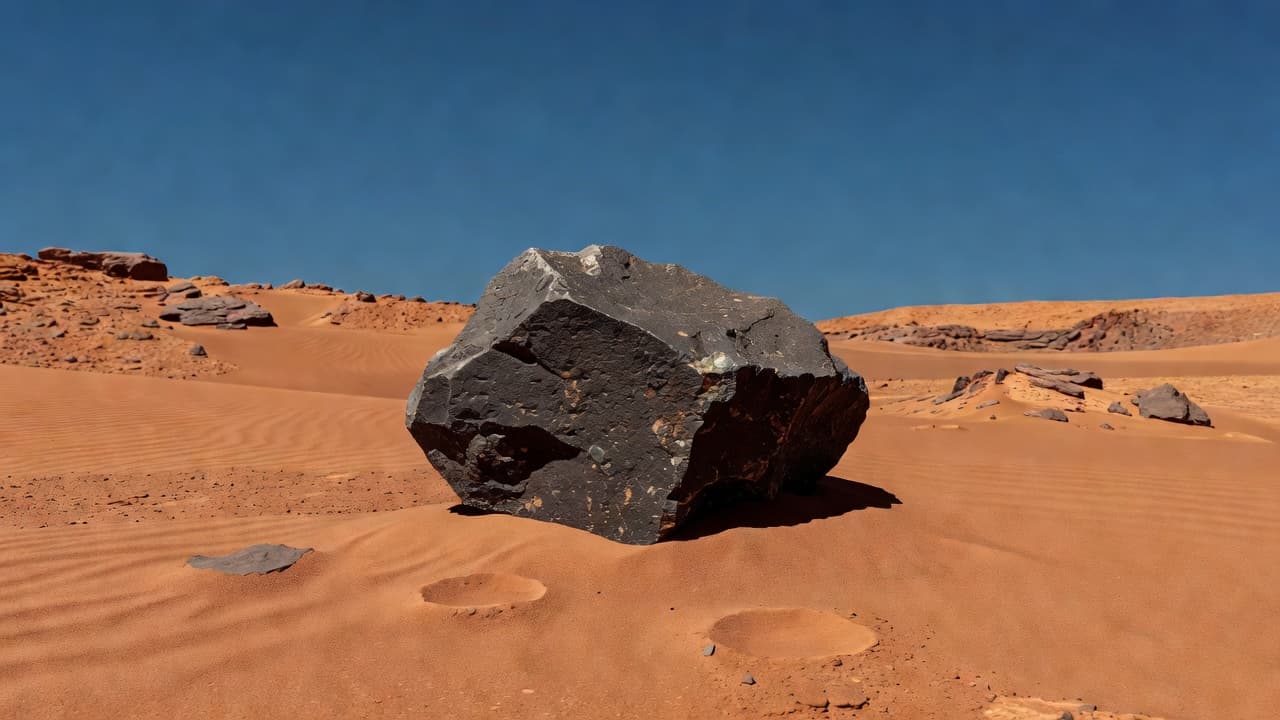
Unlocking the Secrets of Mars Through Meteorite Analysis
A team of scientists, backed by NASA, has made groundbreaking strides in understanding the Martian surface by analyzing one of the oldest meteorites ever discovered. This study not only enhances our knowledge of Mars but also provides vital clues about the planet's ancient environment and its potential for life.
A Window into Mars' Past
The meteorite, known as ALH84001, was found in Antarctica in 1984 and has since become a focal point of research. Recent analyses have revealed that this rock is approximately 4.4 billion years old, placing it among the oldest known samples from Mars. Scientists believe that studying this meteorite can offer profound insights into the planet's geological history.
By employing advanced techniques, researchers have examined the mineral composition and isotopic ratios within the meteorite, uncovering evidence of past volcanic activity and interactions with water. This data points to a once-active Martian environment that may have been conducive to life.
Significance of the Findings
The findings from this study are not merely academic; they hold the potential to reshape our understanding of Mars as a candidate for past life. The evidence of ancient water flow indicated by mineral deposits within the meteorite suggests that Mars may have had conditions suitable for sustaining microbial life.
Moreover, the study emphasizes the importance of meteorite research in planetary science. Each meteorite serves as a time capsule, preserving the history of its parent body. By analyzing these rocks, scientists can piece together a more comprehensive picture of the solar system's evolution.
Future Implications and Research Directions
As we continue to explore Mars through missions and remote sensing, studies like this one provide critical context for what we observe on the planet's surface. Future missions, including sample return efforts, will benefit from the insights gained from ALH84001 and similar meteorites.
The ongoing investigation into Mars meteorites not only fuels our curiosity but also paves the way for potential human exploration. Understanding the planet's past is essential for assessing its habitability and for future colonization efforts.
Conclusion: A Step Closer to Understanding Mars
This NASA-funded study marks a significant milestone in Martian research, confirming that ancient meteorites can reveal the secrets of our neighboring planet. As we unlock the mysteries of Mars' past, we may also find clues about the potential for life beyond Earth.
With continued exploration and analysis of Martian materials, the dream of sending humans to Mars and establishing a presence there becomes ever more attainable. The knowledge we gain from meteorites will undoubtedly play a crucial role in this endeavor.
How this article was made
- Sources
- NASA Science
- Rewriting model:
- openai/gpt-4o-mini
- Image generated with:
- xAI Grok
- Generated on:
- 5d ago
This content is produced by Acerbo.AI's AI editorial pipeline: source gathering, rewriting and imagery are automated. Editorial oversight stays human.
Related Articles
Cosmic Cannibals: Astronomers Uncover Two Actively Feeding Supermassive Black Holes in the Early Universe
A groundbreaking discovery reveals two actively feeding supermassive black holes in the universe's nascent stages, challenging theories of cosmic evolution and galaxy formation.
Cosmic Detective Work: Second-Generation Planet Cracks Hubble's Long-Standing Mystery
Astronomers have unveiled a groundbreaking discovery: a 'second-generation' exoplanet whose unique formation mechanism provides the missing link to solve a perplexing cosmic enigma observed by the Hubble Space Telescope for years.
Cosmic Revelation: Have Scientists Finally Glanced at Dark Matter?
A recent scientific development suggests researchers may have detected dark matter, the universe's most enigmatic substance. This potential breakthrough could redefine cosmology and particle physics.