
Einstein's 'Biggest Blunder' Redeemed: How a Cosmic Constant Reshaped Our Universe
Explore the fascinating journey of Einstein's cosmological constant, initially deemed his 'biggest blunder,' now a cornerstone in understanding dark energy and the accelerating expansion of our universe.
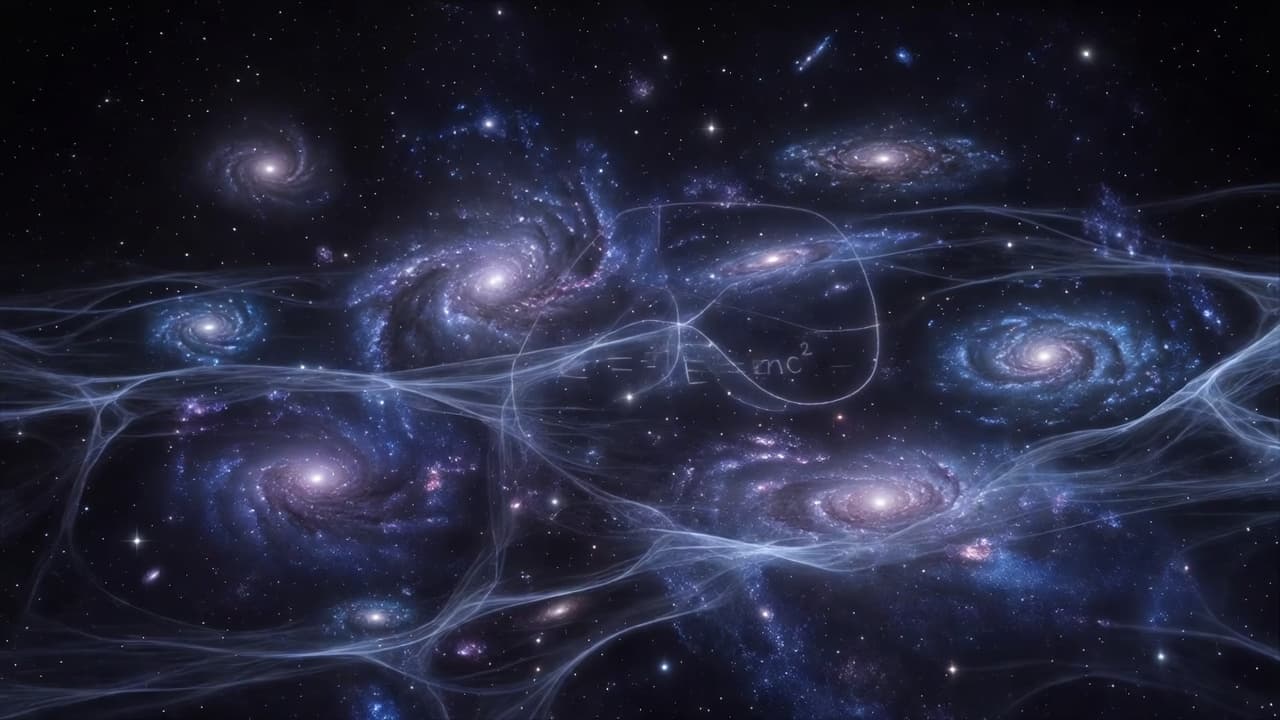
Einstein's "Biggest Blunder": A Cosmic Constant's Redemption
In the annals of scientific discovery, few figures loom as large as Albert Einstein. Renowned for his theory of relativity, Einstein also famously referred to one of his own theoretical constructs as his "biggest blunder." This supposed mistake, the cosmological constant, was initially introduced to maintain a static universe. Yet, in a remarkable twist of cosmic fate, this very concept has not only made a spectacular comeback but now stands as a cornerstone in our understanding of the universe's accelerating expansion, fundamentally reshaping modern cosmology.
The Genesis of a Theoretical "Mistake"
When Einstein formulated his equations of general relativity in 1915, they suggested a dynamic universe – one that was either expanding or contracting. However, the prevailing scientific consensus of the time, even for Einstein, favored a static, unchanging cosmos. To reconcile his groundbreaking theory with this belief, Einstein introduced a new term into his equations: the cosmological constant (represented by the Greek letter Lambda, Λ). This constant acted as a repulsive force, counteracting gravity to prevent the universe from collapsing in on itself or expanding indefinitely, thus ensuring a stable, static state.
Hubble's Revelation and Einstein's Regret
The notion of a static universe was soon challenged by observational evidence. In the late 1920s, astronomer Edwin Hubble made a revolutionary discovery: distant galaxies were receding from us, and the farther away they were, the faster they were moving. This phenomenon, known as the expansion of the universe, definitively disproved the static model. Faced with this overwhelming evidence, Einstein famously retracted his cosmological constant, reportedly calling it his "biggest blunder" – an unnecessary and incorrect modification to his otherwise elegant equations.
The Unforeseen Comeback: The Era of Dark Energy
For decades, the cosmological constant remained largely a historical footnote, a testament to even the greatest minds making assumptions. However, the late 20th century brought a startling new discovery that would resurrect Einstein's "mistake" with unprecedented significance. In 1998, observations of distant supernovae revealed something profound: the expansion of the universe was not merely continuing; it was accelerating. This acceleration implied the existence of a mysterious, pervasive force counteracting gravity on a cosmic scale, pushing galaxies apart at an ever-increasing rate.
Dark Energy: A Constant Reimagined
Scientists dubbed this mysterious force "dark energy." While its exact nature remains one of the greatest puzzles in physics, the simplest and most widely accepted explanation for dark energy is that it behaves precisely like Einstein's cosmological constant. It's a form of energy inherent to the fabric of spacetime itself, with a constant density that doesn't dilute as the universe expands. This "vacuum energy" provides the persistent repulsive force needed to explain the observed cosmic acceleration.
The re-emergence of this concept has transformed our understanding of the universe's composition and its ultimate fate. Current models suggest that dark energy accounts for approximately 68% of the total energy density of the universe, dwarfing ordinary matter and even dark matter. It dictates the future of the cosmos, potentially leading to a "Big Rip" where the expansion tears everything apart, or simply an ever-colder, emptier universe.
Einstein's Enduring Legacy
The story of the cosmological constant is a powerful reminder of the iterative nature of science. What was once considered a monumental error has, through further observation and theoretical refinement, become a crucial component of our most accurate cosmological model. Einstein's initial intuition, though misapplied to a static universe, contained a deep truth about the potential for spacetime itself to exert a dynamic influence. His "blunder" has not only been redeemed but has opened new frontiers in physics, prompting intense research into the true nature of dark energy and the fundamental laws governing our cosmos.
This cosmic constant, once discarded, now stands as a testament to the complex, evolving tapestry of scientific understanding. It underscores that even the greatest minds can stumble upon profound truths, sometimes before the universe is ready to reveal them fully.
How this article was made
- Sources
- ScienceDaily
- Rewriting model:
- gemini-2.5-flash
- Image generated with:
- xAI Grok
- Generated on:
- Aug 18, 2026
This content is produced by Acerbo.AI's AI editorial pipeline: source gathering, rewriting and imagery are automated. Editorial oversight stays human.
Related Articles
Cosmic Revelation: Have Scientists Finally Glanced at Dark Matter?
A recent scientific development suggests researchers may have detected dark matter, the universe's most enigmatic substance. This potential breakthrough could redefine cosmology and particle physics.
Cosmic Breakthrough: Scientists Witness the Birth of a Magnetar, the Universe's Strongest Magnet, for the First Time
A monumental discovery in astrophysics as scientists observe the formation of a magnetar, validating general relativity's predictions and opening new frontiers in understanding cosmic extremes.
Black Hole Energy Unlocked: Scientists Recreate Penrose Process in Lab
In a groundbreaking experiment, researchers have successfully recreated the physics of extracting energy from a spinning black hole using a stationary laboratory device, validating Roger Penrose's theoretical process.