
Oxford Breakthrough: Physicists Forge Unprecedented Schrödinger's Cat-Like Quantum State
Oxford physicists have achieved a monumental feat, creating a novel quantum state akin to the famous Schrödinger's Cat paradox. This breakthrough pushes the boundaries of quantum mechanics, opening new doors for understanding the universe and advancing future technologies.
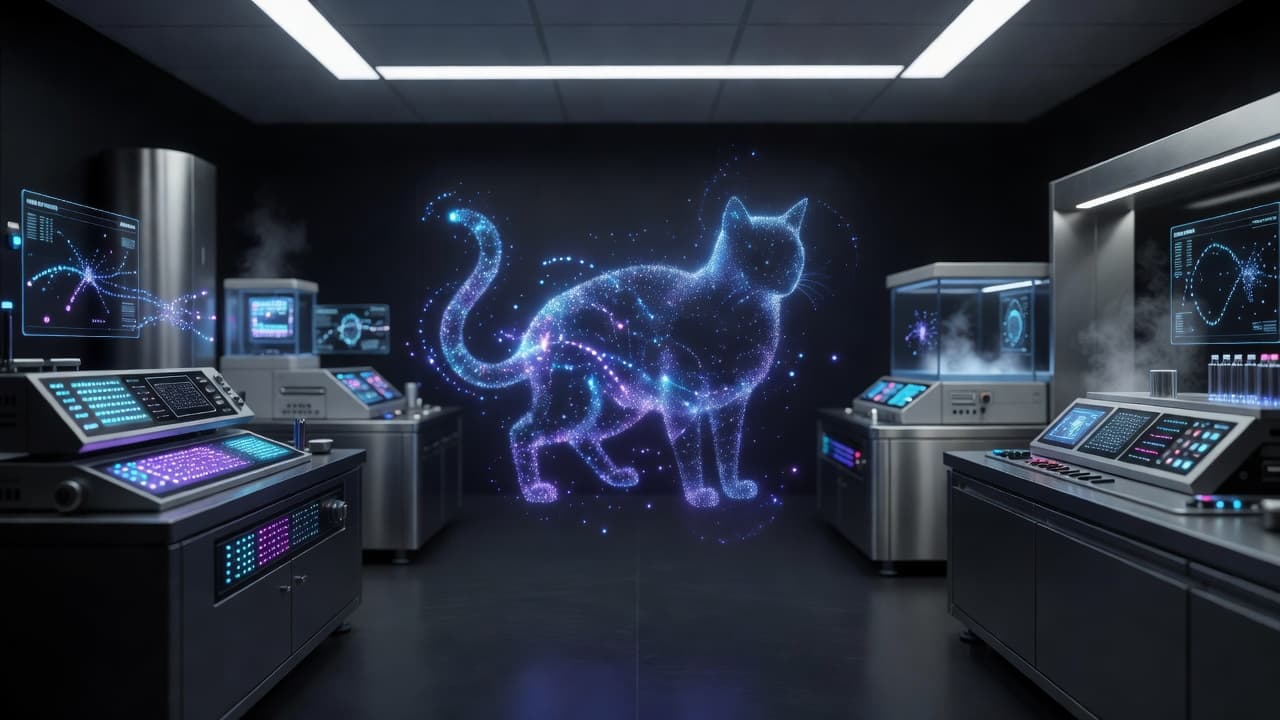
Oxford Breakthrough: Physicists Forge Unprecedented Schrödinger's Cat-Like Quantum State
In a monumental leap for quantum physics, researchers at the University of Oxford have successfully engineered an entirely new type of quantum state, drawing parallels to the iconic Schrödinger's Cat thought experiment. This groundbreaking achievement pushes the frontiers of our understanding of reality at its most fundamental level, showcasing humanity's growing mastery over the bizarre rules governing the subatomic world.
For decades, the concept of a cat being simultaneously dead and alive in a sealed box has served as a vivid, if macabre, illustration of quantum superposition – the ability of a quantum particle to exist in multiple states at once until observed. Now, Oxford physicists have moved beyond mere thought experiments, creating a tangible, unprecedented "cat-like" state that could unlock new avenues for technological innovation and deeper scientific insight.
Unpacking Schrödinger's Paradox: A Quantum Primer
Erwin Schrödinger’s famous paradox, conceived in 1935, was an attempt to highlight the perplexing nature of quantum mechanics when applied to macroscopic objects. It posits a hypothetical cat locked in a steel box with a device that has a 50% chance of releasing a deadly poison. According to quantum theory, until the box is opened and the system observed, the cat exists in a superposition of both "dead" and "alive" states simultaneously.
While an actual cat cannot exist in such a bizarre duality, the underlying principle of superposition is central to quantum mechanics. Particles like electrons or photons can simultaneously possess conflicting properties, such as spinning clockwise and counter-clockwise, or being in multiple locations at once. This inherent ambiguity is what allows quantum computers to perform calculations far beyond classical machines.
Engineering a Novel Quantum Reality
The Oxford team's significant contribution lies in their ability to create a complex quantum state that exhibits similar paradoxical properties to Schrödinger's hypothetical cat, but in a controlled laboratory setting. While the precise details of the experimental setup are intricate, the core achievement involves coaxing a system of particles into an entangled superposition state that is robust and measurable.
This isn't merely about observing existing quantum phenomena; it's about engineering them. The researchers have effectively demonstrated an unparalleled level of control over quantum systems, creating a state that maintains its quantum coherence – the ability to remain in superposition – for a significant duration. This control is paramount for advancing quantum technologies.
- Enhanced Superposition: The new state represents a more complex or larger-scale superposition than previously achieved.
- Robust Coherence: Maintaining quantum properties despite environmental interference is a major challenge, and this breakthrough suggests improved methods.
- Fundamental Insight: It provides a unique platform to test the boundaries of quantum mechanics and the transition from quantum to classical reality.
Beyond the Box: Why This Matters for the Future
The implications of creating such a sophisticated "Schrödinger's cat-like" state are profound and far-reaching. Firstly, it offers an unprecedented tool for fundamental research, allowing physicists to probe the very nature of quantum mechanics and resolve long-standing paradoxes about measurement and observation.
Secondly, and perhaps more immediately impactful, this research has significant ramifications for the burgeoning field of quantum computing. The ability to create and manipulate complex entangled states is the bedrock of powerful quantum processors. Such "cat states" can be leveraged for:
- Error Correction: These states can encode information redundantly, making quantum computers more resilient to errors.
- Enhanced Sensing: Ultra-sensitive quantum sensors could be developed for medical imaging, navigation, or geological surveys.
- Secure Communication: Novel quantum encryption methods could become more robust and complex.
This breakthrough represents a significant step towards building fault-tolerant quantum computers and developing new quantum technologies that could revolutionize industries from medicine to finance.
The Road Ahead for Quantum Science
While the Oxford team's discovery marks a significant milestone, it also opens up a plethora of new questions and research avenues. Future work will undoubtedly focus on scaling up these quantum states, increasing their complexity, and exploring their potential applications in real-world scenarios. The challenge remains to bridge the gap between these delicate quantum phenomena and their practical implementation in everyday technology.
Ultimately, this pioneering research from Oxford physicists not only deepens our understanding of the universe's most enigmatic principles but also accelerates our journey towards a future powered by quantum innovation. The "cat" is out of the bag, and its implications are truly extraordinary.
How this article was made
- Sources
- ScienceDaily
- Generated on:
- Jun 18, 2026
This content is produced by Acerbo.AI's AI editorial pipeline: source gathering, rewriting and imagery are automated. Editorial oversight stays human.
Related Articles

Oxford Physicists Unlock New 'Schrödinger's Cat' Quantum State, Pushing Boundaries of Reality
Oxford physicists have engineered a novel quantum state akin to Schrödinger's Cat, demonstrating superposition in a new way that could revolutionize quantum computing and our understanding of reality.

Quantum Leap: Scientists Observe Metal Lump in Two Places Simultaneously, Shattering Records
Scientists have achieved a record-breaking quantum experiment, observing a tiny metal object existing in two distinct locations at once. This breakthrough pushes the limits of quantum mechanics.

Scientists Uncover "Fractional Fermi Sea": A New Frontier in Quantum Physics with Ultracold Atoms
Researchers have engineered a groundbreaking new quantum state, the 'Fractional Fermi Sea,' using ultracold atoms, offering unprecedented insights into complex quantum phenomena and materials.